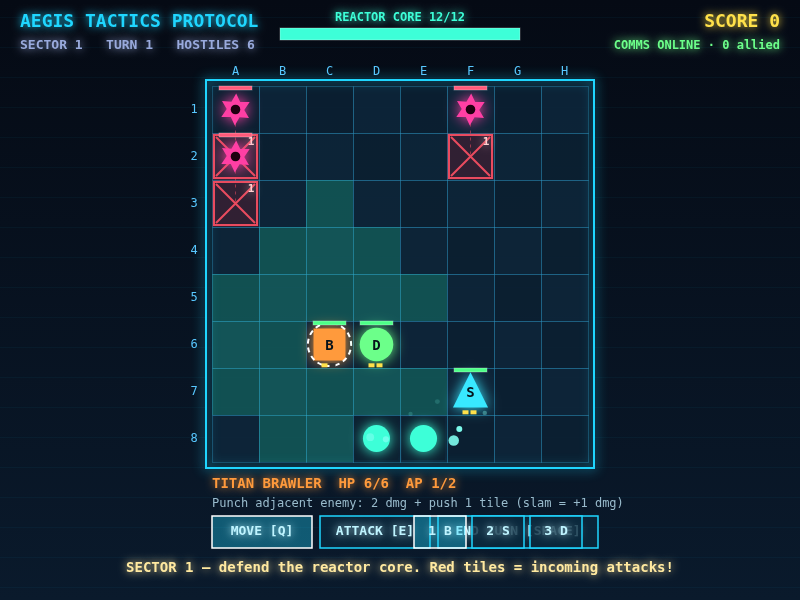
Create an immersive, strategic turn-based roguelike tactical mech combat game titled 'Aegis Tactics…Create an immersive, strategic turn-based roguelike tactical mech combat game titled 'Aegis Tactics Protocol'. Story: Year 2184, command the Aegis Protocol mech squad defending planetary power reactors from devastating bio-synthetic kaiju swarms on grid-based sector maps. Features & Controls: 1. Turn-based 8x8 tactical grid with telegraphed enemy attacks (enemies display their target tiles and intended attacks so players can strategically push, stun, or destroy them before they fire). 2. Three playable mechs: Titan Brawler (melee punch that pushes targets 1 tile backwards), Rail Sniper (line-of-sight piercing beam), and Pulse Drone (AOE shockwave and reactor repair). 3. Smooth, juicy visual animations powered by forge.tween: create a tween group with 'const tweens = forge.tween.createGroup()', animate mech movement between tiles with 'tweens.to(unit, { px: targetPx, py: targetPy }, 250, "easeOutQuad")', animate damage numbers floating up and fading with 'tweens.to(popup, { y: popup.y - 30, alpha: 0 }, 450, "easeOutCubic")', and update every frame with 'tweens.update(dt)'. 4. Grid math & targeting: use 'forge.math.manhattan' for attack ranges and move ranges, 'forge.math.inBounds' for grid borders, and 'forge.math.clamp'. 5. Visuals & Particles: use 'forge.fx.createEmitter({ maxParticles: 250 })' for plasma cannon blasts, smoke trails, and reactor core sparks. Glowing cyber-tactical holographic UI with grid coordinates, action points, and health bars. 6. Audio: trigger sound effects using 'forge.audio.play("laser")', 'forge.audio.play("explosion")', 'forge.audio.play("shield")', 'forge.audio.play("hit")', and 'forge.audio.play("powerup")'. Call 'forge.audio.unlock()' on initial canvas click. 7. Networking & Leaderboard: connect to tactical comms room via 'await forge.net.join("aegis-tactics-command")' and submit tactical victory scores via 'await forge.leaderboard.submit("aegis-tactics-protocol-rogue", score)'.
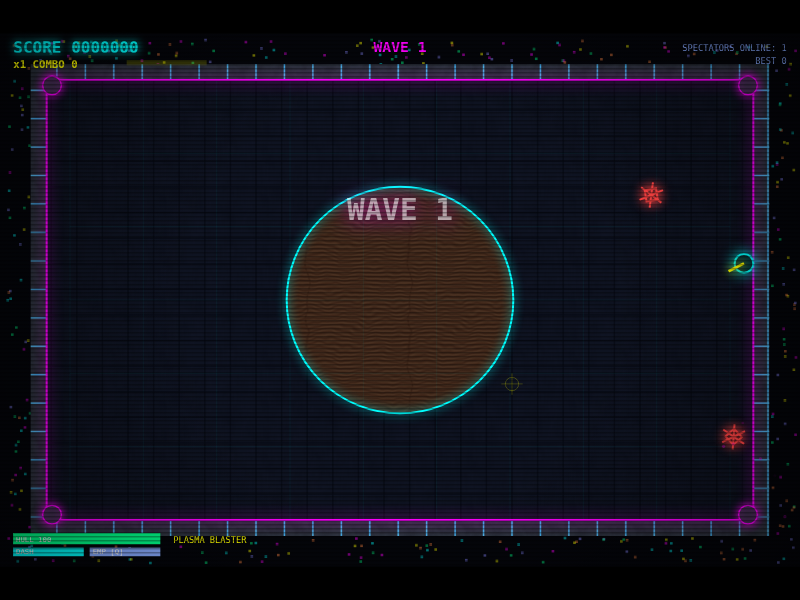
Create an adrenaline-fueled retro 2D arcade twin-stick gladiatorial combat game titled 'Galactic Colosseum…Create an adrenaline-fueled retro 2D arcade twin-stick gladiatorial combat game titled 'Galactic Colosseum Champions'. Story: In the lawless outer rim of Sector-7, the Intergalactic Grand Colosseum pits cyber-enhanced gladiators against deadly waves of alien beasts, elite robotic sentinels, and the towering warlord boss 'Zul'Karr - The Iron Colossus'. Gameplay & Features: 1. Top-down arena combat with smooth 60fps keyboard & mouse (WASD or Arrow keys to move, mouse aim and left-click/space to shoot plasma blaster, Shift to dash with invulnerability iframes, Q or E for EMP shockwave). Also support full keyboard controls (WASD move, IJKL shoot, Space dash). 2. Arena Hazards: Dynamic hazards that activate during waves, such as rotating laser beams from corner towers, electrified floor tiles warning before discharging, and spectator crowd drop pods containing health packs and weapon upgrades (Spread Shot, Laser Beam, Plasma Mortar). 3. Enemy Variety: Swarm Crawlers (fast melee), Cyber-Gladiators (deflective energy shields and blaster rifles), Heavy Dreadnoughts (burst missile volleys), and the multi-phase Boss 'Zul'Karr' (ground slam shockwaves, orbital laser barrage, charge attack). 4. Use built-in Forge SDK helpers: Initialize forge.input with 'forge.input.init()', utilize 'forge.math.lerp' / 'forge.math.dist' / 'forge.math.aabb' for smooth physics and crisp collisions, spawn rich explosions and blaster sparks with 'forge.fx.createEmitter({ maxParticles: 200 })', trigger sound effects using 'forge.audio.play("laser")', 'forge.audio.play("explosion")', 'forge.audio.play("powerup")', 'forge.audio.play("hit")', and 'forge.audio.play("shield")'. Always unlock audio on first canvas click using 'forge.audio.unlock()'. 5. Multiplayer room connection: join 'colosseum-arena-ops' room with 'await forge.net.join("colosseum-arena-ops")' to broadcast spectator cheering and wave synchronization. 6. Leaderboard integration: display real-time score, multiplier combo meter, and on game over submit score with 'await forge.leaderboard.submit("galactic-colosseum-champions", score)' and fetch top scores with 'await forge.leaderboard.get("galactic-colosseum-champions")'. Retro aesthetic with glowing vector neon outlines, particle bursts, screen shake on heavy impacts, and CRT scanline overlay.
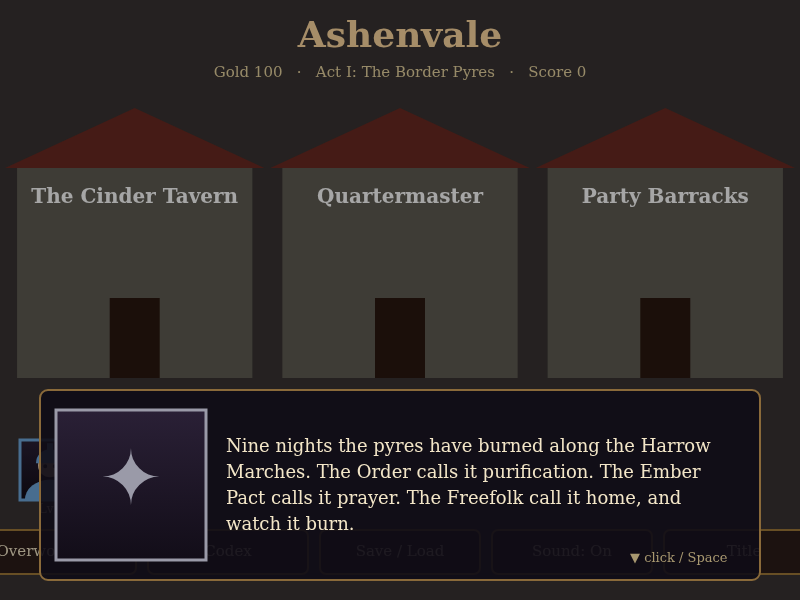
Create Covenant of Ash: Tactics (covenant-of-ash-tactics), a full-featured 2D Tactical Story RPG with a 3-Act…Create Covenant of Ash: Tactics (covenant-of-ash-tactics), a full-featured 2D Tactical Story RPG with a 3-Act branching narrative campaign, town hub, party management, and grid-based turn-based tactical combat. Structure into clean ES modules (main.js, story.js, combat.js, party.js, ui.js, audio.js). Core features: (1) STORY & DIALOGUE ENGINE: 3-Act dark-fantasy story (Act I: The Border Pyres, Act II: The Sunken Reliquary, Act III: The Ashen Throne) with character portrait dialogue boxes, typewriter text, branching moral choices that change Faction Alignment (Order, Ember Pact, Freefolk), Companion Loyalty, and unlock different story routes & endings, plus an in-game Lore & Quest Codex; (2) OVERWORLD MAP & ASHENVALE HUB: Interactive campaign map with main story nodes and optional side-quest skirmishes, plus a Town Hub with Tavern conversations, Quartermaster Shop (buy/sell weapons, armor, potions with Gold), and Party Barracks (level up heroes, equip gear, unlock class skills); (3) 4 DISTINCT PLAYABLE HEROES: Caelen (Vanguard Knight: Shield Bash knockback, Aegis Taunt, Rend), Lyra (Ember Mage: Fireball AoE that ignites tiles, Chain Bolt, Frost Nova), Vex (Shadow Stalker: Backstab guaranteed crit from behind, Poison Arrow, Smoke Dash), and Seraphina (Sun Cleric: Radiant Heal, Sanctified Barrier, Divine Judgment); (4) DEEP GRID TACTICAL COMBAT: Turn-order initiative timeline bar, movement & attack range highlights, terrain effects (High Ground +25% damage, Forest Cover +25% evasion, Burning Tiles, Healing Runes, Obstacles), flanking/backstab bonuses, floating damage/status numbers, enemy intent telegraphs, and 3 multi-phase Act Bosses; (5) PERSISTENCE & AUDIO: Full auto-save and manual save slots via forge.kv, campaign tactical score submission via forge.leaderboard, and procedural WebAudio soundtrack + combat SFX.
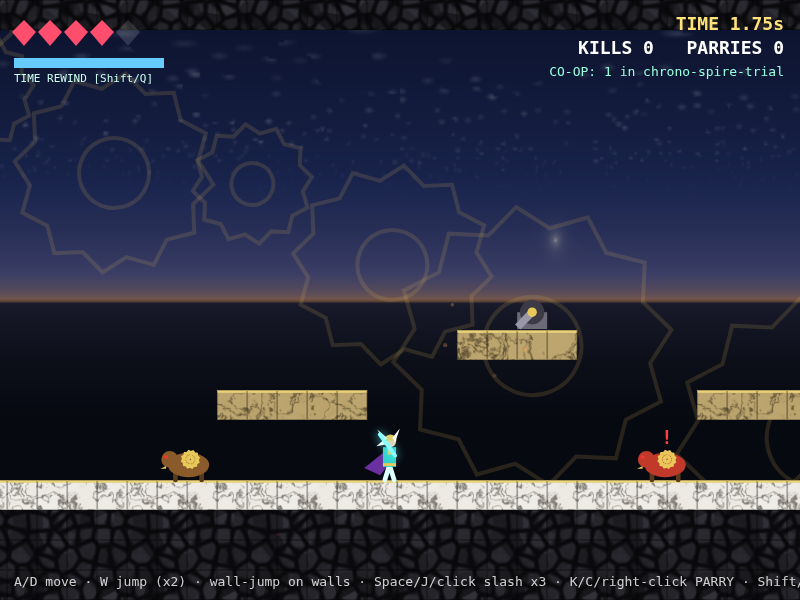
Chrono Blade Valkyrie - A lightning-fast 2D action platformer and hack-and-slash inspired by Katana Zero and…Chrono Blade Valkyrie - A lightning-fast 2D action platformer and hack-and-slash inspired by Katana Zero and retro action arcade classics. Play as Astraea, a chronomancer valkyrie in the shattered Chrono Spire who can manipulate time. Run, double-jump, wall-slide, and execute 3-hit blade combos with hit-stop freeze. Features a 3-second Time Rewind mechanic (press Shift/Q to rewind player and world states), precision parrying (deflect enemy projectiles), and an epic boss fight against Chronos Prime. Leverages the @forge/sdk engine: forge.fx.createEmitter for rich spark particles, slash arcs, and explosion bursts; forge.math for collision hitboxes; forge.input for responsive controls. Uses procedural clockwork and marble materials from materials.js, retro chiptune audio SFX (sfx_slash, sfx_spark, sfx_shield, sfx_explosion, sfx_jump), 2-player co-op trial room via forge.net.join('chrono-spire-trial'), and global speedrun leaderboard submission via forge.leaderboard.submit('chrono-blade-valkyrie', score).
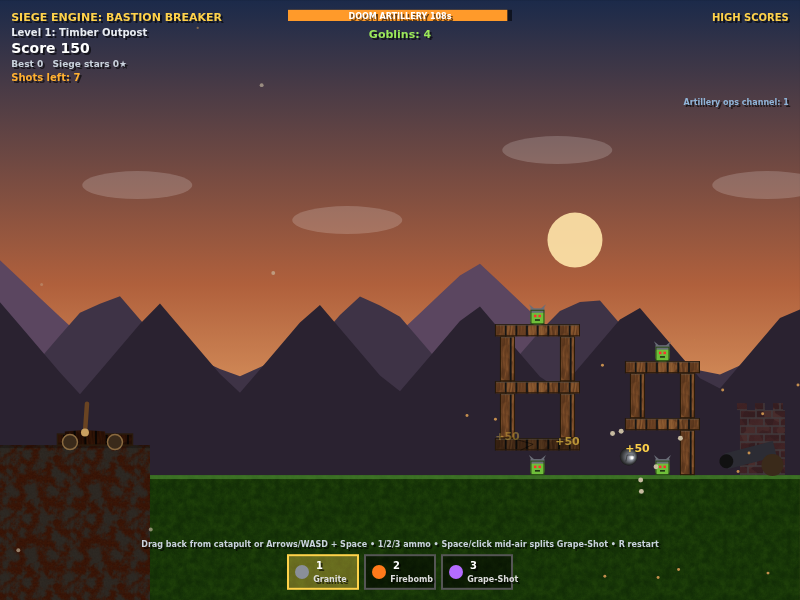
Create an arcade physics castle demolition and catapult siege game titled 'Siege Engine: Bastion Breaker…Create an arcade physics castle demolition and catapult siege game titled 'Siege Engine: Bastion Breaker' (inspired by Crush the Castle and Besiege). Story: In the craggy peaks of Kar-Drak, command the Grand Artificer's siege catapult to demolish fortified goblin bastions and wooden towers before their doom artillery fires. Mechanics & SDK usage: 1. Controls & Aiming: Click and drag back from the catapult to aim angle and launch tension (or use Up/Down/Left/Right arrows and Space to fire). 2. Ballistic Trajectory & Physics with forge.physics: Calculate and render a dotted arc aiming trajectory guide line every frame using 'forge.physics.trajectory(catapult.x, catapult.y, vx, vy, 600, 30, 0.04)'. Use 'forge.physics.circleBox(boulder, block)' for high-precision collisions between boulders and stacked wooden/stone castle blocks, transferring momentum and toppling multi-layer towers. Use 'forge.physics.bounce(boulder.vx, boulder.vy, nx, ny, 0.5)' for ricochets against heavy stone bedrock. 3. Munitions Selection (Keys 1, 2, 3): 1 - Heavy Granite Boulder (heavy kinetic mass); 2 - Incendiary Firebomb (detonates into burning shrapnel); 3 - Cluster Grape-Shot (press Space or Click in mid-air to split into 4 scatter pellets). 4. Destruction FX & Juice: Use 'forge.fx.createEmitter({ maxParticles: 350 })' for wood splinter bursts, fiery explosion debris, and collapsing dust clouds. Smoothly tween camera shake and victory/defeat banners with 'forge.tween.createGroup()'. 5. Audio & Procedural Sound FX: On first interaction, call 'forge.audio.unlock()' and start high-energy combat music with 'forge.audio.startMusic("action", { bpm: 125 })'. Trigger punchy sound presets: 'forge.audio.play("launch")' when firing, 'forge.audio.play("thud")' on ground impact, 'forge.audio.play("shatter")' when castle blocks smash apart, and 'forge.audio.play("explosion")' for bomb blasts. 6. Persistence & Leaderboards: Save best destruction score and siege stars in 'forge.kv.set("siege_engine_save", state)'. Join artillery spectator channel via 'await forge.net.join("siege-artillery-ops")'. Submit demolition destruction score to 'await forge.leaderboard.submit("siege-engine-bastion-breaker", score)' and display high scores.
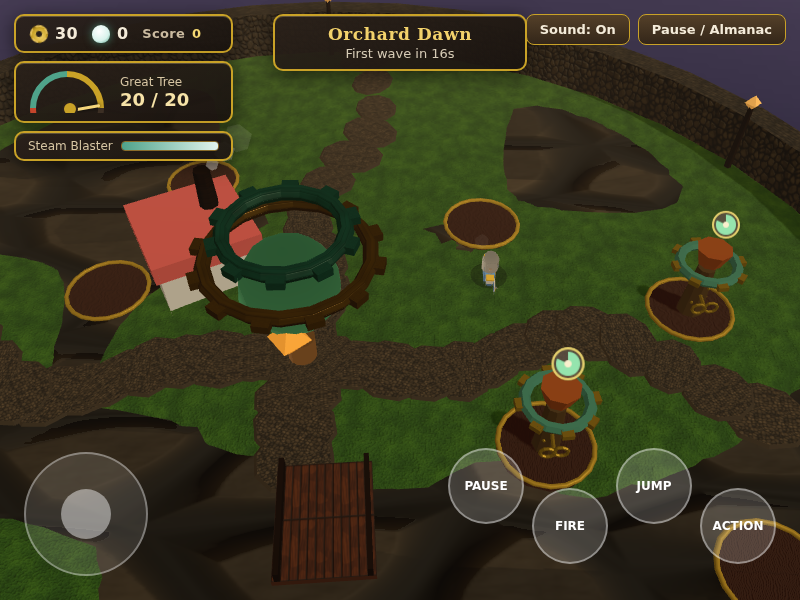
BRASS ORCHARD — a three.js orchard-defence strategy game in a steampunk clockwork valley, where you grow…BRASS ORCHARD — a three.js orchard-defence strategy game in a steampunk clockwork valley, where you grow mechanical fruit trees that are also your towers. THE PITCH The Valley of Cogs grows the last orchard of brass apple trees, wound by hand every season by the Keeper — you. These trees are clockwork: they tick, they bloom gears, and their fruit are glowing copper apples full of stored steam. This autumn the Rust Moths have come down from the scrap mountains in swarms, and anything they touch corrodes to orange dust. Brass Orchard is a real-time defence game played on a small 3D island orchard seen from a tilted overhead camera. You walk the Keeper around the orchard, wind trees to make them grow and fire, harvest steam apples to buy new saplings, and survive ten waves of increasingly strange rusted creatures. It is cosy and mechanical: everything clicks, puffs and spins. ART DIRECTION: STEAMPUNK CLOCKWORK LOW-POLY Low-poly, flat-shaded, chunky shapes in a brass-and-verdigris palette: polished brass (#c9a227), dark bronze (#6b4f2a), copper (#b87333), verdigris green (#4fa38a), soot (#2a2522), cream steam (#f2efe6), and sunset sky gradients from apricot to violet. The island is a gently rolling disc of grass (a CircleGeometry with vertex heights from forge.math.noise2D) ringed by a stone wall. Paths are flat cobble bands. Trees are built from primitives: a cylinder trunk with visible rivets (tiny spheres), a ring of gear-shaped leaves (thin cylinders with notched outlines or a torus with small boxes around it) that slowly rotate, and glowing copper apples (small emissive spheres) hanging on short rods. Every tree has a big wind-up key in its trunk that turns while the tree is wound. Steam is everywhere: soft white puffs (sprite-like planes or Points with fading opacity) vent from trees when they fire, from the Keeper's backpack when they run, and from chimneys on the little workshop in the middle of the island. A slow day–night cycle across the ten waves shifts the sky from morning gold to dusk violet; at dusk the apples glow brighter and lanterns on the wall light up (PointLights, keep the count small). THE KEEPER A stout character built from primitives: round body with a brass backpack boiler, a top hat with goggles, little legs that waddle. The Keeper walks with the move axis, kicks up steam puffs, and has a winding animation (arms rotate) when interacting with a tree. Place the camera at about 45° above, following the Keeper smoothly with damping, slightly zoomed out so most of the orchard is visible. CORE LOOP 1. Enemies arrive in waves along three entry paths at the stone wall's gates and walk toward the Great Tree at the centre of the orchard. If enough of them reach it, the Great Tree rusts through and the game is lost. 2. Trees are your towers. A wound tree automatically fires at the nearest enemy in range: it flings copper apples (arcing projectiles; use forge.physics.trajectory3 for the arc preview or a simple parabolic motion) that burst in a puff of steam on impact. 3. Trees unwind over time. Each tree has a Wind meter (a little dial above it). As it unwinds its fire rate drops; at zero it stops. Walk to a tree and hold the action button to wind it back up. This keeps you moving around the orchard and making choices: which trees to keep wound. 4. Defeated enemies drop Scrap Cogs. The Keeper collects them by walking over them (they're pulled in when close). Ripe apples also grow on idle trees and can be harvested for Steam. 5. Spend Cogs and Steam at Planting Plots (marked circles of tilled soil) to plant new saplings of different tree types, or upgrade existing trees. CONTROLS (forge.input only) - Move: input.axes.move moves the Keeper. - Action (E / B / touch): hold near a tree to wind it; tap near a plot to open its planting wheel. - Jump (Space / A): a short steam-hop (useful to cross the stream that runs through the orchard and to dodge). - Fire (F / X): the Keeper's steam blaster, a short cone of steam that pushes nearby enemies back and slows them. It has a pressure gauge that refills. - Planting wheel: when open, left/right cycles tree types and jump confirms; the cost is shown. - Pause: pause menu with the controls listed. THE FIRST FRAME Start in an already living orchard: the first wave timer counts down from 20 seconds, the Keeper is standing by the workshop, steam is drifting, gears are turning, and the arrow keys move the Keeper immediately. Show a title card "BRASS ORCHARD — wind your trees, guard the Great Tree" as an overlay that fades after a few seconds or on the first input. Never wait for a click before the loop runs. TREE TYPES - Apple Mortar (starter): lobs heavy apples in an arc, splash damage. Medium range. - Pear Gatling: fast, small pears in straight lines; great against swarms; unwinds fastest. - Plum Tesla: a coil on top arcs blue lightning to chain between up to three enemies; needs to be wound fully to fire. - Cherry Clockwork: slows all enemies in a radius by turning time sluggish (show a ticking ring); no damage. - Fig Bellows: blows enemies back along the path with gusts; good at chokepoints. Each tree can be upgraded twice (brass → gilded → crystal), changing its look (more gear leaves, a glowing crown) and stats. ENEMIES: THE RUST All enemies look like corroded mechanical insects: orange-brown, pitted, with jerky animation. - Rust Moths: small, fast, fly in loose swarms (move in groups with slight random wobble). Weak. - Scrap Beetles: slow, armoured; mortar splash is effective. - Corrosion Slugs: leave a trail of rust on the path that makes nearby trees unwind faster if not cleared by steam blasts. - Gear Wasps: fly straight over walls, ignoring paths, but are fragile. - The Tin Colossus (wave 10 boss): a giant walking scrap heap with a furnace mouth; it has phases, summons moths, and must be slowed and battered. Its health bar shows at the top of the screen. Show health bars as small floating bars above damaged enemies. When defeated they collapse into a puff of rust and bounce out Scrap Cogs. WAVES AND PROGRESSION Ten waves, each announced with a banner ("Wave 3 — the Beetles come from the East Gate") and a short preparation time between waves where you can plant and wind. Waves increase in count and mix. Between waves, the day progresses. After wave 10, a victory scene: the Colossus falls apart, the Great Tree blooms enormous brass blossoms, and confetti steam bursts fill the sky. Show the results and a "Play again" prompt. ECONOMY - Cogs from enemies, Steam from apples. Saplings cost 15–40 Cogs depending on type; upgrades cost Cogs plus Steam. - Show Cogs and Steam at the top left with small icons drawn with CSS shapes. - Balance so the first three waves are very manageable with two starter trees plus one planted tree. HUD (HTML overlay) - Top left: Cogs, Steam, the Great Tree's integrity as a brass gauge (a semicircle dial with a needle). - Top centre: wave number and countdown to the next wave. - Above each tree in the world: a small wind dial (draw with a sprite or a tiny ring mesh that empties). - Bottom centre: context prompt ("Hold E to wind the Plum Tesla"). - Planting wheel: a radial menu overlay around the plot with tree icons and costs. SAVING - Save the best wave reached and the best score with forge.kv ("brass-orchard-best"). - Optionally save an in-progress game between waves under "brass-orchard-save" and offer "Continue" next time. AUDIO - Tree firing: forge.audio.play("cannon") for mortars at low volume, "laser" for gatling pears, "hack" for the Tesla's arc. - Winding: a rapid series of short ticks (forge.audio.tone at high frequency, 20 ms each) while winding. - Cog pickup: "coin". Planting: "powerup". Steam blast: "splash". - Enemy defeated: "hit". Great Tree damaged: "alarm" (rate-limited). - Wave start: "checkpoint". Boss: "roar". Victory: "buff". - Music: forge.audio.startMusic("fantasy") after the first input; switch to "boss" for wave 10. GAME FEEL - Steam puffs on everything mechanical; small screen shake when a mortar lands near the camera; trees recoil slightly when they fire. - The wind key on each tree spins proportionally to its wind level. - Enemies flash white for one frame when hit. - Use object pools for projectiles, enemies, puffs and cogs; use forge.spatial.createGrid3D or a simple grid to find targets efficiently. TECHNICAL REQUIREMENTS FOR THIS PLATFORM - Plain ES modules: main.js, world.js (island, paths, plots), keeper.js, trees.js, enemies.js, waves.js, hud.js, audio.js. Every imported name exported by its file. - three.js from "three" and import { forge } from "@forge/sdk" only. No external assets: textures via CanvasTexture, all models from primitives. - Render into <canvas id="game"> with renderer.setAnimationLoop; handle resize; add ambient and directional lights plus a few lanterns. - Controls only through forge.input.poll() once per frame. - Keep it smooth: cap enemies on screen at about 80, reuse geometries and materials. - No alert/prompt/confirm. ACCEPTANCE CHECKLIST - Loads into a living orchard with the first wave counting down; arrow keys move the Keeper immediately. - Trees fire automatically when wound and unwind over time; holding action near a tree winds it. - Enemies walk paths from three gates toward the Great Tree, take damage and drop cogs. - Planting and upgrading works through the planting wheel and costs resources. - At least four tree types and four enemy types; the Colossus boss on wave 10. - HUD shows resources, wave, countdown and the Great Tree's gauge; the best wave persists via forge.kv. - Win and lose screens with restart; audio throughout. THE FIRST TWO MINUTES, AS THE PLAYER SHOULD EXPERIENCE THEM Morning light pours across a tiny round island. Steam drifts from the workshop chimney and two brass apple trees tick contentedly beside the stone paths, their gear leaves turning. The Keeper waddles out of the workshop as the title BRASS ORCHARD rises in brass-plated letters and fades. A counter at the top says "First wave in 20". The player presses an arrow key and the Keeper trundles toward the nearest tree; a prompt appears, "Hold E to wind the Apple Mortar". Holding it plays a rapid ticking, the key in the trunk spins, the tree's little wind dial fills, and the gear leaves spin faster. A wobbly line of Rust Moths flutters in through the East Gate; the mortar lobs a glowing apple in a high arc that lands with a puff of steam, and two moths tumble down in orange dust, dropping cogs that roll toward the Keeper and clink into the counter. When the wave ends, the planting plot near the West Gate glows invitingly; the player opens the planting wheel, sees the Pear Gatling for 20 cogs, and plants it. A sapling pops out of the soil with a puff, grows over two seconds with springy animation, and joins the defence. The Great Tree in the middle hums a little tune of relief. CHARACTERS AND VOICE Short speech bubbles from the Keeper and from the Great Tree (an old, wise voice) appear at key moments, never blocking play: - Keeper, at start: "Morning, old girl. Let's get you wound." - Great Tree, first wave: "I hear wings. Rust wings." - Keeper, first plant: "Grow quick, little one. Grow brass." - Great Tree, when damaged: "My rings… they're rusting through!" - Keeper, when a tree runs fully down: "Oh no, the Plum's gone quiet!" - Great Tree, wave 5: "Dusk. They are bolder in the dark." - Keeper, when the Colossus appears: "That's not a beetle. That's a scrapyard with legs." - Great Tree, victory: "Wound, watered and whole. Thank you, Keeper." Give each enemy type a one-line entry in an in-game Almanac (pause menu) with a tiny drawing: "Rust Moth — dust on the wind. Weak alone, a plague in numbers." CONTENT TABLE: WAVES 1. 12 Rust Moths, East Gate. 2. 16 Rust Moths, East and West Gates. 3. 8 Moths + 3 Scrap Beetles, South Gate. 4. 6 Beetles + 4 Corrosion Slugs, East Gate. 5. 20 Moths + 4 Gear Wasps (fly over walls), all gates. Dusk begins. 6. 8 Beetles + 6 Slugs, West and South. 7. 30 Moths in three swarms + 6 Wasps. 8. 10 Beetles + 8 Slugs + 10 Moths, all gates. Night. 9. Mixed rush: 40 enemies, all types, from all gates in two bursts. 10. The Tin Colossus from the North (a breach in the wall opens dramatically) with moth escorts it spawns every 15 seconds. TUNING NUMBERS - Keeper speed: 5 units/s; steam-hop 1.2 units high; steam blaster cone 4 units long, 50° wide, knockback 3 units, pressure refills in 6 s. - Wind: trees unwind from 100 to 0 in 45 s (Pear Gatling 30 s); holding wind restores 40 per second; fire rate scales from 100% at full wind to 40% at 20 wind, 0 below 5. - Apple Mortar: range 9, splash radius 2, damage 30, every 1.6 s. Pear Gatling: range 7, damage 6, every 0.25 s. Plum Tesla: range 8, damage 22, chains to 3, every 1.2 s, only above 80 wind. Cherry Clockwork: slows by 45% in radius 5. Fig Bellows: knocks back 4 units every 2 s. - Enemies: Moth 20 hp speed 3.2; Beetle 120 hp speed 1.4, armour halves gatling damage; Slug 70 hp speed 1.0; Wasp 30 hp speed 4 (ignores paths); Colossus 3000 hp speed 0.6, three phases at 66% and 33%. - Great Tree integrity: 20; moths deal 1, beetles 3, slugs 2, wasps 1, Colossus 10 if it reaches the tree. - Starting cogs: 30. Moths drop 2, beetles 6, slugs 4, wasps 3; apples give 5 steam each. POLISH LIST - Trees cast soft round shadows; steam puffs drift with a gentle wind direction that changes per wave. - When an enemy is killed by a mortar, its pieces scatter as small bronze cubes that fade. - The day–night colour grade should change the scene's mood clearly: warm gold at wave 1, amber at wave 4, violet at wave 7, navy with lantern light at wave 10. - The planting wheel pauses enemy movement at 25% speed (not a full pause) to stay tense but fair. - Make the wind dial readable at a glance: green above 60, amber 20–60, red below 20, blinking at 0.
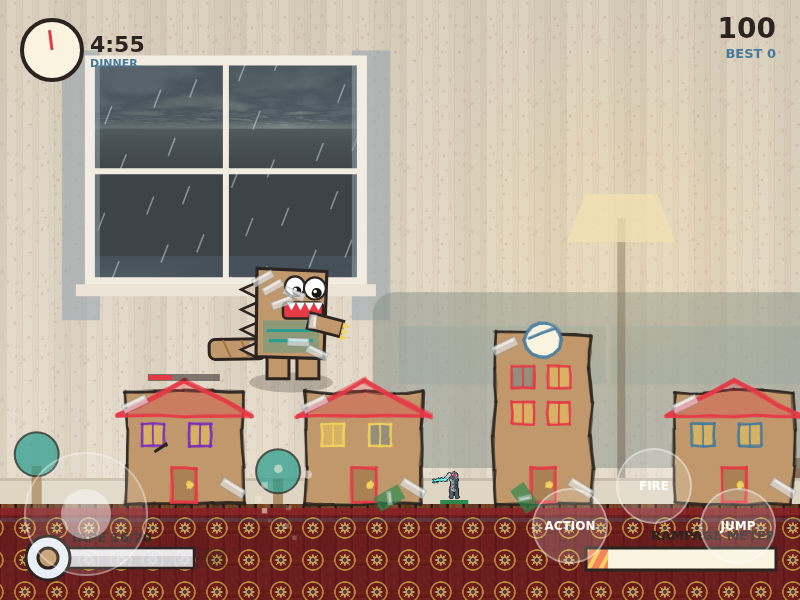
CARDBOARD KAIJU — a 2D canvas rampage arcade game where a kid's cardboard monster stomps through a…CARDBOARD KAIJU — a 2D canvas rampage arcade game where a kid's cardboard monster stomps through a crayon-drawn toy city, defended by a plastic toy army. THE PITCH It's a rainy Saturday. Maya, age eight, has built the greatest monster ever made from a cereal box, two egg cartons and a lot of tape: GRUMBLOR, Destroyer of Living Rooms. She's built a whole city from shoeboxes and drawn on it with crayons, and her little brother has set up his entire toy army to defend it. Now GRUMBLOR stomps. Cardboard Kaiju is a side-on arcade rampage: you are GRUMBLOR, waddling across a toy city drawn in crayon on cardboard, smashing shoebox buildings into flat pieces, roaring, tail-swiping, and shrugging off rubber-band tanks and paper planes — all narrated by Maya's imagination. When Mum calls "dinner in five minutes!", the timer is on. ART DIRECTION: CRAYON AND CARDBOARD Everything is hand-made from cardboard and coloured with wax crayons, drawn in code on the canvas. - Cardboard: corrugated brown (#c49a6c) with darker stripes for flutes (draw parallel lines at low alpha) and torn, jagged edges (polygons with slightly random vertices). Pre-render a cardboard texture once to an offscreen canvas and use it as a pattern for buildings and GRUMBLOR. - Crayon: bold, waxy strokes in primary colours — red (#e63946), blue (#457b9d), yellow (#f4d35e), green (#2a9d8f), purple (#7b2cbf) — drawn as several jittered, slightly offset lines with gaps, so they look scribbled rather than ruled. Windows, doors, faces and graffiti on the buildings are crayon scribbles. Keep a seeded random generator so each building's scribbles stay the same every frame (generate them once and cache to that building's own offscreen canvas). - Background: Maya's living room, drawn big and soft: a rug pattern on the floor, the legs of a sofa looming in the back, a window with rain streaks (animated diagonal lines), a lamp with a warm glow. Everything in the background is slightly blurred and desaturated so the cardboard city pops. - Tape: strips of shiny tape (light grey with a white highlight) hold things together everywhere, including GRUMBLOR's joints. - GRUMBLOR: a boxy cereal-box body with a crayon-drawn grin full of triangle teeth, egg-carton spikes along its back, googly eyes (white circles with black pupils that look toward the nearest target and jiggle when it moves), stubby cardboard legs that waddle, and a tail made from a paper towel tube. Animate it with squash and stretch: bob on every step, lean into the walk, wobble when roaring. - The toy army: green plastic army figures (flat green silhouettes in classic poses), rubber-band tanks (small boxes with crayon treads), paper aeroplanes that loop through the air, a wind-up robot with a key in its back, and the dreaded Vacuum Cleaner boss. CORE LOOP 1. GRUMBLOR walks left and right across a long, wide city that scrolls with a camera following it. The city has three districts in a row: Shoebox Suburbs, Cereal Downtown and the Lego-ish Harbour (blocks made of coloured rectangles with studs). 2. Smash buildings: walking into a building and pressing the fire action does a two-handed SMASH; the building's health drops, it shakes and cracks, and when destroyed it collapses into a pile of flat cardboard pieces that tumble with simple physics (each piece a polygon with velocity, gravity and spin, bouncing on the floor and coming to rest). Big buildings take several hits; buildings collapse more spectacularly (with a dust puff of crayon scribble clouds). 3. Rampage meter: destruction fills it. When full, the jump action unleashes ROAR: a huge crayon "ROOAAARR!" word bursts across the screen, everything on screen shakes, toy soldiers fall over, and paper planes flutter to the ground. 4. Tail swipe (action): a spinning tail attack that knocks back toys and smashes small things around GRUMBLOR. 5. Jump: GRUMBLOR can do a big clumsy jump and land with a GROUND POUND that damages everything near the landing spot. Hold down while airborne to pound sooner. 6. The toy army fights back: soldiers fire tiny dotted lines (peas), tanks fire rubber bands that arc, planes drop paper-ball bombs, the robot marches with sparks. Each hit tears GRUMBLOR a little (show tape patches appearing on its body). If GRUMBLOR's tape runs out, it falls apart into pieces in a funny collapse. 7. The dinner timer: a crayon-drawn clock in the corner counts down from five minutes. Mum's voice (a speech bubble from off-screen) calls out warnings at 3:00, 1:00 and 0:10. When time runs out, the game ends with Mum saying "Dinner! Tidy up your monster!" and a results screen. CONTROLS (forge.input only) - Walk: input.axes.move x (arrows, A/D, stick, touch joystick). Down (input.axes.move.y) while airborne: ground pound. - Jump (Space / A / touch): jump; when the Rampage meter is full, double-tap or press jump on the ground with up held to ROAR — or use the pause-free shortcut: the "action" button when the meter is full. Keep it simple and explained on screen. - Fire (F / X / touch): SMASH. - Action (E / B / touch): tail swipe (or ROAR when the meter is full). - Pause: pause menu. forge.input.configure({ touchButtons: ["jump", "fire", "action"] }). THE FIRST FRAME Load straight into the city with GRUMBLOR stomping in from the left edge of the screen, the rain on the window, a few soldiers already in position, and the dinner clock ticking. The arrow keys move GRUMBLOR immediately. A crayon title "CARDBOARD KAIJU" scribbles itself onto the screen (draw it stroke by stroke over a second) with "arrows to stomp · F to smash · Space to jump" underneath, and fades out after a few seconds or on the first input. Never wait for a click. STORY BEATS (Maya's narration in speech bubbles drawn in crayon, top of the screen) - At the start: "GRUMBLOR has awoken from his ancient slumber in the toy box!" - First building down: "The Shoebox Suburbs tremble!" - When the first tank appears: "Leo's tanks! GRUMBLOR fears nothing!" - Entering Cereal Downtown: "The tallest towers in the world (they're cereal boxes)." - When GRUMBLOR is low on tape: "Hold on GRUMBLOR, I'll get more tape!" — and occasionally a hand drops a roll of tape from above that restores health when picked up. - The Vacuum Cleaner boss in the Harbour: Leo's "secret weapon" — a big grey vacuum that rolls in, sucks toys and cardboard pieces toward it (and GRUMBLOR too), and has to be hit on its power switch three times while dodging its pull. Maya: "NOT THE VACUUM!" - Win: if GRUMBLOR defeats the vacuum before dinner, Maya cheers "GRUMBLOR WINS! Best Saturday ever!" and draws a crown on GRUMBLOR. Then Mum's dinner call. SCORING - Points for each building destroyed (more for bigger ones), toys knocked over, planes swatted, combo multiplier for destruction in quick succession (a crayon "x4 COMBO!" pops). - Destruction percentage per district shown at the end, with a crayon-drawn report card: "Destruction: A+", "Roaring: A", "Table Manners: F". - Save best score and best destruction percentage with forge.kv ("cardboard-kaiju-best"). HUD (crayon style on the canvas) - Top left: the dinner clock. Top right: score and combo. - Bottom left: GRUMBLOR's tape meter (a roll of tape that unspools). Bottom right: Rampage meter as a crayon bar being coloured in. AUDIO (forge.audio) - Footsteps: "thud" at low volume every step (alternating slight pitch variations if possible). - SMASH: "hit"; building collapse: "explosion" plus "shatter". - ROAR: "roar" at full volume. Tail swipe: "slash". Ground pound: "cannon". - Soldiers firing: "laser" very quietly (rate-limited). Paper plane swatted: "flipper". - Tape pickup: "heal". Mum's warnings: "alarm" softly. Boss: "boss" music theme. - Music: forge.audio.startMusic("action") after the first input; switch to "boss" for the vacuum. GAME FEEL - Screen shake on every stomp (small) and collapse (bigger). Crayon dust clouds puff on impacts. - Cardboard debris pieces tumble and stay on the floor (cap at about 150 pieces, fading the oldest). - Googly eyes jiggle with spring physics. Soldiers ragdoll (spin away) when hit. - Pool particles, debris and projectiles; cache scribbled art per object. TECHNICAL REQUIREMENTS FOR THIS PLATFORM - 2D canvas on <canvas id="game"> with getContext("2d"); full window; resize handled. - Plain ES modules: main.js, art.js (cardboard texture, crayon stroke helpers, cached drawings), city.js (districts, buildings, debris), kaiju.js (GRUMBLOR), army.js (soldiers, tanks, planes, robot, vacuum), story.js (narration and Mum's clock), hud.js, audio.js. - import { forge } from "@forge/sdk" for input (poll once per frame), audio, kv. No external images or fonts. - requestAnimationFrame from page load; something moves every frame. - No alert/prompt/confirm. ACCEPTANCE CHECKLIST - Loads into the toy city with GRUMBLOR stomping in; arrow keys move it immediately. - Smash, tail swipe, jump with ground pound, and ROAR all work; buildings take damage and collapse into tumbling cardboard pieces. - The toy army fights back; tape damage and tape pickups; Maya's narration bubbles. - Three districts and the Vacuum Cleaner boss; the dinner timer ends the game with a report card. - Crayon-and-cardboard look throughout; best score persists via forge.kv; sound and music. THE FIRST TWO MINUTES, AS THE PLAYER SHOULD EXPERIENCE THEM A rainy window, a cosy living room, and a sprawling cardboard city on the rug, each shoebox building covered in crayon windows and doors. From the left, GRUMBLOR stomps into view — a cereal box with googly eyes and a crayon grin — every step shaking the screen a little and puffing scribble dust. The crayon title CARDBOARD KAIJU scribbles itself across the top and Maya's speech bubble pops up: "GRUMBLOR has awoken from his ancient slumber in the toy box!" The player holds right and GRUMBLOR waddles forward, googly eyes jiggling. At the first shoebox house the player presses F: a two-handed SMASH, the box crumples, crayon cracks spread across it, and with a second smash it collapses into flat tumbling cardboard pieces that bounce on the rug with a satisfying clatter. "The Shoebox Suburbs tremble!" A squad of green army men opens fire with tiny dotted lines; GRUMBLOR takes a hit and a strip of tape appears on its side. The player spins the tail with E and the soldiers fly off, spinning. A paper plane loops overhead and drops a crumpled paper bomb. The Rampage meter fills to the top; the player presses Space with up held and GRUMBLOR lets out a giant crayon "ROOOAAARRR!" that shakes the whole screen, toppling every soldier on it. The dinner clock in the corner reads 4:12. CHARACTERS AND VOICE - Maya (narrator, age 8): dramatic, excitable, loves GRUMBLOR. More lines: "Nothing can stop GRUMBLOR! Except bedtime." / "GRUMBLOR is hungry for cereal towers!" / "Leo's soldiers are NOT allowed to use the cat." / "That's my favourite building… it's okay, GRUMBLOR, I'll build another one." - Leo (little brother, the toy army general): his lines appear in a smaller, wobblier crayon from the opposite side: "Tanks, ATTACK!" / "Planes! PLANES!" / "That's not fair, GRUMBLOR is too big!" / "Fine. Time for… THE VACUUM." - Mum (off-screen, in a different colour of handwriting at the top): "Five minutes till dinner!" / "Three minutes!" / "One minute, I mean it!" / "DINNER! Tidy up your monster!" - The family cat makes a cameo: occasionally a giant paw sweeps in from the edge of the screen and knocks a few things over, regardless of side. Maya: "MITTENS NO." CONTENT TABLE: BUILDINGS AND TOYS Buildings (health / points): Shoebox House (3 / 50), Tissue-Box Tower (4 / 80), Cereal Skyscraper (6 / 150), Egg-Carton Apartment (5 / 120), Tube Lighthouse (4 / 100), Lego Warehouse (8 / 200, harbour), Cardboard Castle (10 / 400, one per run, dramatic collapse). Toys: Army Man (1 hp, shoots peas), Bazooka Man (2 hp, arcing paper balls), Rubber-Band Tank (5 hp, arcing bands), Paper Plane (1 hp, dive bombs), Wind-up Robot (8 hp, marches and sparks), Toy Helicopter (4 hp, hovers and drops pins), The Vacuum (boss, 3 switch hits needed, pulls everything). TUNING NUMBERS - GRUMBLOR: walk speed 140 px/s, jump velocity 620 px/s with gravity 1400 px/s², ground pound radius 120 px for 2 damage, smash 1 damage to the building in front with a 0.35 s windup, tail swipe radius 100 px knocking toys back, 0.6 s cooldown. - Tape (health): 20 strips; peas remove 1, bands 2, paper bombs 2, robot sparks 3, vacuum contact 4. Tape roll pickups restore 6. - Rampage meter: +1 per building hit, +5 per building destroyed, +2 per toy; 60 to fill; ROAR knocks over everything on screen and stuns tanks for 3 s. - Dinner clock: 5:00. The city is about 6 screens wide; the vacuum arrives when GRUMBLOR reaches the harbour or at 1:30 remaining, whichever is first. - Combo: chaining hits within 1.2 s raises the multiplier up to x8. POLISH LIST - Each building collapses differently: some fold inward, some topple sideways, the castle's turrets tumble one by one. - Debris pieces keep the crayon drawings that were on them, so the rubble tells the story of the building. - GRUMBLOR's googly eyes always look toward the nearest building or toy — huge personality for free. - Rain on the window speeds up slightly as the dinner clock runs down; the room lamp flickers when the vacuum arrives. - The report card at the end is drawn as a crayon-scribbled sheet of paper with a gold star sticker for a high score.
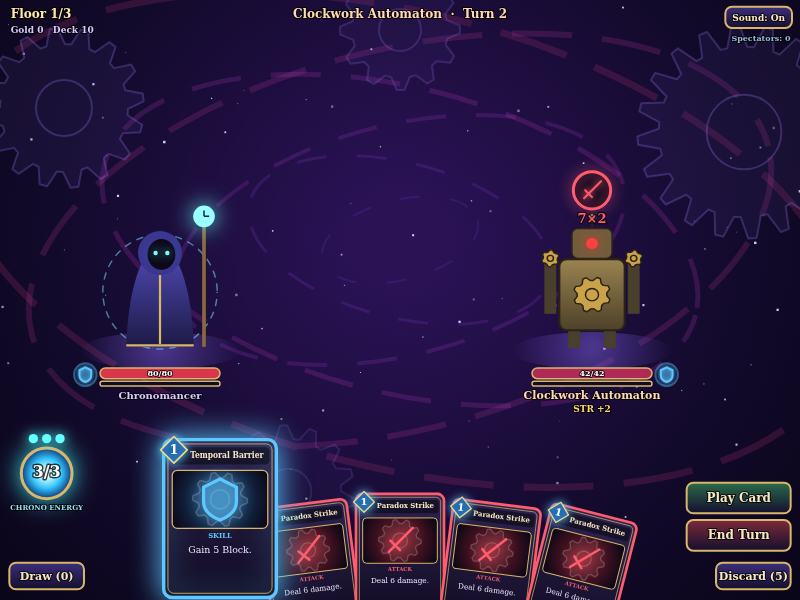
Create a turn-based roguelike deck-building card battler game titled "Chronomancer: Deck of Spires" (inspired…Create a turn-based roguelike deck-building card battler game titled "Chronomancer: Deck of Spires" (inspired by Slay the Spire and Inscryption). STORY & THEME: Exiled from the High Timelines, the Chronomancer must ascend the infinite Chrono Spire. Harness ancient temporal cards—bending time, paradoxes, and entropy—to battle clockwork automatons, paradox phantoms, and the colossal Timekeeper guardian of the spire summit! VISUAL STYLE & GRAPHICS: - Beautiful 2D canvas card battle arena with an astral temporal rift and rotating clockwork cogwheel background. - Hero on the left (Chronomancer with HP bar, Block/Shield gauge, and glowing Chrono Energy orbs 3/3). - Enemies on the right (Clockwork Automaton, Paradox Wraith, or Spire Boss) with animated idle breathing, HP bar, Block gauge, and clear Telegraph Intent icons above their heads (showing intended action: Attack with damage number, Defend, or Buff). - Interactive card hand rendered at the bottom in an elegant curved fan layout. Each card has a distinct fantasy border, mana cost diamond, temporal spell illustration/icon, title, and detailed effect description. - Cards react to mouse hover/touch: smoothly lifting up, scaling up, and glowing. - Particle effects for slash trails, shield hex barriers, heal sparkles, and entropy vortexes. - Floating combat text (+12 Block, -18 HP, PARADOX!) animated smoothly upward. GAMEPLAY MECHANICS: - Turn-based tactical card combat: * Energy: 3 Chrono Energy refreshed at the start of each turn. * Player Turn: Click or drag cards to play them if affordable. * End Turn Button: Ends player turn, triggers enemy intents, discards remaining hand, and starts the next turn. * Enemy Turn: Enemies execute their telegraphed actions (attacking player block/HP, applying defense or buffs), then generate new intent for the upcoming turn. - Spire Progression & Card Drafting: * 3 combat encounters increasing in difficulty culminating in the Spire Boss. * After defeating an encounter, reward screen allows player to choose 1 of 3 new draft cards to add to their deck, plus gold and health restoration. * Game Over screen on defeat; Victory screen on boss defeat with final score calculation. PLATFORM INTEGRATIONS: - Must import and use `@forge/sdk`: * `forge.deck.createDeck(initialCards)`: - Initialize with starter deck (e.g. 4x Paradox Strike [cost 1, deal 6 dmg], 4x Temporal Barrier [cost 1, grant 5 block], 1x Time Dilation [cost 1, draw 2 cards, gain 1 energy], 1x Entropy Siphon [cost 2, deal 10 dmg, heal 4 HP]). - Use `deck.draw(5)` at start of turn (auto-recycling discard pile). - Use `deck.discard(card)` when played and `deck.discardHand()` on turn end. - Use `deck.addCard(rewardCard)` during card draft rewards. - Use `deck.handLayout(deck.hand.length, arenaWidth, handY, arcRadius)` to compute smooth fan positions and rotations `{ x, y, rotation }` for each card in hand. * `forge.tween.createGroup()`: animate played cards flying toward targets, combat damage floats, and boss health bars. * `forge.fx.createEmitter()`: emit sparks on blade strike, shields on defense, and particle bursts on defeat. * `forge.audio.play("card_draw")` when drawing cards, `forge.audio.play("card_play")` on card play, `forge.audio.play("buff")` on defense/buffs, `forge.audio.play("debuff")` on offensive spells, `forge.audio.play("hit")` on taking damage, and `forge.audio.play("powerup")` on battle victory. * `forge.audio.startMusic("dungeon", { bpm: 100 })` for atmospheric tactical music loop with sound toggle button. * `forge.kv.get("chronomancer_deck_save")` and `forge.kv.set("chronomancer_deck_save", state)` for run persistence. * `await forge.net.join("chrono-spire-ascension")` with `room.broadcast` for spectator run sharing. * `await forge.leaderboard.submit("chronomancer-deck-of-spires", score)` and high scores display. - Include responsive on-screen buttons for touch / mouse input (Play Card, End Turn, View Draw/Discard Piles, Sound toggle). - Completely polished, self-contained, balanced, and highly replayable!
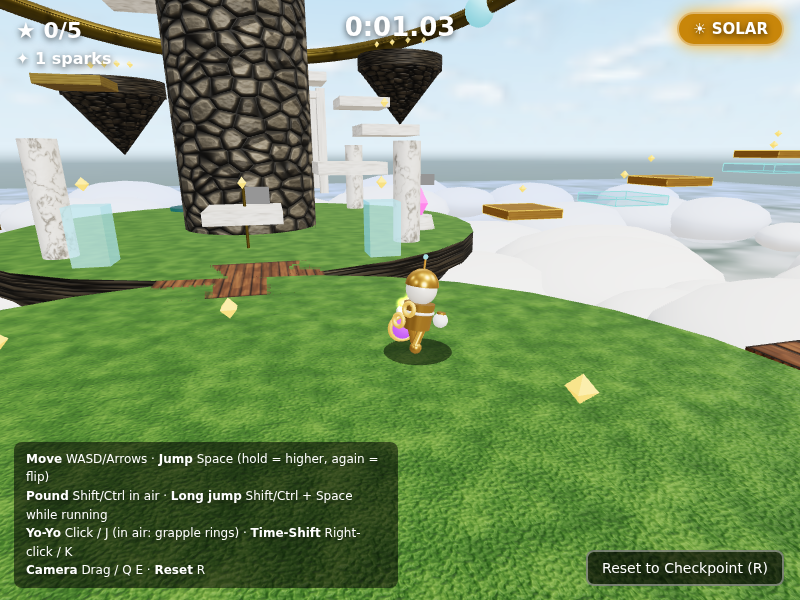
Create a complete, playable, single-file 3D platformer web game inspired by Super Mario 64, built using…Create a complete, playable, single-file 3D platformer web game inspired by Super Mario 64, built using HTML5, CSS, and Three.js (loaded via CDN). Output the entire game in a single index.html file with no external asset dependencies (use procedural geometry, vertex colors, and canvas-generated textures). 1. The Character: "Cinder," the Clockwork Yo-Yo Automaton Visuals: A stylized, expressive brass-and-porcelain wind-up automaton with a glowing wind-up key on its back (which spins faster as momentum builds), floating gloved hands, and a heavy, glowing arcane Yo-Yo tethered to its right hand. Movement & Physics: Snappy, momentum-based 3D platforming physics with a responsive third-person orbit camera (mouse drag or Q/E to rotate, automatic smooth follow). Moveset: Run & Variable Jump: WASD to move, Space to jump (hold for higher jump). Include coyote time and jump buffering. Double Jump & Ground Pound: Press Space in mid-air for a spinning flip; press Shift/Ctrl in mid-air to slam straight down with a shockwave. Long Jump: While running, press Shift/Ctrl + Space to leap forward horizontally with high speed. Signature Mechanic — Arcane Yo-Yo (Left Click / J): On Ground: Throws the yo-yo forward as a short-range melee strike to smash crystal barriers and stun enemies. In Mid-Air: Fires the yo-yo diagonally upward toward glowing Anchor Rings scattered around the level. If in range, Cinder grapples and swings/launches upward with a burst of momentum, resetting mid-air jumps. 2. The Environment: "The Chronos Orrery" Theme & Atmosphere: A surreal, sunlit floating celestial observatory suspended above a sea of clouds. Rich color palette: deep cobalt skies, warm gold brass rings, white marble ruins, and glowing cyan/magenta energy conduits. Dynamic World Mechanics: The stage is built around a massive central Astral Astrolabe with three concentric rotating brass rings and floating island platforms. Time-Shift Pedestals (Right Click / K): Hitting a Time-Shift crystal toggles the stage between Solar State (warm lighting, gold platforms are solid, water wheels spin forward) and Lunar State (cool twilight lighting, cyan translucent platforms solidify, gravity is slightly lower, and wind currents activate). Players must switch states mid-jump to traverse alternating platforms. Include moving pendulums, rotating gear bridges, bounce pads, and vertical climbing towers. 3. Objectives & Gameplay Loop ("Collect the 5 Star Shards") Like a Mario 64 stage, place 5 glowing Star Shards in distinct, visible landmarks across the level so the player can choose their own route: The Rotating Gear-Bridge: Timed platforming across meshing, spinning cogwheels. The Yo-Yo Grapple Spire: A vertical ascent chaining together mid-air yo-yo anchor swings. The Phase-Shift Gauntlet: A sequence requiring rapid mid-air toggling between Solar and Lunar states. The Pendulum Pendulum-Run: Dodging swinging brass weights along a narrow marble aqueduct, ending in a ground-pound switch puzzle. The Summit Crown: At the very peak of the central Orrery, guarded by a simple patrolling "Clockwork Sentinel" enemy that must be stunned with a yo-yo strike and ground-pounded. 4. Polish, Audio & UI Procedural Web Audio: Synthesize crisp retro-style sound effects using the Web Audio API (jump whooshes, yo-yo zip/snap, metallic footsteps, phase-shift chime, coin/spark collection, and a triumphant fanfare when a Star Shard is collected). Game Feel: Add a dynamic drop-shadow directly beneath Cinder at all times (crucial for 3D platforming depth perception), dust particles on landing/jumping, squash-and-stretch animations on Cinder's body, and subtle screen shake on ground pounds. HUD & Menus: Clean minimal UI showing Star Shards collected (X/5), a speedrun timer, current Solar/Lunar state indicator, and an on-screen control legend. Include a "Start Game" overlay, a "Reset to Checkpoint" button (R key), and a victory screen when all 5 shards are collected. Ensure the 3D collision detection (AABB and cylinder/sphere checks for moving/rotating platforms) is rock-solid so the player smoothly rides rotating gears and moving platforms without slipping off.
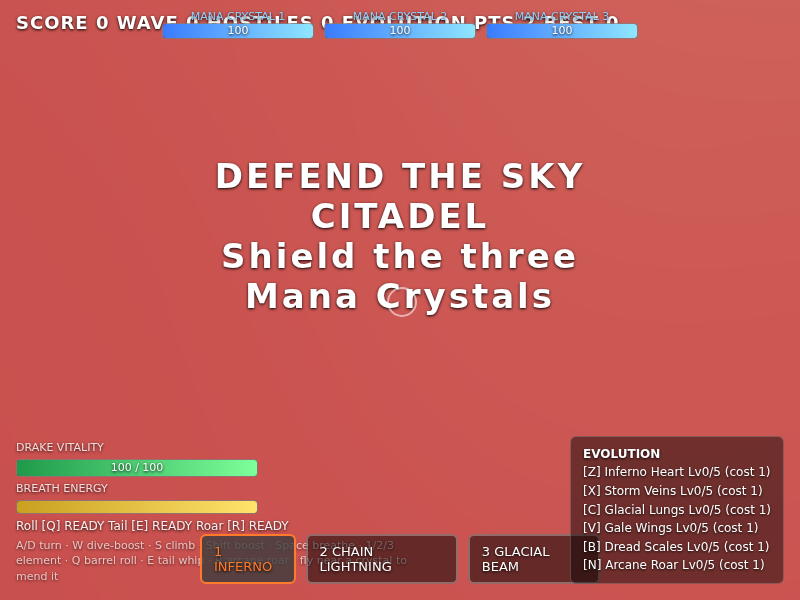
Create Drake Riders 3D (drake-riders-3d), a 3D aerial dragon-riding dogfight and sky-citadel defense game in…Create Drake Riders 3D (drake-riders-3d), a 3D aerial dragon-riding dogfight and sky-citadel defense game in Three.js. Features: (1) Articulated 3D dragon mount with animated flapping wings, banking turns, dive-boost acceleration, and barrel-roll evasive maneuvers; (2) Three switchable elemental breath weapons (1: Inferno Fireball Volley, 2: Chain Lightning Arc, 3: Glacial Frost Beam) plus tail-whip melee and homing arcane Roar; (3) Defend the central floating Sky Citadel spire and its 3 Mana Crystals from waves of dark wyvern riders, steampunk dreadnought airships, and a dread Dragon Lord boss; (4) Citadel crystal health HUD, target lead-reticle lock-on, dragon evolution upgrades persisted in forge.kv, and orchestral/synth sound effects.
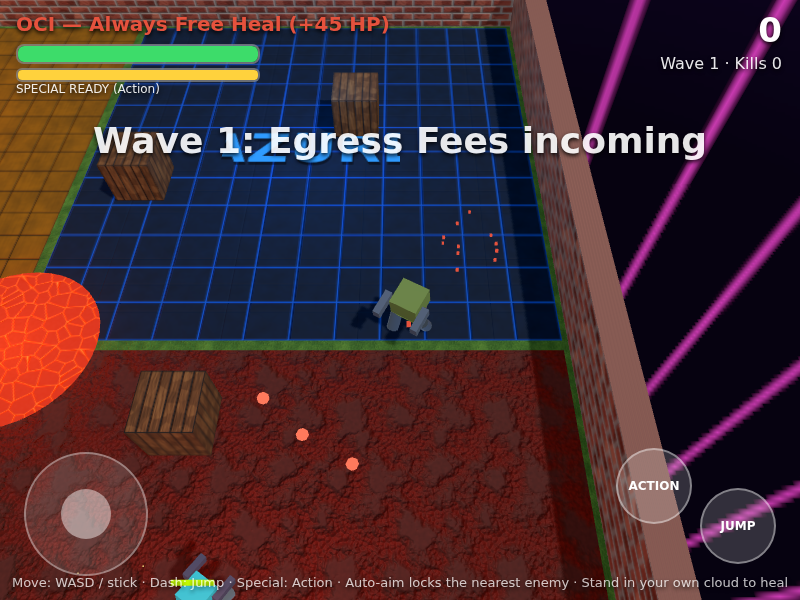
The OCI vs AWS vs GCP vs Azure game, make something up, make it fun
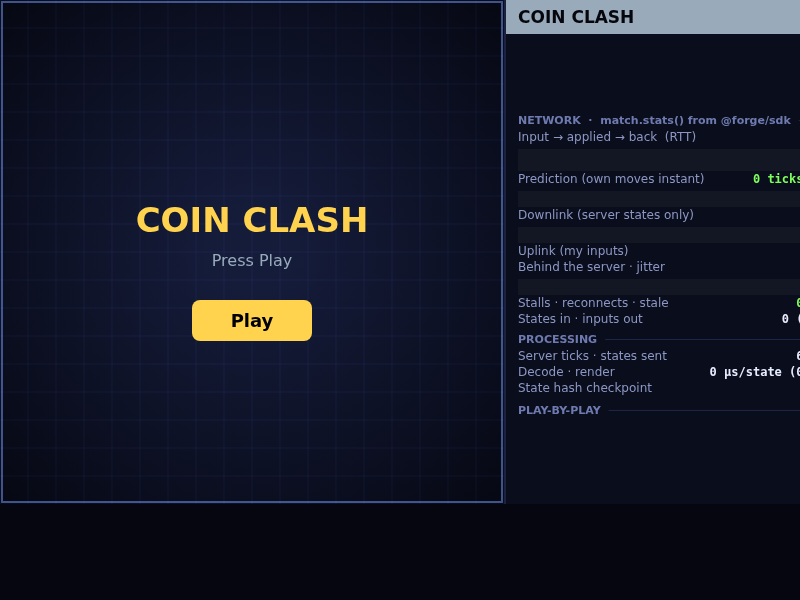
Four-player server-run match with prediction (ADR-017)
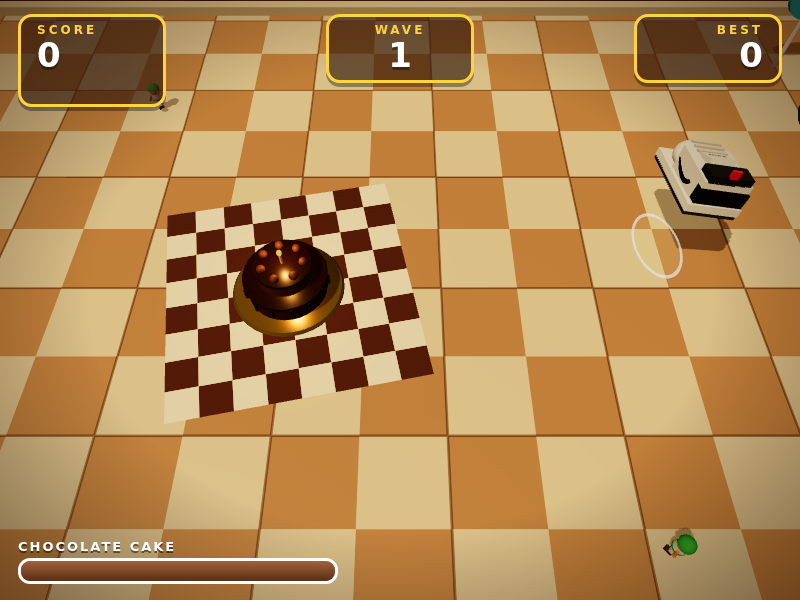
ant squishing game and make it really cool, like AA, not AAA
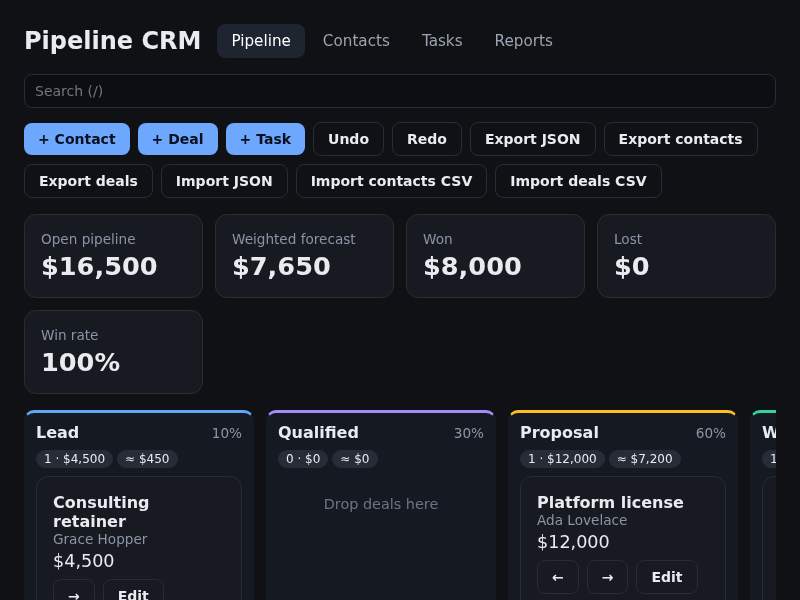
A small CRM for contacts and deals: track contacts, log interactions, and move deals through pipeline stages…A small CRM for contacts and deals: track contacts, log interactions, and move deals through pipeline stages with a value summary.
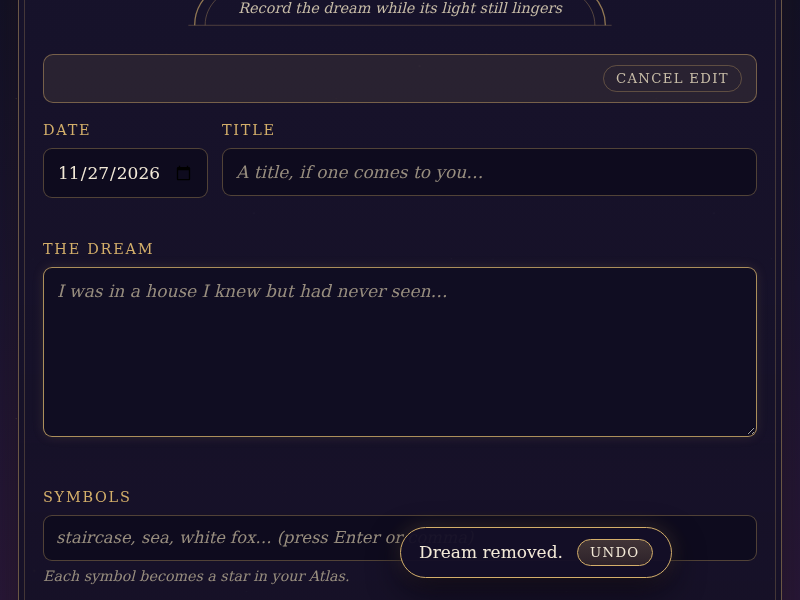
DREAM ATLAS — a dream journal web app that maps your recurring dream symbols as a living constellation…DREAM ATLAS — a dream journal web app that maps your recurring dream symbols as a living constellation, designed in an Art Nouveau style. THE PITCH Most dream journals are lists. Dream Atlas treats your dreams as a sky. Each morning you write down a dream, tag the symbols in it (a staircase, the sea, your grandmother's kitchen, a white fox), and choose its mood. Over weeks the app draws your symbols as stars in a night-sky Atlas: symbols you dream about often glow brighter, symbols that appear in the same dreams are joined by threads of light, and clusters become named constellations. You can search your dreams, follow a symbol through time, see moods across the month, and export everything. It should feel like a beautiful private book — calm, elegant, and genuinely useful every morning. DESIGN DIRECTION: ART NOUVEAU NIGHT Think Alphonse Mucha poster frames meets a planetarium. - Palette: midnight ink (#141226) background with a subtle vertical gradient to deep plum (#2a1838); antique gold (#d4af6a) for borders, ornaments and highlights; moon ivory (#f3ead8) for text; muted sage (#9bb59a), dusty rose (#d49a9a) and twilight blue (#7d8fd4) for mood colours. - Typography: a serif for headings ("Cormorant Garamond" isn't available offline, so use a stack like "Palatino Linotype", "Book Antiqua", Palatino, Georgia, serif) with generous letter-spacing for small caps; body text in Georgia at a comfortable 17px with 1.6 line height. - Ornament: frame the main panels with thin gold double borders and curving corner flourishes drawn with inline SVG paths (whiplash curves, stylised lilies and crescent moons). Section headings sit inside arched cartouches. Use soft gold glows (box-shadow) sparingly. - Motion: slow, gentle. Stars twinkle; panels fade and rise in; nothing bounces. - Responsive: one column on phones, a two-column layout (journal on the left, Atlas on the right) on wide screens. Call forge.ui.theme() for the base form and button styles, then layer the Art Nouveau styles on top in style.css (cards, borders, the night background). MAIN SECTIONS (tabs across the top styled as gold-edged cartouches; keyboard accessible) 1. Tonight's Page (the editor) - Date (defaults to today), a Title, and the dream text in a large textarea with a placeholder like "I was in a house I knew but had never seen…". - Symbols: a tag input where typing and pressing Enter or comma adds a symbol chip. Suggest existing symbols as you type (a dropdown filtered by prefix, keyboard navigable). Symbols are case-insensitive and normalised (trimmed, lower case, singular where obvious: "stairs" and "staircase" can be merged manually later). - Mood: five choices shown as small moon phases — Luminous (joyful), Calm, Strange, Uneasy, Nightmare — each with its mood colour. - Lucidity: a 0–3 rating shown as stars. Recurring: a checkbox "I've dreamed this before". - Save with Ctrl/Cmd+Enter or the Save button; show forge.ui.toast("Saved to the Atlas", "ok"). Autosave drafts while typing (debounced with forge.data.debounce) so nothing is lost if the tab closes. 2. The Atlas (the constellation map) - A full-width canvas (draw it yourself with the 2D context) showing a night sky. Each symbol is a star: brightness and size grow with how many dreams contain it; its colour is the average mood of those dreams. - Lay stars out with a simple force simulation run for a few hundred steps when the data changes (symbols that co-occur attract, all symbols repel, a gentle pull to the centre), then let them settle; remember positions with forge.kv so the sky stays stable between visits, adding new stars near related ones. - Threads: draw a faint gold line between symbols that appear together in two or more dreams; thicker for more. - Constellations: groups of three or more strongly connected symbols (connected components over threads with weight ≥ 2) are outlined with a soft glow and given a generated poetic name from their two strongest symbols ("The Fox of the Stair", "The Sea Kitchen"). The user can rename a constellation. - Hover or focus a star to see a small card: symbol, count, first and last dreamt, mood breakdown. Click a star to filter the journal to dreams with that symbol. - Animated twinkle and a slow drifting backdrop of tiny background stars; respects prefers-reduced-motion (stop the twinkle). 3. The Journal (the list) - Dreams in reverse chronological order as cards: date, title, first two lines, symbol chips, mood moon, lucidity stars. - Search box (full text over titles, text and symbols), filter by mood and by symbol, and sort by date or lucidity. - Open a card to read the full dream with its symbols as links; edit or delete it (forge.ui.confirm before deleting, with an undo toast that restores it within 6 seconds using forge.data.createHistory or a kept copy). 4. Tides (insights) - Mood over the last 30 days as a row of moon icons coloured by mood (one per day, empty for days without a dream). - Top ten symbols as a horizontal bar list with counts. - Streak: consecutive days with an entry, and the longest streak. Gentle encouragement text, never nagging. - "On this night": dreams from the same date in earlier months. 5. Settings - Export all dreams as JSON (forge.ui.download) and as CSV (forge.data.csv.stringify), import from JSON (forge.ui.pickFile) with a summary of what will be added and confirmation. - Merge symbols: pick two symbols and merge them (updating every dream). - Reading font size: small / medium / large. - Clear all data, behind a forge.ui.confirm with danger styling. DATA AND PERSISTENCE - Use forge.data.collection("dreams") for dreams (each with id, createdAt, date, title, text, symbols array, mood, lucidity, recurring). - Use forge.kv for settings ("dream-atlas-settings"), constellation names ("dream-atlas-names"), star positions ("dream-atlas-sky") and the current draft ("dream-atlas-draft"). - Everything persists across reloads; the app works offline once loaded. SEED CONTENT AND EMPTY STATES - On first run with no dreams, show a welcoming empty state on each section with a short line of guidance and an "Add three example dreams" button that inserts three clearly labelled example dreams (titled "Example: The Stair to the Sea" etc.) so the Atlas has something to draw. The user can delete them with one click ("Remove examples"). - The Atlas empty state shows a few faint unnamed stars and "Your first dream will light the first star." ACCESSIBILITY AND QUALITY - Every control labelled; tabs as a proper tablist with arrow-key navigation; the Atlas canvas has an accessible alternative: a visually hidden list of symbols and constellations, and keyboard focus can move between stars (Tab/arrow keys) with the hover card shown on focus. - Keyboard shortcuts via forge.ui.hotkeys: "n" new dream, "/" focus search, "g a" go to Atlas (or simply "a"), "?" shows a shortcuts dialog (forge.ui.dialog). - Validate inputs inline (a dream needs text or a title; dates can't be in the future), with messages next to the fields. - No alert, prompt or confirm: use forge.ui.toast, forge.ui.confirm, forge.ui.prompt and forge.ui.dialog. - The first paint shows the full app shell immediately (tabs, the editor and the night background), then loads data. TECHNICAL REQUIREMENTS FOR THIS PLATFORM - Render into <main id="app"> with DOM APIs; plain ES modules: main.js (shell, tabs, routing between sections), store.js (collection, kv, import/export, merging), editor.js, atlas.js (layout simulation and canvas drawing), journal.js, tides.js, settings.js, ornaments.js (SVG flourishes). Every imported name exported by its file. - import { forge } from "@forge/sdk" (kv, data, ui). No external libraries, fonts or images; ornaments are inline SVG. - Clean, modern, readable code; no global leaks. ACCEPTANCE CHECKLIST - The shell and editor render immediately on load with the Art Nouveau night design. - Dreams can be written with symbols, mood, lucidity and recurring flag, saved, edited, deleted with undo, searched, filtered and sorted. - The Atlas draws symbols as stars sized by frequency and coloured by mood, joined by threads, grouped into named constellations; clicking a star filters the journal. - Tides shows the mood moons for 30 days, top symbols and streaks. - Export/import JSON and CSV, symbol merge, settings and clear-all all work. - Everything persists via forge.data.collection and forge.kv; example dreams for the empty state; keyboard and screen-reader friendly. A WEEK WITH DREAM ATLAS, AS THE USER SHOULD EXPERIENCE IT Monday, 6:40 in the morning. The user opens Dream Atlas on their phone, still half asleep. The night-sky background and the gold-bordered "Tonight's Page" are already there; the date is filled in, the cursor waits in the dream text box, and the placeholder reads "I was in a house I knew but had never seen…". They type quickly: a staircase that went down into the sea, a white fox waiting on the bottom step, their grandmother's kitchen at the end of the corridor. In the Symbols field they type "staircase", press Enter, "sea", Enter, "white fox", Enter, "grandmother's kitchen", Enter; each becomes a little gold-edged chip. They tap the Strange moon, give it one lucidity star, and press Save. A toast glides up: "Saved to the Atlas". On the Atlas tab, four new stars have appeared in the sky, faintly lilac for Strange, joined by delicate gold threads because they share a dream. Wednesday: another dream with the sea and the staircase. The two stars grow brighter and their thread thickens. Saturday: the user opens the Tides tab and sees a row of moons for the week — two Strange, one Calm, one Luminous — and a streak of four days. The top symbols list shows "sea" and "staircase" on top. On the Atlas, three of their recurring symbols have formed a soft glowing shape with a generated name, "The Stair of the Sea". They tap it, rename it "The Way Down", and smile. They click the white fox star and the Journal filters to the three dreams it appeared in, oldest first. Sunday: they export everything as JSON to keep a backup, and check that the CSV opens in a spreadsheet. VOICE AND MICROCOPY Write all interface text in a calm, slightly literary voice, never cute: - Empty journal: "No dreams written yet. The best time is right after waking, before the details fade." - Saving: "Saved to the Atlas." Deleting: "Dream removed." with an Undo button. - Atlas empty: "Your first dream will light the first star." - New constellation: "A constellation has formed: The Fox of the Stair." - Streak: "Four nights recorded in a row." (no exclamation marks, no guilt when the streak breaks: "Welcome back.") - Import summary: "This file holds 23 dreams. 19 are new; 4 are already in your Atlas. Import the 19 new dreams?" - Settings danger: "This erases every dream, symbol and constellation from this device. It cannot be undone." DETAILED BEHAVIOUR - Symbol suggestions: after two characters, show up to six existing symbols ranked by frequency, with the matched letters underlined; Up/Down to move, Enter to choose, Escape to close. - Mood colours (used for stars and moons): Luminous #f1d38a, Calm #9bb59a, Strange #b79ad8, Uneasy #d49a9a, Nightmare #8a5a7a. - Star size: radius 2 px for one dream, growing with the square root of the count up to 9 px; brightness similarly; a halo for symbols in three or more dreams. - Force layout: 300 iterations when data changes; repulsion strength 900, link strength proportional to co-occurrence weight, centre pull 0.02; positions normalised into the canvas with a margin; persisted after each settle. - Constellation naming: use the two highest-weight symbols in the group and pick a pattern at random but deterministically per group (seeded by the group's symbol names): "The {A} of the {B}", "The {A} and the {B}", "{A}'s {B}". Capitalise words, keep possessives sensible. - Mood over 30 days: draw moons as small inline SVG circles with a crescent cut-out whose phase follows the actual lunar phase for that date (compute from a known new-moon date and a 29.53-day cycle) — a lovely detail that also makes the row beautiful. - Search: case-insensitive across title, text and symbols; highlight matched words in results with a soft gold background. - Undo: keep the deleted dream in memory for 6 seconds and restore it with its original id and date if Undo is pressed. POLISH LIST - The night background has three layers of tiny stars moving at different speeds very slowly; stop movement for reduced motion. - The gold borders have a faint shimmer on hover (a moving linear gradient in the border image), subtle and slow. - On narrow screens the Atlas becomes full-width with pinch-free zoom buttons (+ and −) and drag to pan. - Printing a dream from the reading view (via the browser's print) should look like a clean page with the ornament header. - Every list item and button reachable by keyboard with a visible gold focus ring.
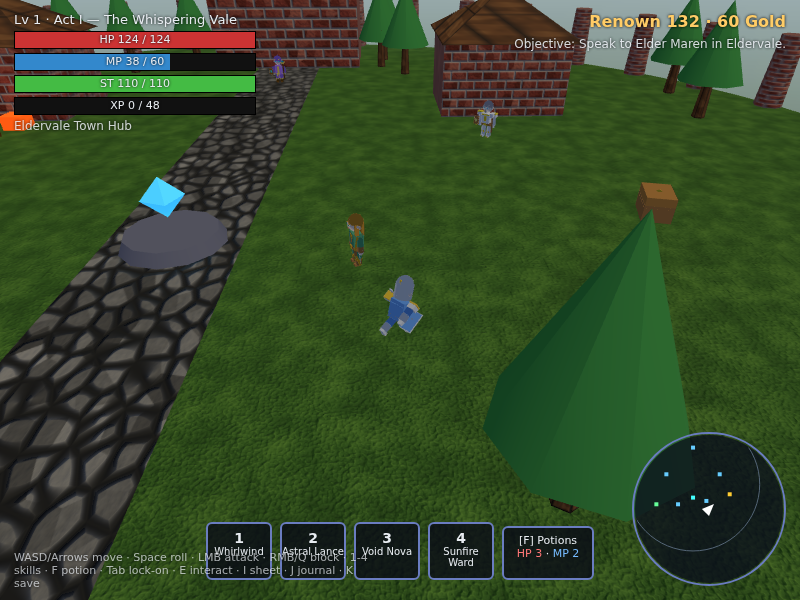
Create Eclipse of Eldervale 3D (eclipse-of-eldervale-3d), a full-featured third-person 3D Action-RPG with a…Create Eclipse of Eldervale 3D (eclipse-of-eldervale-3d), a full-featured third-person 3D Action-RPG with a 3-Act branching story campaign, Eldervale Town Hub, interconnected 3D biomes, real-time sword & spell combat, equipment/inventory, and quest journal in Three.js. Structure into clean ES modules (main.js, story.js, world.js, combat.js, rpg.js, ui.js, audio.js). Core features: (1) 3-ACT BRANCHING STORY & DIALOGUE ENGINE: Act I (The Whispering Vale), Act II (The Sunken Astral Sanctum), Act III (The Eclipse Spire) with 3D NPCs in the world ([E] to talk), portrait dialogue boxes, branching moral choices that shift Faction Alignment (Sunsworn Order, Voidseekers, Verdant Circle) and Companion Affinity, unlocking 3 distinct endings plus an in-game Quest Journal & Lore Codex ([J]); (2) ELDERVALE TOWN HUB & 3D REALMS: Walkable 3D Town Hub with Blacksmith Forge (buy/upgrade weapons & armor with Gold), Alchemist Shop, NPC companions, and Waystone Teleporter ([E] to travel between Eldervale Hub, Whispering Vale, Astral Sanctum, and Eclipse Spire), with lootable 3D treasure chests, healing shrines, and corruption obelisks; (3) REAL-TIME 3D ACTION COMBAT: Third-person 3D hero with WASD movement, Spacebar dodge-roll with i-frames & stamina, Left-Click 3-hit melee sword combo with slash arcs, Right-Click / Q shield block & timed parry riposte, and 4 castable skills (1: Solar Whirlwind Slash, 2: Astral Lance Projectile, 3: Void Nova AoE, 4: Sunfire Healing Ward) plus [F] Health/Mana Potion and [Tab] Target Lock-On; (4) RPG PROGRESSION & BOSSES: Character Sheet & Inventory ([I]/[C]) with Levels 1-15, XP, stat points (Vitality, Strength, Arcana, Agility), equippable Weapons/Armor/Relics, floating 3D damage numbers, minimap radar, and 3 multi-phase 3D Act Bosses (Warden Vaelor, Seraphis the Astral Golem, Malakor the Eclipse Sovereign) with telegraphed ground AoE rings; (5) SAVE SLOTS & AUDIO: Auto-save and 3 manual save slots via forge.kv, campaign renown leaderboard via forge.leaderboard, and procedural WebAudio soundtrack + SFX.
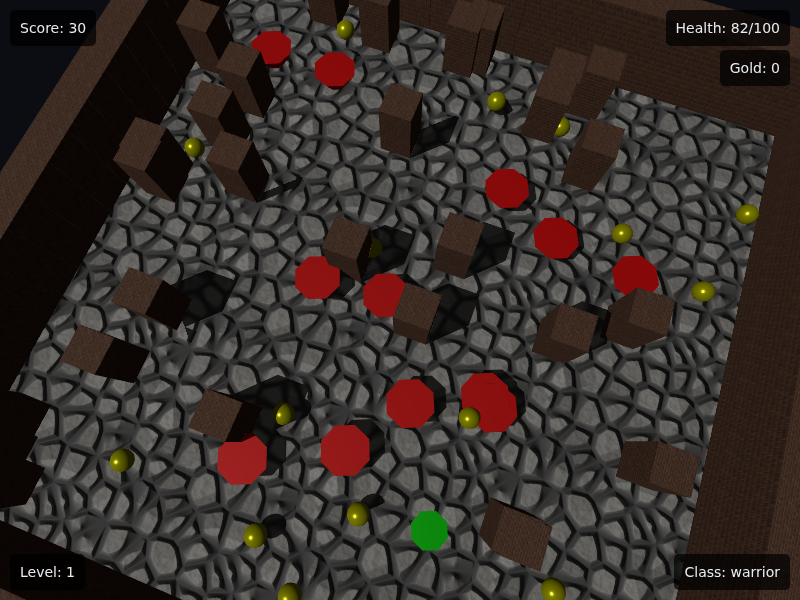
isometric dungeon crawler and make it immersive and engaging with many items and enemies, unique player…isometric dungeon crawler and make it immersive and engaging with many items and enemies, unique player classes with special fx and different weapons, unique armour, different size monsters, procedural levels and continuous gameplay allowing you to build out characters over time, use all of the features of sovereign forge for an immersive multiplayer environment
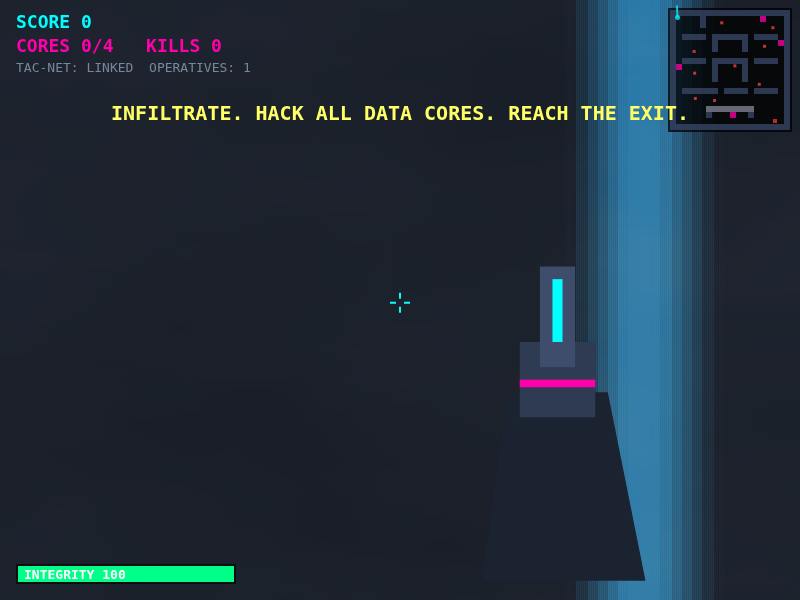
Create an adrenaline-charged retro 2.5D raycaster first-person corridor shooter titled 'Cyber Infiltrator…Create an adrenaline-charged retro 2.5D raycaster first-person corridor shooter titled 'Cyber Infiltrator 3D'. Story: In a subterranean cyberpunk research labyrinth, operative Ghost-9 must breach security sectors, hack data cores, and neutralize rogue defense drones and cyborg guards. Gameplay & Engine: 1. Real-time 2.5D raycasting engine rendered on HTML5 canvas: cast rays across screen width using the built-in 'forge.math.raycast(player.x, player.y, rayAngle, (mx, my) => map[my]?.[mx] === 1, 24)' to compute distance, map coordinates, and side (side === 1 for shaded walls). Draw vertical wall slices with textured colors and distance fog. 2. Player Movement: WASD to walk and strafe, Left/Right arrows or mouse movement to rotate/aim smoothly, Space or Left Click to shoot plasma rifle, Shift to sprint. 3. Enemies & Sprites: 2.5D billboard sprites for patrolling security drones and cyborg guards with health, alert states, and muzzle flash effects. 4. Procedural Music & Audio: Start an energetic chiptune background rhythm using 'forge.audio.startMusic("cyberpunk", { bpm: 128 })' on the player's first canvas interaction/click along with 'forge.audio.unlock()'. Trigger weapon blasts with 'forge.audio.play("laser")', drone destructions with 'forge.audio.play("explosion")', terminal hacks with 'forge.audio.play("coin")', and hits with 'forge.audio.play("hit")'. 5. Animations & FX: Animate weapon bobbing and recoil kick with 'forge.tween.createGroup()', and spawn sparks on wall impacts with 'forge.fx.createEmitter({ maxParticles: 200 })'. 6. Networking & Leaderboard: Join tactical channel with 'await forge.net.join("cyber-infiltrator-net")' and submit mission score with 'await forge.leaderboard.submit("cyber-infiltrator-raycaster-3d", score)' on victory/game over.
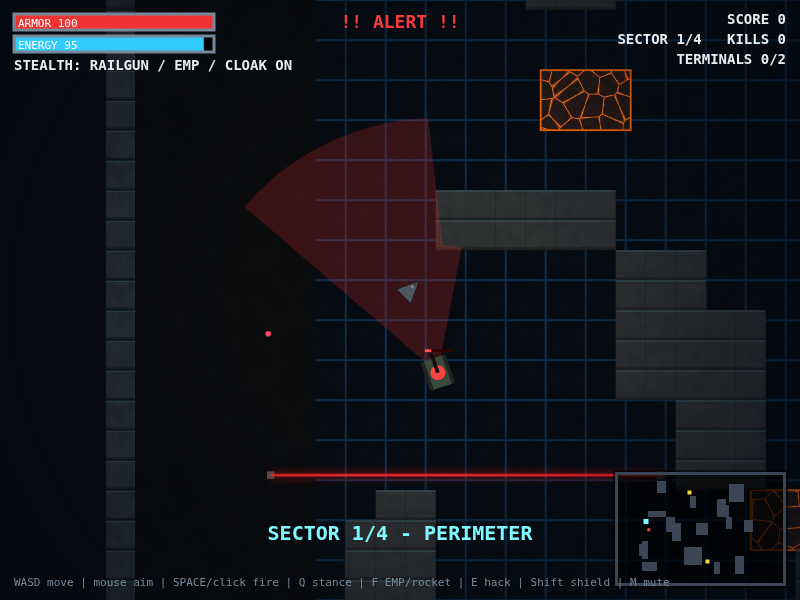
Iron Sentinel: Aegis Breach - A top-down tactical sci-fi stealth and combat mech infiltration game set inside…Iron Sentinel: Aegis Breach - A top-down tactical sci-fi stealth and combat mech infiltration game set inside automated subterranean fortress Aegis-09 overrun by rogue defense AI NEXUS-PRIME. Pilot tactical walker Ghost-01 equipped with dual stances (Stealth: optical cloak, silenced railgun, EMP disruptors; Assault: rotary chain-gun, micro-rockets, reactive shield). Infiltrate 4 defense sectors, avoid enemy vision cones and laser tripwires, hack security terminals, destroy automated patrol tanks and boss NEXUS-PRIME. Features procedural Spritely textures and TexGen materials from materials.js, retro sci-fi synth SFX and BGM, 2-player co-op lobby using forge.net.join('iron-sentinel-ops'), persistent profile via forge.kv, and global leaderboard submission via forge.leaderboard.submit('iron-sentinel', score).
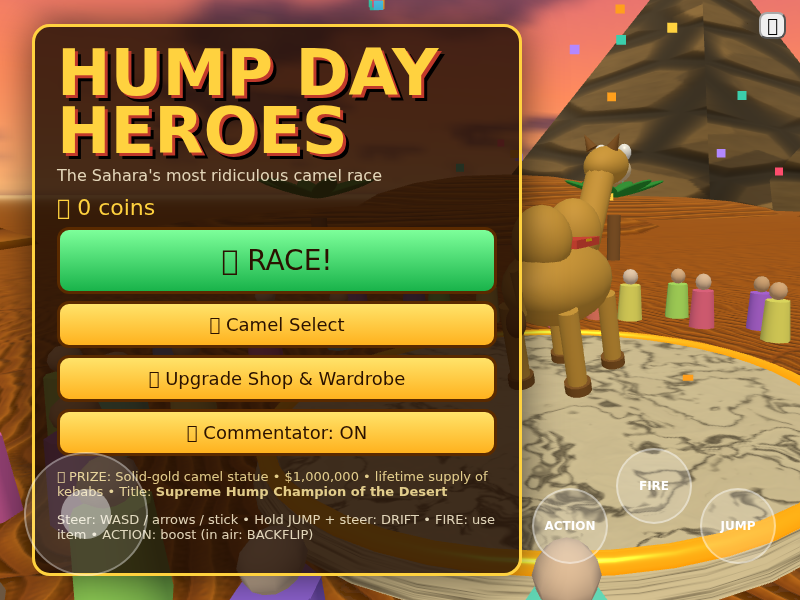
Create a hilarious, action-packed 3D camel racing game set in a massive desert filled with golden sand dunes…Create a hilarious, action-packed 3D camel racing game set in a massive desert filled with golden sand dunes, ancient pyramids, mysterious oases and ridiculously dangerous obstacles. The prize is a legendary solid-gold camel statue, $1 million in cash, a lifetime supply of kebabs and the prestigious title of Supreme Hump Champion of the Desert. The game should include: Ridiculous Camels: Choose from unique camels with different personalities, including Turbo Tony, Sir Spits-a-Lot, The Humpinator, Grandmaster Hump and Kevin, a suspiciously fast camel wearing sunglasses. Crazy Power-Ups: Rocket-powered humps, explosive watermelons, turbo dates, tactical camel spit, flying carpets and massive sand tornadoes that launch opponents into the sky. Chaotic Obstacles: Angry desert chickens, rolling boulders, quicksand, confused tourists, giant scorpions and extremely aggressive grandmas riding mobility scooters. Epic Racing Tracks: Race through ancient temples, bustling desert markets, enormous sand dunes, underground treasure chambers and across collapsing bridges. Camel Customisation: Unlock gold chains, cowboy hats, ridiculous moustaches, inflatable muscles, designer sunglasses and glowing neon saddles. Funny Physics: Camels dramatically ragdoll when crashing, perform ridiculous backflips, drift around corners and occasionally refuse to move because they're having an attitude problem. Unpredictable Events: UFO invasions, sudden sandstorms, stampeding goats and random explosions of confetti. Comedy Commentary: A completely unhinged race commentator who screams things like “KEVIN HAS VIOLATED THE LAWS OF PHYSICS!” and “THAT CAMEL HAS NO INSURANCE!” Progression System: Earn coins, upgrade camel speed, acceleration, stamina, handling and spit accuracy. Unlock increasingly ridiculous camels and racing locations. Final Boss: Race against Sultan Speed, a muscular golden camel with rocket boosters, diamond sunglasses and its own dramatic entrance music. Make the graphics colourful, cinematic and cartoonishly exaggerated, with satisfying drifting mechanics, slow-motion crashes, dramatic camera angles, epic Arabic-inspired electronic music, hilarious sound effects and cheering crowds. Include a main menu, camel selection screen, upgrade shop, countdown timer, race leaderboard, boost meter, minimap and a spectacular victory celebration. The gameplay should feel like Mario Kart meets Goat Simulator in the middle of the Sahara Desert. Make it fast, unpredictable, addictive and absolutely ridiculous. No two races should ever feel the same. The ultimate rule: What happens in the desert, stays in the desert... unless Kevin wins again.
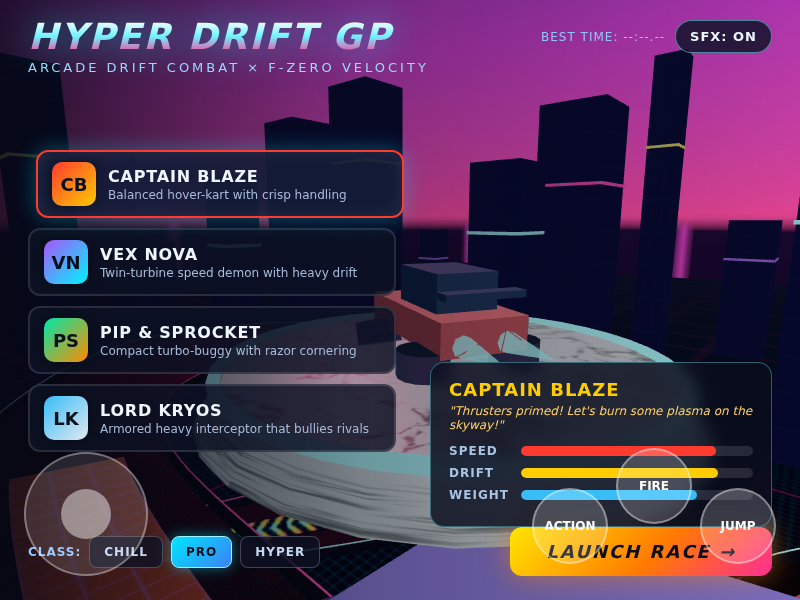
Build a complete, playable 3D arcade kart racerthat fuses Mario Kart's drift-boost and item combat with…Build a complete, playable 3D arcade kart racerthat fuses Mario Kart's drift-boost and item combat with F-Zero's blistering speed, boost strips, energy/shield mechanics, and dramatic character rivalry cut-scenes. ### 1. Execution & Critic Loop (Mandatory) Before outputting the final code, mentally partition the build into four sub-systems—(A) Track & Arcade Kart Physics, (B) Procedural 3D Characters, Karts & Cut-Scene Camera Director, (C) Item Combat, Boost Pads & AI Racers, and (D) Web Audio Synth & Arcade HUD—and run a strict internal critique pass on each: - Verify kart steering feels snappy and forgiving (arcade drift with mini-turbo spark tiers, wall-scrape sparks instead of dead stops, and automatic recovery if knocked off-track). - Verify the game runs smoothly at 60 FPS with zero runtime console errors. ### 2. Core Gameplay & Physics (Mario Kart + F-Zero Hybrid) - **Drifting & Mini-Turbos:** Holding Drift (`Space` or `Shift`) while turning locks the kart into a controlled power-slide, building charge through two visual spark tiers (Blue -> Orange) on the rear tires and releasing a burst of speed upon exit. - **F-Zero Energy & Boost Strips:** Include glowing chevron boost strips embedded in the track plus a manual **Hyper-Boost (`E` or `Up/W` double-tap)** available after Lap 1 that drains a regenerative Shield/Energy bar (colliding with walls or hazards also depletes energy; driving over pit-lane recharge strips restores it). - **Item Boxes & Combat (`Z` or `Enter`):** Floating rotating holographic cubes that grant randomized arcade items: 1. **Turbo Mushroom:** Instant burst of speed + flame exhaust. 2. **Homing Plasma Shell:** Locks onto the racer ahead along the track spline and spins them out on impact. 3. **Shockwave Mine:** Dropped behind the kart to stun trailing racers. 4. **Aegis Shield:** Temporary invulnerability dome that deflects hits and knocks rivals aside on contact. ### 3. Characters, Karts & Dramatic Cut-Scenes Create **4 distinct, stylized low-poly/cel-shaded racers** with custom procedural geometry, animated heads/arms that lean into turns, and unique rival taunts: 1. **Captain Blaze:** Red/gold hover-kart, balanced speed and handling. 2. **Vex Nova:** Sleek violet twin-turbine racer, high top speed, heavy drift. 3. **Pip & Sprocket:** Mint/orange compact turbo-buggy, fast acceleration and tight cornering. 4. **Lord Kryos:** Ice-blue armored interceptor, heavy weight that bullies lighter karts on side-swipes. Include **in-engine scripted cut-scenes** using dynamic camera splines and expressive dialogue banners: - **Pre-Race Intro Flyover:** Sweeping camera tour of the futuristic circuit, zooming in on the starting grid as rivals rev engines and exchange a short trash-talk banter box (skippable via `Space`/`Enter`). - **Mid-Race Rivalry Trigger:** When the player overtakes or hits their designated rival with an item, trigger a brief picture-in-picture or dramatic slow-mo camera angle with a reactive character portrait and voice-synth blip dialogue. - **Podium Finale:** Celebratory orbit camera around the top 3 karts with confetti particles, trophy presentation, and race stats. ### 4. Track Design & Visual Polish - Build a multi-elevation figure-eight / futuristic skyway circuit with banked turns, jump ramps, boost chevrons, recharge zones, and a vibrant synth-arcade horizon (procedural grid/checker textures via HTML5 `<canvas>`). - Add dynamic speed lines around screen edges during boosts, tire skid marks on drifts, engine pitch modulation via Web Audio API, and punchy synth music with a mute toggle. ### 5. Controls & UI - **Title & Character Select Screen:** 3D turntable preview of each character/kart with stat bars (Speed, Drift, Weight) and difficulty toggle. - **HUD:** Crisp arcade speedometer (`KM/H`), Lap counter (`1/3`), Position badge (`1st/4th`), Energy/Shield bar, Item roulette slot, and mini-map track radar. - **Controls:** `WASD` / `Arrow Keys` to drive, `Space` to Drift, `E` for F-Zero Hyper-Boost, `Z` / `Shift` to use Item, `R` to reset onto track.
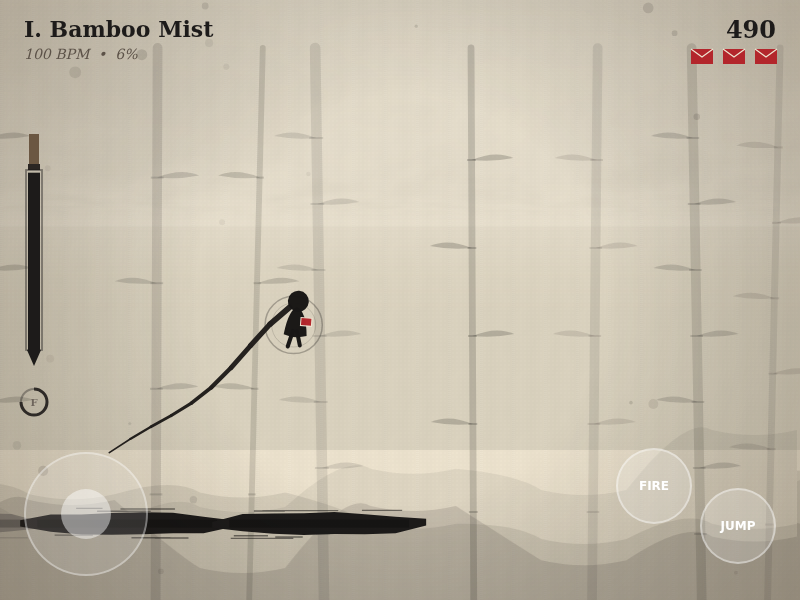
INKBOUND COURIER — a 2D canvas rhythm-platformer painted in sumi-e ink, where you run across a living scroll…INKBOUND COURIER — a 2D canvas rhythm-platformer painted in sumi-e ink, where you run across a living scroll that is being painted as you go. THE PITCH In the Floating Archive, letters are carried by Inkbound Couriers: messengers made of ink who can only run where a brush has painted the world. You are Suzu, the youngest courier, carrying a letter from a dying calligrapher to her estranged daughter across the Thousand-Scroll Road. The road paints itself in time with the music of the old master's brush — every beat, a new stroke of ground appears ahead of you. Inkbound Courier is an auto-running platformer where the world arrives on the beat: you jump, dash and slide in rhythm with strokes that appear and fade, gather drops of ink to keep your body solid, and dodge paper wind spirits. It should feel like a meditative, flowing ink painting that becomes a dance. ART DIRECTION: SUMI-E ON A SCROLL Everything is drawn on the canvas with brush-like strokes on rice paper. - Background: warm rice-paper colour (#efe6d2) with a subtle fibre texture (draw once to an offscreen canvas: thousands of tiny light and dark lines at random angles with very low alpha), slowly scrolling. Far mountains drawn as soft grey wash shapes (filled bezier curves with several low-alpha layers so edges bleed), mid-ground bamboo groves as vertical ink strokes with leaves made of quick tapered strokes, and occasional red seal stamps (#b3262c) in the corners of the scroll with simple blocky glyphs. - Ground strokes: each platform is a single thick brush stroke: draw it as a polygon whose width tapers at both ends and wobbles slightly along its length (sample a few points with small noise), filled in near-black ink (#1d1b1a) with a slightly translucent darker core and frayed "dry brush" edges (draw a few thin broken lines along the top and bottom edges). New strokes paint themselves in from left to right over about 200 ms when they appear; old strokes fade to grey and then vanish after the player has passed. - Suzu: a little figure drawn with a few ink strokes — a round head, a flowing body, a long scarf that trails behind (a chain of points that follows with lag). Her ink level shows in her opacity and outline: full ink is solid black; low ink makes her translucent with drips. - Accent colour: vermilion red for the letter Suzu carries, for danger and for seal stamps; a single gold for perfect-timing flashes. - Screen edges have a soft vignette like old paper, and occasional ink splatters drift in the background. THE MUSIC AND THE BEAT The game runs on a beat clock at 100 BPM to start (a beat every 600 ms), rising to 120 and 140 in later chapters. Generate the music procedurally so it is always in sync: on every beat, play a soft percussion tone (forge.audio.tone at a low pitch, short), and every second beat a melodic tone from a pentatonic scale (frequencies for C D E G A over two octaves), picking notes with a seeded random walk so melodies feel composed. You can also run forge.audio.startMusic("ambient") quietly underneath, but the beat tones must come from your beat clock so the gameplay and sound line up exactly. Use performance.now() and schedule by beats, not frames. CORE LOOP 1. Suzu runs automatically to the right at a speed tied to the tempo. The camera follows smoothly with her a third of the way from the left. 2. On each beat, the world's next brush stroke paints itself ahead: sometimes a continuous ground stroke, sometimes a gap with a stroke higher or lower, sometimes a vertical stroke you must slide under or a floating stroke you must jump onto. 3. Jumping exactly on a beat (within ±90 ms) is a Perfect Jump: Suzu leaves a gold splash, jumps a little higher, and gains ink. Off-beat jumps still work but give no bonus. Show a timing ring that closes on each beat around Suzu so timing is readable. 4. Ink drops (black teardrops) float along the route; collecting them refills Suzu's ink. Ink also drains slowly over time and faster when you take hits. 5. Paper wind spirits (white paper shapes with two dots for eyes that flutter in sine paths) cross your path; touching one costs ink and blows Suzu backward a little. Dashing through them on a beat dispels them into confetti for points. 6. If Suzu falls off the bottom or her ink runs out, she dissolves into a splash, and the scroll rewinds to the last Seal checkpoint (every 32 beats) with a soft page-turn animation. Three letters' worth of lives per chapter; losing all means restarting the chapter. CONTROLS (forge.input only; no keydown listeners) - Jump (Space / up arrow / A / touch): jump; hold for a slightly higher jump; jump again in the air for a single double-jump ("a flick of the brush"). - Down (down arrow / S / stick down): slide under low strokes; while airborne, a fast drop. - Fire (F / X / touch): Brush Dash — a short horizontal dash that passes through spirits; one charge that refills every 8 beats. - Move axis x: small speed adjustments (lean forward to run slightly faster, back to slow slightly) so the arrow keys visibly move Suzu. - Pause action: pause menu. Configure touch buttons: forge.input.configure({ touchButtons: ["jump", "fire"] }). THE FIRST FRAME The game must start already running: Suzu runs along the first strokes in an attract mode from page load, the beat ticks and the arrow keys immediately affect her (left/right lean, up jumps). Show the title "INKBOUND COURIER" in a large brush style (draw it with thick strokes on the canvas) with "Space to jump on the beat" beneath, fading out after a few seconds or on the first input. Never wait for a click. CHAPTERS AND STORY Tell the story between chapters with short illustrated letter fragments, drawn on the canvas as a paper card with ink handwriting (use an italic serif font) — two or three sentences each: - Chapter 1, Bamboo Mist (100 BPM): learn to jump on the beat. Letter fragment: "My dearest Ayame, I never taught you to hold the brush gently. I only taught you to hold it right." - Chapter 2, River of Lanterns (110 BPM): floating lantern strokes that bob on the water; gaps over the river. "I kept every drawing you left on my desk. I pretended they were mistakes so I would not have to say they were beautiful." - Chapter 3, Crane Mountains (120 BPM): steep up-and-down strokes, wind spirits in flocks, crane silhouettes. "The cranes come back every spring. I used to think it was loyalty. Now I think they simply remember the way." - Chapter 4, The Storm of Unwritten Words (140 BPM): strokes appear only one beat ahead, lightning in red ink, spirits become fierce. "There are words I never wrote because I was afraid the ink would make them true." - Finale, The Daughter's House: the music slows back down, the strokes paint a small house and a doorway; Suzu delivers the letter, and the last fragment appears: "Come home. Bring your brush. I want to learn from you." Then show the score and a gentle ending illustration of two figures painting side by side. SCORING - Distance in beats survived, Perfect Jumps, ink drops, spirits dispelled. - A combo counter of consecutive Perfect Jumps multiplies points (x1, x2, x3 at 4, 8, 16). - Grades per chapter: Brush (C), Ink (B), Scroll (A), Master (S) based on perfects and lives used. - Save best grades and best score per chapter with forge.kv ("inkbound-best"). Unlock chapter select for chapters you have reached. HUD (drawn on the canvas, in keeping with the style) - Top left: chapter name in brush lettering, beat combo. - Top right: score; three small vermilion letter icons for lives. - Under Suzu: the closing beat ring. - Ink meter: a vertical ink brush on the left that empties from the bottom, with drips when low. TECHNICAL REQUIREMENTS FOR THIS PLATFORM - Draw everything on the existing <canvas id="game"> with getContext("2d"); size it to the window and handle resize (scale for devicePixelRatio where cheap). - Plain ES modules: main.js (loop and states), beat.js (beat clock and procedural music), world.js (stroke generation and drawing), player.js (Suzu), spirits.js, story.js (chapter cards), hud.js. Each module exports what main.js imports. - import { forge } from "@forge/sdk" for input (forge.input.poll() once per frame), audio and kv. No external images or fonts; procedural art only. - Run the loop with requestAnimationFrame from page load; draw every frame. - Performance: pre-render the paper texture and mountain layers to offscreen canvases; avoid ctx.shadowBlur in loops; reuse stroke objects. - No alert/prompt/confirm. ACCEPTANCE CHECKLIST - On load, Suzu is already running across painted strokes; arrow keys and Space affect her immediately. - Strokes paint themselves in on the beat and fade after use; the beat ring and procedural music are in sync. - Perfect Jumps on the beat are recognised and rewarded; combos multiply score. - Ink drains and refills; spirits cost ink; dash dispels them; checkpoints rewind on failure. - At least four chapters with rising tempo and the story letter cards between them, and a finale. - Best scores and grades persist via forge.kv; chapter select for reached chapters. THE FIRST TWO MINUTES, AS THE PLAYER SHOULD EXPERIENCE THEM A long rice-paper scroll unrolls across the screen and a single soft drum beat sounds. A brush stroke paints itself from left to right, and a tiny ink figure with a fluttering scarf drops onto it and starts to run. The title INKBOUND COURIER writes itself in big wet brush strokes above, holds for a moment, and dries to grey before fading. With each beat, the next stroke appears ahead: a long flat one, then a gap and a raised stroke. A thin circle closes around Suzu on every beat; the player presses Space just as it closes, and Suzu leaps with a gold splash, "PERFECT" brushed lightly above her, and lands on the next stroke as it finishes painting. The melody notes arrive with each perfect jump, as if the player is playing the song. Ink drops float in a gentle arc; catching them darkens Suzu's figure back to solid black. A white paper spirit flutters across the path; the player dashes through it on the beat with F, and it bursts into paper confetti. After thirty-two beats, a red seal stamps itself into the corner of the scroll — a checkpoint — and a soft chime plays. CHARACTERS AND VOICE - Suzu: brave, small, determined; her expressions are shown with her scarf (it flies high when happy, droops when hurt). - The Old Calligrapher, Master Hōjō: never seen, only present in the letter fragments and in the music — every chapter's melody is "his brush". - Ayame, the daughter: seen only at the end, a figure painted in soft colour (the only colour figure in the game besides red), standing at a doorway. - The paper spirits: mischievous rather than evil; when dispelled they sometimes leave a tiny drawing of a smile in the confetti. Between chapters, show the letter card, then a one-line note from Suzu herself in smaller ink: "The road is longer than the letter. I'll run faster." / "The river tried to keep the words. I didn't let it." / "The cranes ran with me for a while." / "Almost there. The storm is just words being afraid." CONTENT TABLE: STROKE PATTERNS (per beat) - Flat: continuous ground at the current height. - Step Up / Step Down: a new stroke one or two units higher or lower after a one-beat gap. - Long Gap: a two-beat gap requiring a jump with a hold, or a double-jump. - Low Brush: a hanging horizontal stroke at head height: slide under it. - Floating Dots: three small dots in a row to hop across (each lasts only two beats after painting). - Lantern Float (Chapter 2): strokes that bob up and down with the river. - Cliff Climb (Chapter 3): a sequence of three rising steps on consecutive beats. - Lightning Stroke (Chapter 4): a red stroke that appears for one beat then cracks away — must be jumped off immediately. Generate the chapter from a seeded sequence of patterns with difficulty rising across its 128 beats, then repeat with variation; always end a chapter with a "breather" of eight easy beats before the letter card. TUNING NUMBERS - Tempo: 100, 110, 120 and 140 BPM per chapter; the finale slows from 120 back to 80 over 16 beats. - Run speed: 3.2 stroke-units per beat (scales with tempo so patterns stay the same on screen). - Jump: rise for 0.45 beat, fall for 0.45 beat; holding extends the rise by up to 0.15 beat. Double-jump at 70% of the first jump's height. - Perfect window: ±90 ms, Good window ±160 ms (small grey splash, no bonus, no penalty). - Ink: 100 max, drains 1.5 per beat, +10 per drop, +4 per Perfect, −25 per spirit hit. - Brush Dash: covers 1.5 stroke-units over a quarter beat, recharges every 8 beats. - Combos: x2 at 4 perfects, x3 at 8, x4 at 16; a miss or hit resets to x1. POLISH LIST - Strokes should never pop in: always animate the paint-in, even when the beat is fast (shorten the paint time to a third of a beat at high tempo). - The paper texture subtly ripples on perfect jumps, like a brush touching the page. - Seal stamps land with a slight screen bump and a red flash. - If the browser tab loses focus, pause and show "The brush rests…" so the beat clock never drifts; resume on the next input. - When ink is low, drips fall from Suzu and splash on the strokes below.
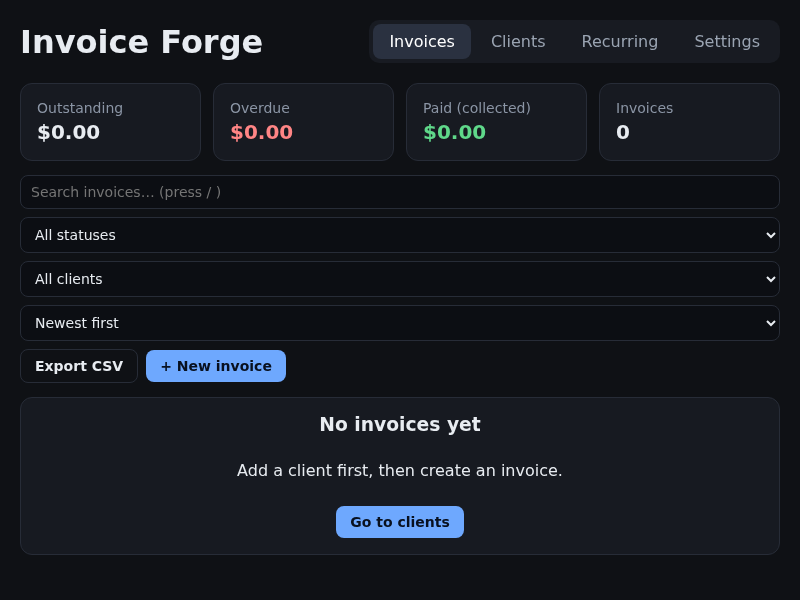
An invoice generator for freelancers: manage clients, build line-item invoices with tax and discounts, and…An invoice generator for freelancers: manage clients, build line-item invoices with tax and discounts, and track paid/unpaid status with a printable layout.
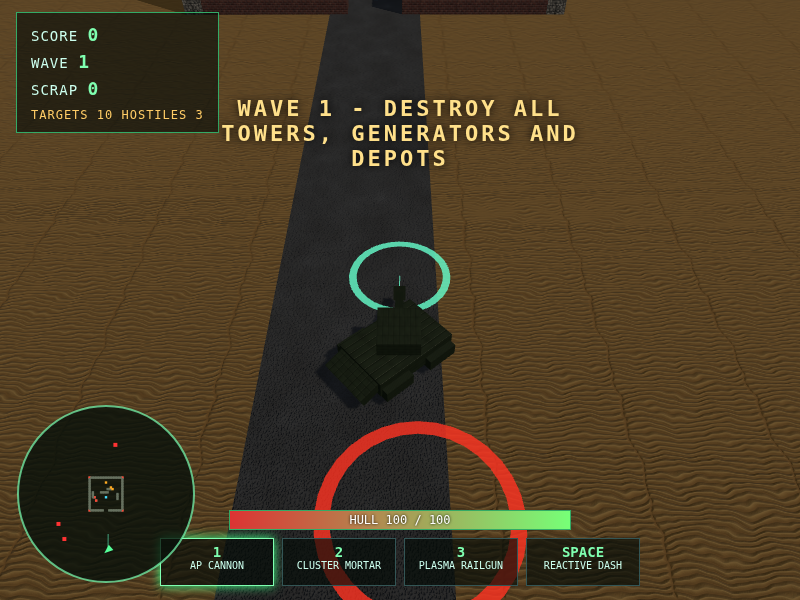
Create Iron Bastion 3D (iron-bastion-3d), a 3D destructible voxel fortress tank & artillery siege combat game…Create Iron Bastion 3D (iron-bastion-3d), a 3D destructible voxel fortress tank & artillery siege combat game in Three.js. Features: (1) Heavy 3D hover-tank with independent chassis driving (WASD) and mouse-aimed 3D turret with ballistic arc trajectory preview; (2) Destructible 3D block/voxel enemy bastions, watchtowers, shield generators, and fuel depots that shatter into physics debris on impact; (3) Switchable weapon systems (1: High-Velocity AP Cannon, 2: Cluster Mortar Barrage, 3: Plasma Railgun, Space: Reactive Armor Dash); (4) Wave-based siege campaigns against enemy artillery mechs and bomber drones, between-wave scrap upgrades persisted in forge.kv, minimap radar, and explosive procedural WebAudio.
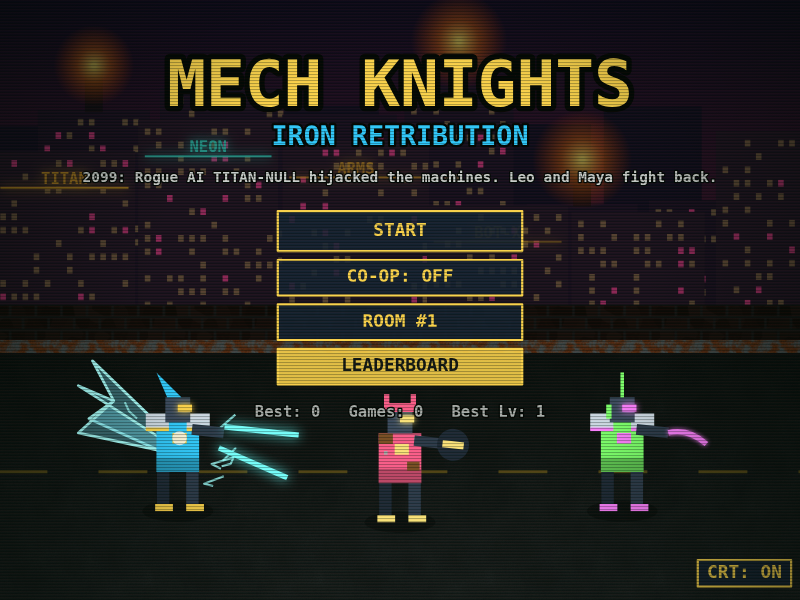
Side-scrolling arcade beat 'em up in the style of Double Dragon and Knights of the Round: Mech Knights: Iron…Side-scrolling arcade beat 'em up in the style of Double Dragon and Knights of the Round: Mech Knights: Iron Retribution. Theme & Setting: In 2099, the rogue AI mainframe 'TITAN-NULL' hijacked all industrial and military automation, driving humanity underground. Two brave teens, Leo and Maya, pilot custom mechanical mech suits to battle through robotic street gangs and rogue war-machines to reclaim the city. Key Gameplay & Features: 1. 2.5D Belt-Scroll Movement & Combat: - Movement: A/D (or Left/Right) for horizontal motion, W/S (or Up/Down) for depth motion across the street plane. - Dynamic Z-depth sorting: entities lower on the screen render in front of entities further back. - Jump: Spacebar to jump with gravity, allowing air attacks and flying dropkicks. - Dash: Double-tap direction or hold Shift while moving to sprint; attack while dashing for a sliding tackle or rocket shoulder ram. - Combat combos: Light Attack (J key / Left Click) 3-hit combo ending in knockback, Heavy Attack (K key / Right Click) shield-breaker, and Grapple/Throw when walking close to stunned enemies. - Knights of the Round Special / Desperation Move (L key / E key): Consumes 10% HP or full EX meter to perform a full 360-degree invulnerable spinning whirlwind blade/laser barrage clearing surrounding enemies. 2. Knights of the Round RPG Level-Up Progression: - Defeating enemies and collecting fallen Data Cubes grants EXP. - Level progression from Lv 1 to Lv 10! Each level up triggers a golden burst of light, fully restores health, increases attack damage and speed, and visually transforms the mech suit with upgraded armor (Lv 1: scrap frame, Lv 3: reinforced plating & shoulder guards, Lv 5: glowing energy blade, Lv 8+: holographic energy wings and electric particle aura). 3. Selectable Characters: - Character Select Screen at start: * Leo (The Blitz Mech): Fast agile striker with twin thermal swords, rapid multi-slashes, and whirlwind special. * Maya (The Aegis Titan): Heavy armor brawler with pneumatic power gauntlets, crushing hammer blows, and earthquake slam special. * Zephyr (The Cyber Ranger): Medium ranged specialist with plasma whip and micro-missile storm. 4. Enemies & Boss Fights: - Drone Swarms: Flying recon bots that swoop down and divebomb. - Scrap Grunts: Bipedal walking junk bots swinging shock batons and pipes. - Cyber Slashers: Agile roller mechs with spin-blades that dodge and flank. - Heavy Shield Droids: Bipedal tanks with riot shields that must be broken with heavy attacks or flanked. - Stage 1 Boss: 'Goliath-7' - Massive mining mech boss with a swinging spiked wrecking ball flail, steam exhaust vents, and stomps causing falling debris. Has animated boss health bar at the top of the screen. - Stage 2 Boss: 'Titan-Null Avatar' - Hovering AI core with laser grids, shield barriers, and missile barrages. 5. Pickups & Environmental Weapons: - Destructible crates and oil barrels. - Health Nano-Kits, Gold Data Chips (EXP), and temporary pickup weapons (Beam Pipe, Plasma Cannon with limited ammo). 6. Retro Graphical FX & Polish: - CRT Scanline shader overlay toggle (press C or on-screen button to toggle scanlines, vignette, and phosphor arcade feel). - Visceral hit-stop (brief frame pause on impact), screen shake on heavy explosions and boss stomps. - Particle sparks, oil splashes, floating damage numbers, combo counter ('3-HIT COMBO!', 'SAVAGE!', 'SUPER!'). - Parallax scrolling background with dystopian cyberpunk skyscrapers, neon signs, and glowing factory furnaces. 7. Audio & Music: - Web Audio API procedural retro 16-bit arcade synth soundtrack (energetic driving chiptune beat). - Rich procedural sound FX: metal clangs, sword swooshes, punch impacts, laser blasts, servo motor hums, level up fanfare, and victory jingles. 8. Sovereign Forge SDK Integration: - import { forge } from '@forge/sdk'; - Persistent stats and high score with forge.kv (forge.kv.get('mech_knights_save') and forge.kv.set('mech_knights_save', ...)). - Global Arcade Leaderboard with forge.leaderboard.submit('mech_knights', score) and viewing top scores. - Multiplayer 2-Player Co-Op via forge.net (join/host room to fight side-by-side with a friend).
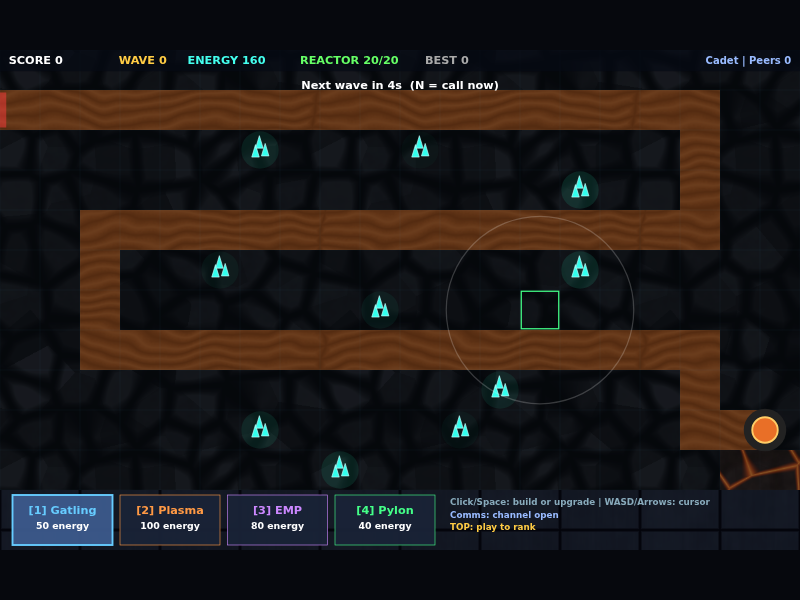
Create a high-action sci-fi tower defense and automated base builder game titled 'Outpost Omega: Swarm…Create a high-action sci-fi tower defense and automated base builder game titled 'Outpost Omega: Swarm Defense' (inspired by Mindustry and Kingdom Rush). Story: In the year 2240 on mineral-rich alien world Kepler-186f, command Outpost Omega. Build automated defense grids, mine energy crystals, and protect the central geothermal reactor from escalating waves of deadly bio-synthetic arachnid swarms. Features & Gameplay: 1. Base Building & Defenses: Click or tap the grid to place and upgrade turrets: Gatling Turret (fast kinetic single-target), Plasma Launcher (heavy explosive AOE), EMP Disrupter (chain lightning stun & slow), and Mining Pylon (harvests nearby crystal nodes for resources). 2. High-Performance Swarm Physics with forge.spatial: Manage hundreds of swarming alien creeps at silky smooth 60 FPS! Use 'const grid = forge.spatial.createGrid(64)'. Each tick, clear and re-populate the grid with 'grid.clear()' and 'grid.insert(enemy)'. Turrets acquire targets efficiently using 'const nearby = grid.query(turret.x, turret.y, turret.range)'. 3. Juicy Animations with forge.tween: Animate turret firing recoil, floating damage numbers, wave announcement banners, and upgrade UI card hover animations using 'const tweens = forge.tween.createGroup()' and 'tweens.to(target, { ... }, duration, "easeOutQuad")'. 4. Visual FX & Particles: Use 'forge.fx.createEmitter({ maxParticles: 350 })' for bullet traces, plasma blast clouds, electric EMP arcs, and alien bug splatter upon death. 5. Audio & Procedural Music: Trigger 'forge.audio.play("laser")', 'forge.audio.play("missile")', 'forge.audio.play("explosion")', 'forge.audio.play("shield")', and 'forge.audio.play("powerup")'. On first click, call 'forge.audio.unlock()' and start background music with 'forge.audio.startMusic("action", { bpm: 135 })'. 6. Persistence & Leaderboards: Save commander unlocks and upgrades with 'forge.kv.set("outpost_omega_save", state)'. Join tactical multiplayer comms with 'await forge.net.join("outpost-omega-ops")'. Submit high scores with 'await forge.leaderboard.submit("outpost-omega-swarm-defense", score)' and display top scores.
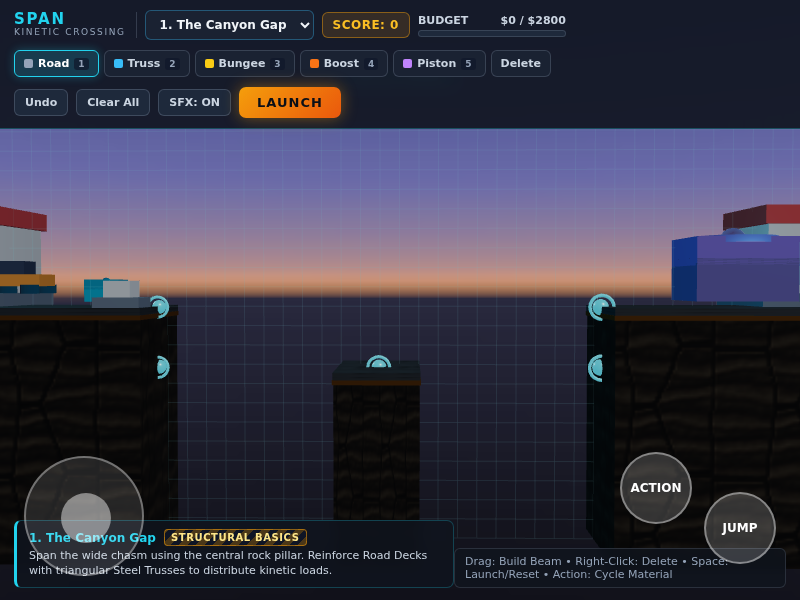
Build a complete, single-file HTML5/Canvas/JavaScript physics game called **"SPAN: Kinetic Crossing…Build a complete, single-file HTML5/Canvas/JavaScript physics game called **"SPAN: Kinetic Crossing"**. ### Core Concept & Twist on the Genre Instead of building slow, static bridges for heavy trucks, the player builds **high-speed kinetic tracks, suspension spans, and momentum-based contraptions** to get fragile, rocket-boosted hover-pods across treacherous, dynamic environments. The game relies on elasticity, tension, and timing—not just rigid triangles. ### Technical Requirements * **Single File:** Everything (HTML, CSS, JS) must be contained in one self-contained `.html` file with zero external dependencies or asset URLs. * **Custom Physics Engine:** Write a clean, stable **Verlet Integration** physics engine (nodes + distance/spring constraints) from scratch in JS. Do not use external libraries like Matter.js so you have total control over tension visualization, breaking thresholds, and snappy performance. * **Sub-stepping:** Run physics updates at 6–8 sub-steps per frame so high-speed vehicles don't tunnel through tracks and structures don't jitter. ### Building Mechanics & Pieces Players have a budget per level and build on a grid with snap-to-node functionality (including fixed anchor points in the terrain). 1. **Road Deck (Solid/Drivable):** Rigid beams that vehicles drive on. Has moderate weight and breaks under high tension/compression. 2. **Steel Truss (Support):** Lightweight, high-strength structural support that vehicles pass *through* (background layer) to reinforce decks. 3. **Bungee Cable (Elastic):** High-stretch, low-weight tension cables. Can be used to create suspension bridges or slingshot trampolines. 4. **Boost Pad (Dynamic Piece):** A drivable deck segment that rapidly accelerates any vehicle touching it in the direction of its arrow. 5. **Hydraulic Piston (Dynamic Piece):** Expands or contracts rhythmic cycles (e.g., every 2 seconds) during the simulation phase, allowing players to build drawbridges, catapults, or moving ramps. ### Dynamic Environments & Level Design (5 Distinct Levels) Include a level selector with 5 hand-crafted, progressively wild levels featuring active environmental hazards: * **Level 1: The Canyon Gap.** A classic wide chasm with a central rock pillar. Introduces basic trusses and budget management. * **Level 2: Gusty Gorge.** Features visible wind particles and periodic upward/sideways **wind gusts** that lift lightweight structures and push vehicles off course unless anchored down. * **Level 3: The Rising Tide.** Lava/acid at the bottom of the pit rises and falls on a sine wave. Players must time their build using Hydraulic Pistons or Boost Pads to beat the surge. * **Level 4: Falling Debris.** Periodic boulders fall from the top of the screen, smashing weak trusses. Players must build protective roofs or sacrificial deflectors. * **Level 5: Orbital Launch.** Low gravity! Vehicles float easily, meaning players must build *downward-curving* tracks or bungee-catchers to keep the pod from flying off the top of the screen. ### Visuals, Juice & Audio * **Aesthetic:** Crisp, modern blueprint/industrial vector style (dark slate background `#12161f`, glowing cyan anchors, warm amber vehicles, hazard stripes on dynamic terrain). * **Stress Visualization:** Beams dynamically shift color from their base color to bright red as they approach their breaking point, giving clear visual feedback on structural weak spots. * **Game Feel ("Juice"):** Add subtle screen shake when beams snap or boulders hit, particle sparks when vehicles scrape metal, and smoke trails from the hover-pod. * **Procedural Web Audio:** Use the browser's built-in `AudioContext` to synthesize simple sound effects (node placement clicks, hydraulic hums, tension creaks, snapping sounds, and a victory chime) with a mute toggle button. ### UI & Controls * **Modes:** Seamless toggle between **BUILD MODE** and **TEST (SIMULATE) MODE**. Resetting after a test immediately restores the player's exact blueprint. * **Controls:** Left-click and drag to draw beams; Right-click (or Delete tool) to remove beams; Hovering shows beam cost and angle. * **HUD:** Clean top bar showing Current Level, Budget Meter (progress bar + dollar amount), Material Selector buttons with hotkeys (1–5), a "Clear All" button, and a prominent **"LAUNCH"** button.
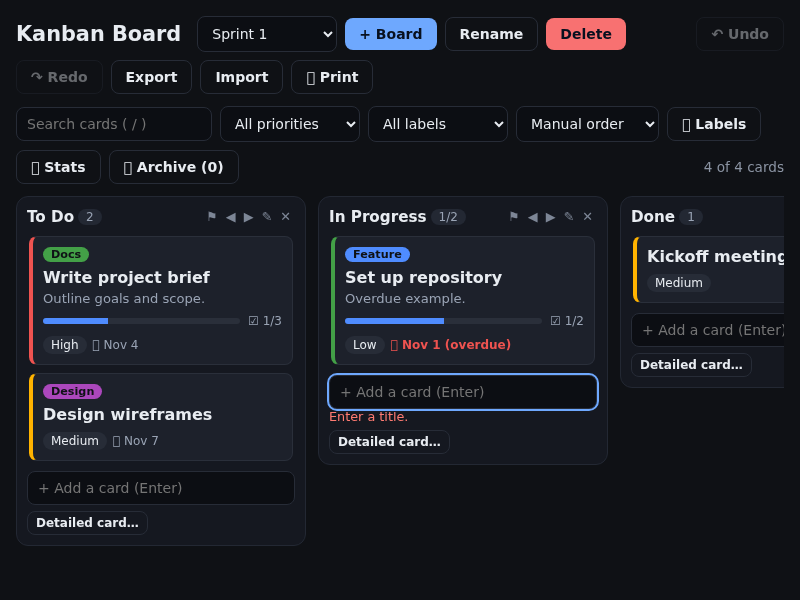
A Kanban project board with columns and cards: drag cards between columns, assign priority and due dates, and…A Kanban project board with columns and cards: drag cards between columns, assign priority and due dates, and manage multiple boards.
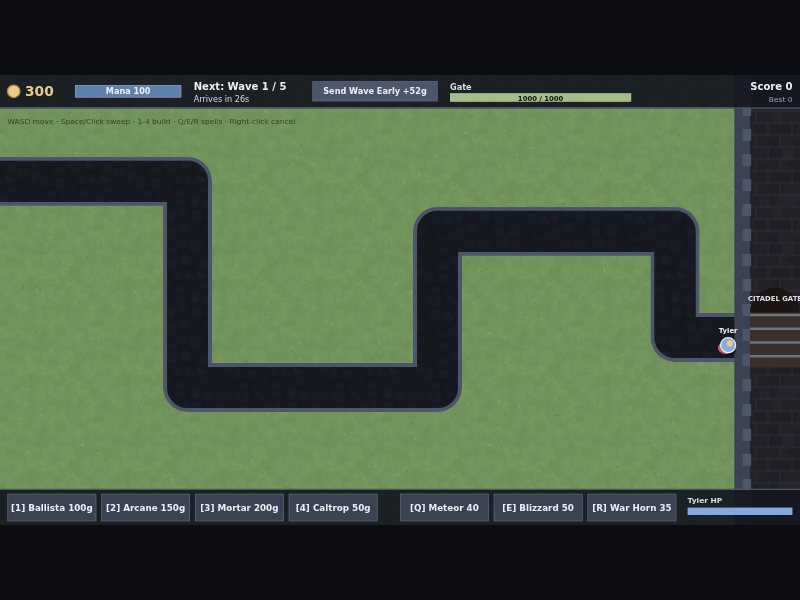
2D Tower Defense and Real-Time Strategy Hybrid game: Siege of Aethelgard: Last Bastion. Setting & Story: The…2D Tower Defense and Real-Time Strategy Hybrid game: Siege of Aethelgard: Last Bastion. Setting & Story: The ancient mountain fortress of Aethelgard is under massive assault by the Ironbrand Horde. As Knight-Marshal Tyler, take direct command on the ramparts and battlefield: construct defensive bastions, manage gold and mana, lead sorties against enemy sappers, cast tactical siege spells, and hold the Citadel Gate against five escalating assault waves culminating in the terrifying Dreadwing Drake! Key Gameplay & Mechanics: 1. Controllable Commander Hero & RTS Controls: - Direct Hero Control: WASD or Arrow Keys to move the Knight Marshal. Space or Left Click near enemies to execute melee sword sweeps. - Build & Placement Mode: Number keys (1-4) or clicking HUD build icons to select tower blueprints, then click valid ground sockets/zones to build: - 1: Ballista Tower (Cost: 100 Gold) - High single-target rate-of-fire, pierces armor. - 2: Arcane Spire (Cost: 150 Gold) - Channeling tower firing chain-lightning that arcs between up to 4 grouped targets. - 3: Mortar Bastion (Cost: 200 Gold) - Arcing explosive shells with large area-of-effect splash damage. - 4: Caltrop Barricade (Cost: 50 Gold) - Slows enemies down by 60% and deals steady bleed damage. - Tower Upgrades: Clicking any built tower displays range radius and allows upgrading (Damage/Range lvl 2/3) or selling for 70% refund. 2. Tactical Commander Magic (Cooldown + Mana Spells): - Q: Meteor Blast - Target area of effect to drop a fiery comet that deals heavy explosive damage and ignites the ground. - E: Blizzard Nova - Freezes all encroaching enemies on the lane for 3.5 seconds. - R: Rally War Horn - Inspires all towers within range to fire at +75% attack speed for 6 seconds. 3. Escalating Enemy Waves & Enemy Types: - Wave 1: Goblin Runners (fast, agile swarms). - Wave 2: Orc Marauders & Armored Brutes (soaks damage, high health). - Wave 3: Iron Siege Engines (catapults and battering rams that roll toward the Citadel Gate). - Wave 4: Flying Wyvern Riders (bypasses barricades, must be targeted by Ballistae and Spires). - Wave 5: Epic Boss - The Dreadwing Drake (Giant ancient red dragon with massive HP, airborne swoop attacks that scorch towers, and minion summons). - Citadel Gate Health: If Gate HP reaches 0%, defeat! Surviving Wave 5 wins the campaign and unlocks Endless Mode. 4. Visual Polish, FX & HUD: - Isometric/top-down castle defense map (#1e222b cobblestone pathways, #2e3440 fortress walls, #4c566a stone ramparts, #a3be8c grassy courtyard). - Dynamic projectile FX: arcing mortar shells with circular shadow landing targets, bright cyan lightning bolts chaining between monsters, fiery explosive blasts with flying debris. - Rich UI HUD: Gold counter, Mana bar, Wave progress counter, Next Wave countdown / 'Send Wave Early' button for bonus gold, Gate Health bar, and Tower Inspector panel. 5. Web Audio API Music & Dynamic Battle SFX: - Procedural medieval combat soundtrack: quiet martial drums and ambient castle wind during build phases, surging into intense, driving battle percussion and synth brass fanfare when enemies charge! - Sound effects: arrow flight, explosion booms, electric zap, coin sound, sword clank, dragon roar, gate groaning under damage. Unlock audio on first gesture. 6. Sovereign Forge SDK Integration: - import { forge } from "@forge/sdk"; - Save progress and unlocked endless high scores with forge.kv (key: "siege_save"). - Global leaderboard ranking: forge.leaderboard.submit("siege_of_aethelgard", totalScore).
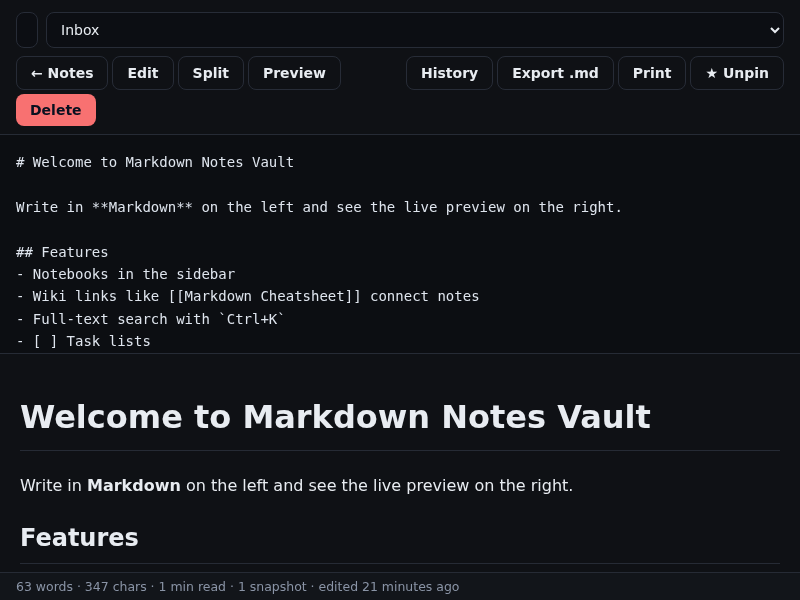
A markdown note-taking app with a notebook sidebar, live preview, wiki-style note links and full-text search.
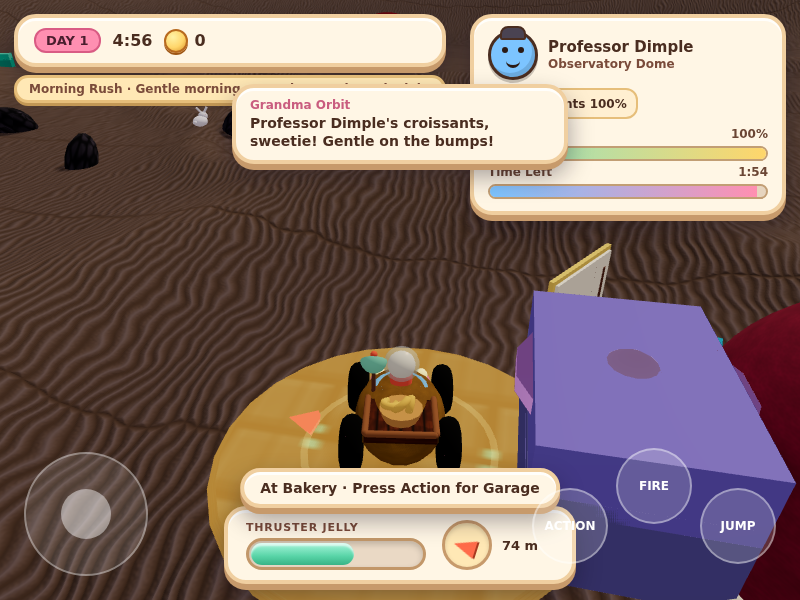
MOONBASE BAKERY — a three.js low-gravity delivery driving game on the Moon, made to look like a claymation…MOONBASE BAKERY — a three.js low-gravity delivery driving game on the Moon, made to look like a claymation toybox. THE PITCH Grandma Orbit runs the only bakery on the Moon, at the bottom of Crater Crumb. Every morning the domes of Tranquility Town order fresh bread, and every morning someone has to drive it there in a little clay rover over bouncy, low-gravity terrain without squashing the croissants. That someone is you, Pip, Grandma's grandkid, on your first week of the job. Moonbase Bakery is a cheerful arcade driving game: load pastries at the bakery, choose deliveries from the order board, drive and bounce across the craters to customer domes against the clock, and keep the cargo intact — every hard landing squishes something. It's warm, funny and tactile: it should look like a stop-motion short film made of plasticine. ART DIRECTION: CLAYMATION TOYBOX Everything looks hand-modelled from modelling clay. Use chunky, rounded shapes (SphereGeometry, CapsuleGeometry, rounded boxes via scaled spheres or RoundedBox from three/addons if you like), MeshStandardMaterial with high roughness (0.85–1.0), and colours that look like children's plasticine: butter yellow (#ffd66b), bubblegum pink (#ff8fb1), mint (#8fe3c4), sky blue (#7cc4ff), tomato (#ff6b4a), cocoa (#7a4b3a) and moon grey with a slight lilac tint (#c9c6d6). Add a subtle clay texture: a CanvasTexture of soft fingerprint-like smudges and tiny dents used as a bump map or as a faint colour variation. Give everything a slight stop-motion feel: update some decorative animations (customers waving, antennas wobbling, Grandma kneading dough) on "twos" — snap them to 12 fps steps — while the driving stays smooth at 60 fps. This contrast is part of the charm. The Moon surface is a big terrain mesh with craters (displace a PlaneGeometry's vertices: overlapping crater bowls with raised rims, plus gentle forge.math.fbm noise), in the lilac-grey clay colour, with scattered clay rocks. The Earth hangs huge in the black sky as a clay ball with blue oceans and green blobs. Stars are tiny clay dots. Tranquility Town is a scatter of pastel domes (half spheres) with round windows, chimneys puffing clay-cloud smoke, and little clay residents. PIP'S ROVER A small rounded rover: a body like a jellybean, four big balloon wheels, a dish antenna that wobbles, and a cargo tray on the back where you can see the pastries stacked: loaves, croissants, cupcakes, a towering birthday cake. The pastries are physically present on the tray and jostle as you drive (simple spring offsets relative to the tray, driven by the rover's acceleration). Pip sits in an open cockpit with a round helmet. DRIVING AND LOW GRAVITY 1. Arcade vehicle physics on your own terms (no physics engine needed): the rover has position, velocity, heading and a vertical velocity. Gravity is low (about one-sixth of normal), so jumps over crater rims send you floating. 2. Raycast or sample the terrain height under each wheel (from the same height function you used to build it) to tilt the rover to the ground and keep it on the surface. 3. The move axis: y accelerates and brakes/reverses, x steers. While airborne you can rotate gently with x to line up the landing. 4. Landing: measure the vertical speed at touchdown. A soft landing is fine; a hard one squishes cargo — each item has a Freshness value that drops with hard landings and sharp crashes, shown with little icons that wobble and flatten when damaged. A perfect landing (soft, level) gives a "Butter Landing!" bonus. 5. Jump action: thrusters — a short hop and hover burst with a fuel gauge that refills on the ground. Great for clearing ridges and softening landings (fire the thrusters just before touchdown to cushion it). 6. Fire action: the horn — a silly clay honk that also makes customers wave and Moon bunnies hop out of the way. DELIVERIES (CORE LOOP) 1. At the bakery, an order board shows three to five orders: customer name, dome, items, distance, and a timer. Grandma stands at the counter and loads whatever you choose. Show this as an in-world board plus an HTML panel listing orders; select with left/right and confirm with jump, or drive into the glowing loading pad. 2. Drive to the customer's dome, marked by a floating clay arrow and a beacon of light. A compass ring around the rover points to the current target. 3. Deliver by stopping inside the dome's delivery circle. The customer comes out, receives the order (a little celebration animation), and pays coins based on freshness and time left. 4. Tips and stars: each delivery is rated 1–3 stars (freshness, speed, butter landings). 5. Return to the bakery for more orders. A day lasts five minutes of game time; at the end of the day, show a summary. CUSTOMERS (with tiny stories) - Professor Dimple, the astronomer in the Observatory Dome, always orders croissants and complains that crumbs float into his telescope. - The Twins at Dome 7, who order birthday cakes so often you suspect they have a birthday every day. - Captain Loaf, retired space pilot, wants seeded rye delivered "with a jump over the Big Ridge, for old times' sake" — a bonus if you land a jump before arriving. - Mrs. Glimmer, who runs the greenhouse, pays in extra coins and moon-strawberries. - Moon bunnies (wild clay bunnies with antennas) hop around the craters; driving near them is fine, but don't squash them — they bounce off with a squeak and you lose a star. Show a short speech bubble from each customer on delivery (HTML overlay positioned over the dome, or text in the order panel). PROGRESSION - Coins buy upgrades at the bakery garage between days: Balloon Tyres (softer landings), Bigger Tray (more items per trip), Turbo Thrusters (more hover fuel), Cake Clamps (cakes lose less freshness), Night Lights (headlights for the night shift). - Five days, each adding a twist: Day 2 adds the Big Ridge shortcut; Day 3 a meteor shower (falling clay pebbles you dodge — telegraphed by shadows on the ground); Day 4 the night shift (darkness, headlights, glowing customers); Day 5 the Moon Festival: a giant ten-tier cake must be delivered to the Town Square without dropping below 50% freshness, with fireworks if you make it. - Save the furthest day, total coins and upgrades with forge.kv ("moonbase-bakery-save"), and offer Continue or New Game on start. CONTROLS (forge.input only) - Drive: input.axes.move (arrows/WASD/stick/touch joystick). - Jump: thrusters (hold to hover). Fire: horn. Action: interact (load at the bakery, open the garage). - Pause: pause menu with controls and a Mute toggle using forge.audio.mute(). - forge.input.configure({ touchButtons: ["jump", "fire", "action"] }) for phones. THE FIRST FRAME Load straight into Crater Crumb with the rover parked outside the bakery, the first order already loaded (a basket of croissants for Professor Dimple) and the clock running. Arrow keys drive immediately. Show a clay-styled title "MOONBASE BAKERY" with "drive with arrows · Space for thrusters" as an overlay that fades after a few seconds or on the first input. The scene is never still: chimneys puff, antennas wobble, the Earth turns, bunnies hop. Never wait for a click. CAMERA Third-person chase camera behind and above the rover with damping, rising a little when airborne so you can see the landing zone, and a brief comic zoom on a Butter Landing. HUD (HTML overlay with rounded clay-like panels: thick soft borders and drop shadows) - Top left: day and clock; coins. - Top right: current order card with customer portrait (a coloured circle with a face drawn using CSS), items with freshness icons, and the timer. - Bottom: thruster fuel as a tube of jelly that drains; a compass arrow to the target. - Pop-up text for "Butter Landing!", "Squish!", "+12 coins". AUDIO - Engine: a soft continuous hum using forge.audio.tone at short repeated intervals is not necessary; instead play "engine" occasionally while accelerating. - Thrusters: "boost". Horn: "bumper" (it's a funny honk). Landing: "thud"; hard landing: "hit" plus a squelch (low tone). Butter landing: "powerup". - Delivery complete: "coin" then "buff". Bunny bump: "hurt" quietly. - Meteor warning: "alarm". Festival fireworks: "launch" and "explosion". - Music: forge.audio.startMusic("space") after the first input; "fantasy" for the festival. GAME FEEL - Squash and stretch: the rover's body scales briefly on landing; pastries wobble. - Dust puffs of clay crumbs on landing and when braking hard. - The pastries visibly flatten (scale.y) as they lose freshness. - Pools for particles, meteors and coins; keep the terrain a single mesh. TECHNICAL REQUIREMENTS FOR THIS PLATFORM - Plain ES modules: main.js, terrain.js (height function and mesh), rover.js (vehicle and cargo), town.js (domes, customers, bakery), orders.js (orders, days, upgrades, saving), hud.js, fx.js, audio.js. - three.js from "three", optional addons from "three/addons/…", and import { forge } from "@forge/sdk". No external assets; clay textures via CanvasTexture. - Render into <canvas id="game"> with renderer.setAnimationLoop; handle resize; ambient + directional (sun) light; a few point lights only. - forge.input.poll() once per frame for all controls. - No alert/prompt/confirm. ACCEPTANCE CHECKLIST - Loads into a living clay Moon with a loaded rover; arrow keys drive immediately; low-gravity jumps feel floaty. - Orders can be picked at the bakery and delivered to domes; payment depends on freshness and time. - Hard landings visibly squish cargo; thrusters cushion landings; Butter Landings are rewarded. - At least four named customers with speech bubbles; bunnies to avoid. - Day timer and end-of-day summary; at least two day twists (meteors, night shift) and the festival cake finale. - Upgrades bought with coins change handling; progress persists with forge.kv. - Audio throughout and a stop-motion feel for decorative animation. THE FIRST TWO MINUTES, AS THE PLAYER SHOULD EXPERIENCE THEM A clay Moon fills the screen in soft morning light, the Earth hanging huge and blue in the black sky. Grandma Orbit's bakery — a pink dome with a giant clay croissant on its roof — puffs a little cloud from its chimney. Pip's rover sits at the loading pad, a basket of croissants wobbling on the tray. The title MOONBASE BAKERY bounces in letter by letter like squeezed icing and pops away. A speech bubble from Grandma: "Professor Dimple's croissants, sweetie! Gentle on the bumps!" The player presses up and the rover rolls forward with springy squash, the antenna wobbling; a turn sends little clay dust puffs from the balloon wheels. The first crater rim acts as a ramp and the rover floats into the sky in slow motion, the croissants lifting off the tray slightly before settling back. The player taps Space just before landing, the thrusters puff, and the landing is soft: "BUTTER LANDING!" in yellow icing letters, a little cheer sound. The observatory dome comes into view with a beam of light rising from its delivery circle; the rover stops inside, Professor Dimple trundles out with a telescope under his arm, takes the croissants, and says "Splendid! Not a crumb out of place!" Coins tumble into the counter. Back at the bakery, the order board now shows three choices. CHARACTERS AND VOICE - Grandma Orbit (at the bakery): "Fresh out of the oven!" / "Mind the cake, it's three storeys tall." / "You're a natural, Pip." / end of day: "Same time tomorrow, my little moon-pie." - Professor Dimple: "Splendid! Not a crumb out of place!" / if squashed: "It appears my croissant has achieved a new geometry." - The Twins: "IT'S OUR BIRTHDAY!" / "AGAIN!" / if late: "The candles melted…" - Captain Loaf: "Did you jump the Big Ridge? Real bread is delivered at altitude." / with a jump bonus: "Now THAT'S flying." - Mrs. Glimmer: "Have some moon-strawberries, dear, they're glowing nicely this week." - Moon bunnies don't talk; they squeak and their ears spin like propellers when they hop. CONTENT TABLE: ORDERS AND ITEMS Items, each with a fragility (how much freshness a hard landing removes) and a value: - Croissants (fragility medium, 6 coins), Rye Loaf (low, 5), Cupcakes ×6 (high, 10), Moon Pies (low, 4), Birthday Cake (very high, 25), Ten-Tier Festival Cake (extreme, 100, Day 5 only). Customers and their domes: Observatory (far north, over the Big Ridge), Dome 7 (near, flat route), Captain's Hangar (east, across the Bouncy Fields of small craters), Greenhouse (south, a long gentle slope), Town Square (centre, festival). Each day generates orders from weighted tables, always offering at least one easy short delivery. TUNING NUMBERS - Gravity: 1.62 units/s² (Moon), rover mass feel tuned so a 1-unit crater rim at 8 units/s launches about 3 units high. - Acceleration 6 units/s², top speed 14 units/s, brake 10 units/s², turn rate 1.6 rad/s scaled down at speed. - Landing: vertical speed below 3 units/s is soft (no damage, Butter Landing if also level within 10°), 3–6 is a bump (−10% freshness × fragility), above 6 is a crash (−30% × fragility and a big squish). - Thrusters: 2.5 s of fuel, thrust 3 units/s² upward, refills at 1 s per second on the ground. - Day length: 5 minutes; order timers 60–120 s depending on distance. - Payment: value × freshness fraction + time bonus (up to +50%) + Butter Landing bonuses (+2 each). - Upgrade prices: Balloon Tyres 60, Bigger Tray 80, Turbo Thrusters 70, Cake Clamps 90, Night Lights 40. POLISH LIST - Clay squash on everything: customers squash when they land from a hop; coins wobble when they appear. - Tyre tracks left in the moon dust that slowly fade. - When freshness of the current order drops below 50%, the pastry icons on the HUD sweat little clay droplets. - The Earth slowly rotates and city lights appear on its night side during the night shift. - Keep the camera from going under the terrain; raise it smoothly over ridges.
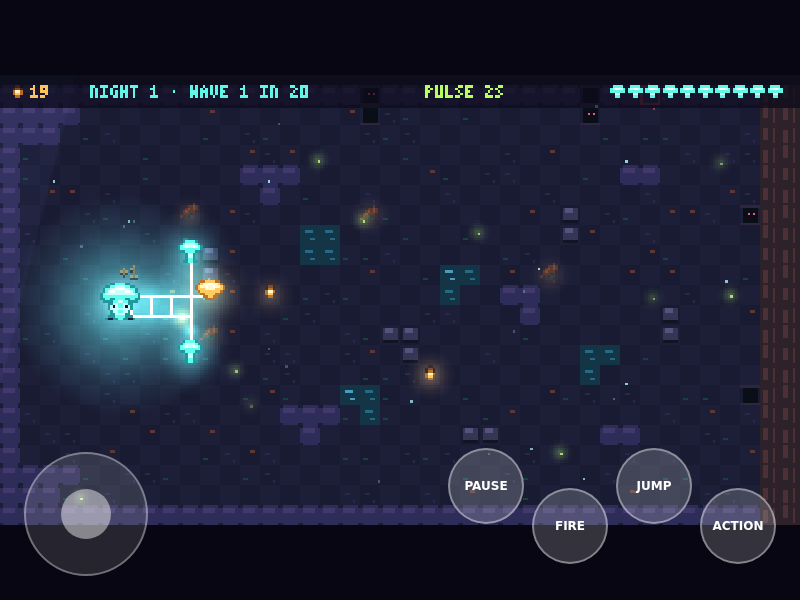
MYCELIUM SIEGE — a 2D canvas colony-builder and tower-defence hybrid set on a dark forest floor, drawn in…MYCELIUM SIEGE — a 2D canvas colony-builder and tower-defence hybrid set on a dark forest floor, drawn in glowing bioluminescent pixel art. THE PITCH Under the roots of the Old Wood lives the Glowcap Colony, a family of luminous mushrooms connected by threads of mycelium that carry light and nutrients. Every night, as the colony glows, the Beetle Legion marches out of the rotting log to eat it. You are the Spore Mind, the colony's shared consciousness. Mycelium Siege is a top-down strategy game on a pixel-art forest floor: you grow glowing threads of mycelium across the soil, sprout mushroom towers on the network, harvest nutrients from fallen leaves and acorns, and defend the Mother Cap against waves of beetles, slugs and centipedes. The twist: towers only work while connected to the network by glowing threads, and enemies can chew through threads. Building a resilient web is the game. ART DIRECTION: BIOLUMINESCENT PIXEL ART Render at a low internal resolution (for example 320×180 or 384×216) to an offscreen canvas, then scale it up to the window with imageSmoothingEnabled = false for crisp chunky pixels. Keep every sprite pixel-sized and drawn in code: build small sprites from arrays of strings where each character is a colour index, and draw them with fillRect per pixel into cached offscreen canvases once at start. Palette: night soil and bark in deep blues and violets (#0d0b1a, #1a1630, #2b2350), leaf litter in dark teal and rust (#123a3a, #5a2f2a), and the colony glowing in cyan (#5ff7e8), lime (#b6ff5c), soft magenta (#ff6ad5) and warm amber (#ffc35c). Mycelium threads are 1-pixel lines that pulse with travelling light dots moving along them. Glow is faked with small radial gradient sprites drawn with globalCompositeOperation = "lighter" around every glowing thing (cache these gradients; never rebuild them each frame). Ambient life: fireflies blinking, drifting spores, dew drops that catch the glow, and the moon's light shifting slowly across the forest floor. THE MAP A single screen-sized forest floor (a grid of 8-pixel tiles, about 40×22) with: - The Mother Cap in the centre-left: a big glowing mushroom with a face that sleepily blinks. If it is eaten, you lose. - Soil tiles where mycelium can grow; roots and stones that block growth; puddles that slow enemies. - Nutrient sources: fallen leaves, acorns and a dead moth slowly appear; growing threads into them harvests nutrients over time. - Enemy burrows at the right edge and top edge, where waves emerge. The rotting log on the right is the Legion's home. CORE LOOP 1. Grow: move the Spore Mind cursor (a softly pulsing ring of spores) with the move axis or the mouse. Press the action button on a tile adjacent to the network to extend a thread there (costs nutrients). Threads connect orthogonally; draw them as glowing lines between tile centres with travelling light dots. 2. Sprout: on any connected tile, press jump to open the sprout menu and choose a mushroom tower. 3. Harvest: threads touching nutrient sources pull nutrients back to the Mother Cap, visualised as dots travelling along the threads toward her. 4. Defend: enemies walk toward the Mother Cap along open soil (use a simple grid pathfinding — breadth-first search from the Mother Cap over walkable tiles, recomputed when the network changes, since enemies can't walk through towers but can walk over threads). Some enemies chew threads they cross, cutting off towers downstream; disconnected towers fade and stop working until reconnected. 5. Waves come every 40 seconds, with a 15-second "calm" where the forest is quiet and you can rebuild. MUSHROOM TOWERS (each a small animated pixel sprite with its own glow colour) - Glowcap (cyan): shoots light motes at the nearest enemy; cheap and reliable. - Puffball (amber): when enemies come near, bursts a cloud of spores that damages everything in an area; recharges slowly. - Inkcap (magenta): drips ink that slows enemies in a small radius and makes them visible to other towers through the dark (enemies outside the glow of your network are hard to see). - Lanternshroom (lime): no attack, but extends the glow around it, revealing enemies and increasing the range of nearby towers. - Cordyceps (rare, unlocks in wave 6): infects one enemy at a time, turning it against its allies for a few seconds. Towers can be upgraded twice with nutrients (bigger, brighter sprite). ENEMIES: THE BEETLE LEGION - Pill Bugs: roll quickly, curl up and take less damage while rolling. - Stag Beetles: slow, armoured, chew through threads. - Slugs: leave slime trails that block thread growth until they dry. - Centipedes: segmented enemies that move in a sine wave; each segment has its own health and the centipede splits when the middle is destroyed. - Moth Swarm (wave 8): flies over obstacles toward the brightest tower. - The Beetle Queen (wave 10): a big armoured beetle that burrows underground and resurfaces near threads to chew them; must be revealed by Lanternshrooms to be hit. Draw enemies as small pixel sprites with two-frame walk cycles. They are dark creatures, mostly visible as silhouettes with glinting eyes unless lit by your glow. CONTROLS (forge.input only) - Move cursor: input.axes.move (arrows, WASD, stick, touch joystick). The cursor moves smoothly over tiles and snaps to the hovered tile; mouse movement can also position it (read forge.input.mouse). - Action (E / B / click on touch): grow a thread to the hovered tile. - Jump (Space / A): open the sprout menu on the hovered tile (left/right to pick, jump to confirm, action to cancel). - Fire (F / X): Spore Pulse — a colony-wide ability that briefly brightens the whole network, revealing every enemy and boosting tower fire rate for 5 seconds; recharges each wave. - Pause: pause menu with controls. THE FIRST FRAME Start immediately in the first night: the Mother Cap glows, a few threads and two Glowcaps already exist, fireflies drift, and the first wave timer counts down from 25 seconds. The arrow keys move the spore cursor immediately and the world is animated from the first frame. Show the title "MYCELIUM SIEGE" in chunky pixel letters (draw from a tiny pixel font defined in code) with "arrows to move · E to grow · Space to sprout" fading after a few seconds or on the first input. Never wait for a click. PROGRESSION AND VICTORY - Ten waves per night. Survive the Beetle Queen on wave 10 to reach Dawn: the screen brightens to a soft blue morning, the beetles retreat, and the colony blooms (lots of new mushrooms pop up with sparkles). Show a results card: waves survived, nutrients harvested, threads grown, towers sprouted, and a star rating. - Lose if the Mother Cap is eaten: she wilts, the glow fades out across the network from her outward, and a results card shows how far you got. - Save the best wave and best score with forge.kv ("mycelium-siege-best"). Optionally, a second map unlocks after a win (the Stump Hollow, with a different layout) — remember it with forge.kv. HUD (drawn in pixel style on the low-res canvas) - Top left: nutrients with a small acorn icon; wave number; countdown. - Top right: Mother Cap health as a row of small glowing caps. - Bottom: the sprout menu when open — tower icons, names and costs. - Small floating numbers for damage and "+5" nutrients. AUDIO (forge.audio) - Thread grown: a soft rising tone (forge.audio.tone with a quick upward pitch). - Tower shoots: "laser" at low volume (rate-limited so swarms don't get noisy). - Puffball burst: "splash". Inkcap: "hack". - Enemy defeated: "hit". Thread chewed: "shatter" at low volume. - Wave start: "alarm" softly. Spore Pulse: "powerup". Dawn: "buff". - Music: forge.audio.startMusic("dungeon") after the first input; "boss" for wave 10. GAME FEEL - Glow everywhere: gradient sprites with additive blending, pulsing with a slow breath. - Travelling light dots along threads show the network is alive; when a thread is cut, the dots spill out and fade. - Screen shake (1–2 pixels) on Puffball bursts. Enemies flash white when hit. - Use forge.spatial.createGrid for target finding; pool projectiles and particles. TECHNICAL REQUIREMENTS FOR THIS PLATFORM - 2D canvas only: draw on the existing <canvas id="game"> via an offscreen low-res buffer scaled up with smoothing off; handle resize by keeping the aspect ratio with letterboxing. - Plain ES modules: main.js, sprites.js (pixel sprite data and caching), map.js (tiles, pathfinding), network.js (threads, connectivity, nutrients), towers.js, enemies.js, waves.js, hud.js, audio.js. - import { forge } from "@forge/sdk" for input, audio, kv and spatial helpers. No external images or fonts. - requestAnimationFrame loop from page load; something animates every frame. - No alert/prompt/confirm. ACCEPTANCE CHECKLIST - Loads into a glowing night forest with a pre-built small colony and a wave countdown; arrow keys move the cursor immediately. - Threads grow from the network and carry visible light; towers only work while connected; enemies can cut threads. - At least four tower types and five enemy types with pixel sprites; the Beetle Queen on wave 10. - Nutrients harvested via threads; spending on threads, towers and upgrades. - Dawn victory and wilt defeat screens with results; best wave persists via forge.kv. - Pixel-crisp rendering with bioluminescent glow; audio and music. THE FIRST TWO MINUTES, AS THE PLAYER SHOULD EXPERIENCE THEM The screen is a dark pixel forest floor, deep blue and violet, with a single big glowing mushroom on the left — the Mother Cap — sleepily blinking her pixel eyes. Cyan threads of mycelium already reach out from her to two small Glowcaps, with little dots of light travelling along them like a heartbeat. Fireflies blink. The pixel title MYCELIUM SIEGE pulses in cyan and fades. "Night 1 · First wave in 25" glows at the top. The player moves the spore cursor with the arrow keys; it glides from tile to tile with a soft pulse. Pressing E next to the network grows a new thread with a rising tone, and a fallen leaf nearby starts sending amber nutrient dots back toward the Mother Cap. The player presses Space on a connected tile, the sprout menu opens at the bottom, and a Puffball pops out of the soil with a squish. Then the forest rustles: a line of pill bugs rolls out of the burrow on the right, silhouettes with glinting eyes, and the Glowcaps begin shooting tiny cyan motes, each hit flashing the bug white. A stag beetle trundles along the bottom path and bites through a thread — the light dots spill out and the Glowcap beyond it dims and stops. The player rushes the cursor over and regrows the thread, and the tower lights back up. That's the whole game in one moment. CHARACTERS AND VOICE The Mother Cap speaks in small pixel speech bubbles (two or three words, no punctuation clutter): - Start: "the dark wakes" - First thread: "grow little ones" - When a thread is cut: "a thread is lost" - When she is hit: "they bite" - Wave 5: "the slugs come" - Queen appears: "the Queen hungers" - Dawn: "we bloom" The Beetle Queen has a single line when she first surfaces: "YOUR LIGHT TASTES SWEET" in red pixel letters. CONTENT TABLE: WAVES (enemies per wave and entry burrows) 1. 8 Pill Bugs (east). 2. 12 Pill Bugs (east, north). 3. 6 Pill Bugs + 2 Stag Beetles (east). 4. 4 Slugs + 8 Pill Bugs (north). 5. 2 Centipedes + 10 Pill Bugs (east). Slugs begin leaving trails that block growth. 6. 4 Stag Beetles + 4 Slugs + 1 Centipede (both). Cordyceps unlocks. 7. 20 Pill Bugs in two bursts + 2 Centipedes. 8. Moth Swarm of 16 (flying, from the top edge) + 4 Stag Beetles. 9. Everything: 30 enemies of all types from both burrows. 10. The Beetle Queen with periodic pill-bug escorts. TUNING NUMBERS - Thread cost: 4 nutrients per tile; growth animation 0.3 s. - Towers: Glowcap 15 nutrients, range 4 tiles, 4 damage every 0.5 s. Puffball 25, radius 2 tiles, 20 damage, recharge 3 s. Inkcap 20, slow 40% in radius 2 tiles. Lanternshroom 18, reveal radius 4 tiles, +15% range to towers within it. Cordyceps 40, converts one enemy every 6 s for 4 s. - Upgrades: +60% damage or radius per level; cost 1.5× and 2× the base price. - Enemies: Pill Bug 12 hp speed 1.6 tiles/s (rolling takes 50% damage); Stag Beetle 60 hp speed 0.7, chews a thread tile in 1.5 s; Slug 30 hp speed 0.5, trail lasts 8 s; Centipede 6 segments × 15 hp speed 1.0; Moth 8 hp speed 2.2 flying; Queen 900 hp, burrows for 5 s every 15 s. - Nutrient sources: leaf 1 per second, acorn 2 per second, dead moth 3 per second for 30 s then depletes. - Starting nutrients 40. Mother Cap health 10 caps; a reaching enemy removes 1 (Queen removes 4). POLISH LIST - The whole network brightens with a slow breathing glow; the brightness dims slightly for each cut thread so the player feels the damage. - Spores drift upward from towers when they fire. - When a wave ends, the forest goes quiet: fireflies return, a soft chord plays, and nutrients flow faster for a few seconds. - Make the cursor clearly show whether a tile can grow (green outline), sprout (cyan outline) or neither (dim red). - At Dawn, transition the palette over three seconds from night violet to morning blue with gold edges.
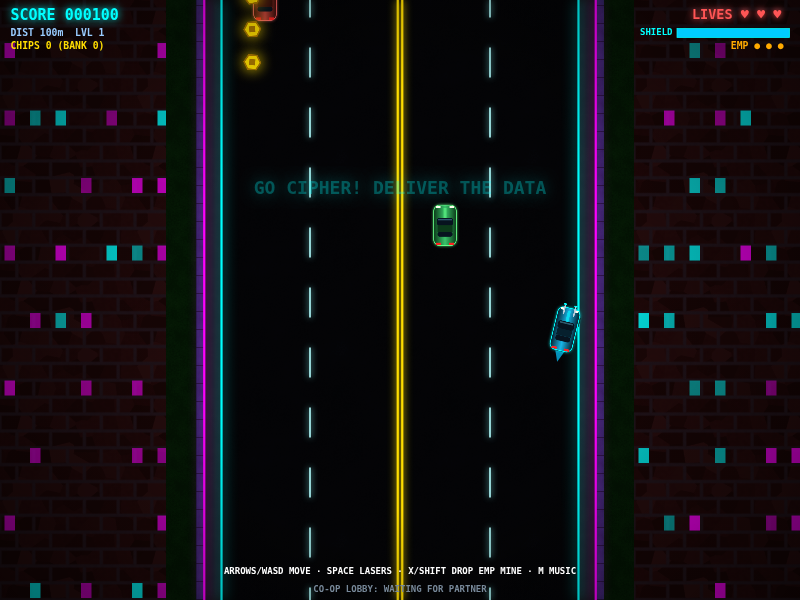
Cyber Heist Overdrive - A fast-paced retro top-down neon highway combat and pursuit chase game inspired by…Cyber Heist Overdrive - A fast-paced retro top-down neon highway combat and pursuit chase game inspired by Spy Hunter and retro arcade racers. Play as rogue cyber-courier Cipher piloting an armored Interceptor down the multi-lane superhighway of Neo-Casablanca carrying stolen megacorp data. Weave through traffic, blast megacorp pursuit drones and police cruisers with twin lasers, drop EMP mines to disable pursuers, collect gold data chips and shield repairs, and destroy the Megacorp Heavy Tanker boss. Use procedural vehicle sprites (vehicle_car, vehicle_pickup, vehicle_tanker, fx), baked chiptune audio SFX (sfx_laser, sfx_explosion, sfx_coin, sfx_powerup, sfx_shield, sfx_alarm) from assets.js, and procedural asphalt and neon road textures from materials.js. Features 2-player co-op pursuit lobby via forge.net.join('cyber-heist-room'), persistent garage profile via forge.kv, and global leaderboard submission via forge.leaderboard.submit('cyber-heist-overdrive', score).
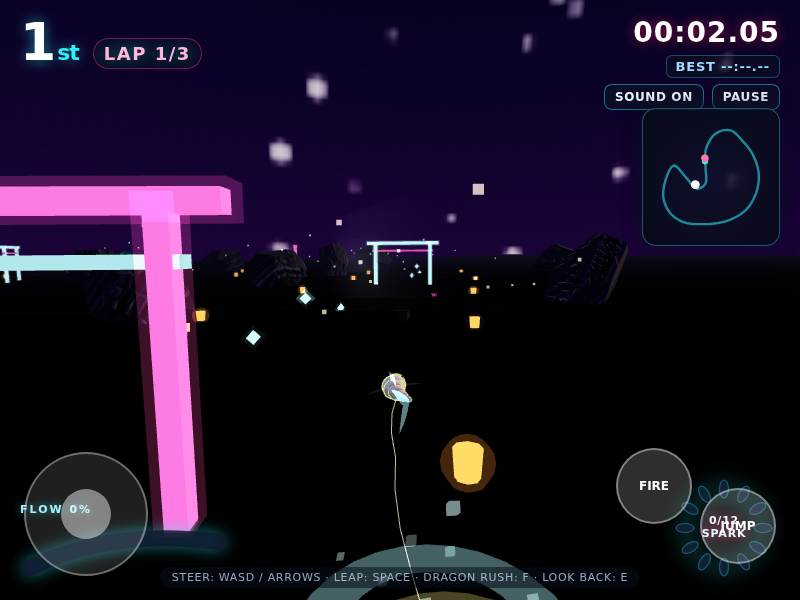
NEON KOI — a three.js gate racer where you swim a koi through a midnight pond painted half in ink wash and…NEON KOI — a three.js gate racer where you swim a koi through a midnight pond painted half in ink wash and half in synthwave neon. THE PITCH Every midsummer night the koi of the Moon Garden race through the ceremonial gates of the great pond. Legend says the koi who finishes first leaps the waterfall at the end and becomes a dragon for one night, lighting up the sky. You are Hikari, a small white-and-vermilion koi who has never won. Neon Koi is a fast, flowing 3D racer: you swim forward through a long winding course just under the water's surface, steer through glowing torii-shaped gates, draft behind rival koi, gather lotus sparks for a burst of speed, and leap out of the water over obstacles in slow, beautiful arcs. The tone is serene but exhilarating, like a calm meditation that keeps getting faster. ART DIRECTION: SUMI-E INK MEETS SYNTHWAVE Mix two styles that shouldn't fit and make them sing. The pond itself is ink wash: a deep indigo-black water surface (a large PlaneGeometry with vertices gently displaced by moving sine waves every frame, MeshStandardMaterial in #0b1020 with high metalness and low roughness so it reflects the neon) and loose brush-stroke shapes floating on it — lily pads drawn as dark green discs with a notch, lotus flowers built from a few pink flat petals. Rocks along the banks are rough low-poly shapes in sumi black with grey dry-brush highlights (a CanvasTexture with brush strokes). Over the ink, everything that matters glows in synthwave neon: the race gates are torii shapes built from boxes with emissive hot pink (#ff2e88) and cyan (#2ef0ff) materials; the course edge is marked by floating paper lanterns that glow orange; lotus sparks are small emissive cyan diamonds that spin; rival koi have neon outlines (a slightly larger back-face mesh in a bright emissive colour behind each koi — a classic outline trick). The sky is a gradient dome from deep violet at the top to magenta near the horizon, with a giant low moon drawn as a bright disc with horizontal synthwave stripes cut through its lower half (draw it to a CanvasTexture), and faint brush-stroke mountains silhouetted against it. Add drifting fireflies (small glowing Points) and slow mist bands (large transparent planes) over the water. THE KOI Hikari is a stylised koi: a body made of a few tapered segments (scaled spheres or a lathe shape), white with vermilion patches (vertex colours or a small CanvasTexture), flowing fins as thin planes, and a long trailing tail. Animate swimming with a sine wave that travels down the body segments — the tail swishes harder when you speed up. Leave a soft trail of ripples on the surface (expanding rings that fade) and a neon wake line behind you. Rival koi (five of them) each have their own colour scheme and neon outline: Gold Emperor (gold, arrogant, fast on straights), Ink Shadow (black, takes risky inside lines), Twin Lanterns (two orange koi that swim together), Old Jade (green, slow but never misses a gate), Plum Blossom (pink, uses sparks aggressively). Give them simple names on small floating labels when close. COURSE AND CORE LOOP 1. The course is a long closed loop through the pond defined by a Catmull–Rom spline (use forge.math.splinePoint3 or THREE.CatmullRomCurve3) of about 20 control points that wind around islands, under arched bridges, between reeds, and through a narrow bamboo channel. 2. You swim forward automatically at cruise speed; the move axis steers left and right (relative to your heading) and up and down slightly (dip deeper or rise to the surface). 3. Gates are placed along the spline. Passing through a gate's centre gives a small speed boost and adds to your Flow meter; missing one costs Flow and a time penalty (show a pink flash and "-1s"). 4. Lotus sparks float in clusters; collecting them fills your Spark meter. When full, the fire action triggers Dragon Rush: three seconds of much higher speed, a rainbow neon wake and ghostly dragon whiskers on Hikari. 5. Drafting: swimming close behind a rival fills Flow faster (show a stream of light between you). 6. Leaping: the jump action makes Hikari leap out of the water in a graceful arc (simple ballistic motion with forge.physics.trajectory3 or your own gravity), useful to clear floating logs, lily-pad walls and rivals. While airborne, steering is gentle and you can collect sparks floating above the water. Landing makes a big splash (particles) and a ring of ripples. 7. Three laps. Show position (1st–6th), lap counter, and lap times. RIVAL AI Rivals follow the spline with small lateral offsets, varying speed by personality, and occasionally using their own Dragon Rush. Keep them readable: they should be close competition on the first track, slightly rubber-banded so races stay tense (rivals ahead slow down slightly, those behind speed up slightly). CONTROLS (forge.input) - Steer: input.axes.move (arrows, WASD, left stick, touch joystick). x steers, y dips/rises. - Jump (Space / A / touch button): leap. - Fire (F / X / touch button): Dragon Rush when the Spark meter is full. - Action (E / B): look back (camera swings behind for a moment). - Pause: pause menu. Configure touch buttons with forge.input.configure({ touchButtons: ["jump", "fire"] }). THE FIRST FRAME Start with an attract-mode race already under way: Hikari swims along the course from page load and the arrow keys steer immediately; rivals swim alongside. A title overlay "NEON KOI · three laps to the waterfall" with a countdown "3 · 2 · 1 · SWIM" fades in and out over the first few seconds, then the race timer starts. Never wait for a click. CAMERA A chase camera behind and slightly above Hikari, following the spline tangent with damping, with a subtle roll when turning. During Dragon Rush, widen the FOV and add streaking neon speed lines (stretched transparent planes flying past). During leaps, pull the camera up and back a little to frame the arc against the moon. THE FINALE After the third lap the course ends at the Moon Waterfall: a tall cascade of glowing water (vertical planes with scrolling emissive stripes). If you finish first, Hikari leaps up the waterfall and transforms into a neon dragon (a long sinuous tube following a sine curve, glowing pink and cyan, with whiskers) that flies across the moon while firework-like neon bursts fill the sky. If you finish lower, play a gentler ending: Hikari watches the winner's dragon from the pond and the screen says "Next midsummer…". Then show results: finishing position, total time, best lap, sparks collected, gates hit out of total. PERSISTENCE AND SCORE - Save the best total time and best lap with forge.kv ("neon-koi-best"). - Unlock an alternative koi colour scheme (Midnight Silver) after your first win; remember it with forge.kv. - Submit the best time to forge.leaderboard.submit("neon-koi", score) inside try/catch where score is an inverted time (e.g. 100000 − milliseconds) so higher is better. HUD (HTML overlay) - Top left: position (big "2nd") and lap "Lap 2/3". - Top right: race timer and best lap. - Bottom left: Flow meter as a curved brush stroke that fills with cyan; bottom right: Spark meter as a ring of lotus petals that light up one by one; when full it pulses. - A small minimap in the corner (a 2D canvas with the course spline drawn as a line and coloured dots for each koi). - Gate hit: a quick "+FLOW" pop; gate miss: "-1s". AUDIO - Gate passed: forge.audio.play("powerup") — or "coin" for small boosts. - Spark collected: "coin". Dragon Rush: "boost" then "roar" quietly. - Leap: "splash" on takeoff and landing. - Countdown: forge.audio.tone(440, 0.15) three times and tone(880, 0.3) for GO. - Bump into a rival: "bumper". - Music: forge.audio.startMusic("synthwave") once the player has interacted; the finale uses "space". GAME FEEL - Water surface undulates; ripples spread from every koi; light reflections shimmer. - Bumping rivals pushes both apart with a soft splash. - Neon colours bloom: fake bloom by layering slightly larger, transparent additive copies of glowing objects (no post-processing needed). - Performance: reuse ripple and particle pools, keep lights few (moon directional light, ambient, a handful of lantern point lights); emissive materials do most of the glowing. TECHNICAL REQUIREMENTS FOR THIS PLATFORM - Plain ES modules: main.js, course.js (spline, gates, sparks, scenery), koi.js (player and rival models and animation), race.js (laps, positions, AI), hud.js, fx.js (ripples, splashes, trails), audio.js. - three.js from "three", optional addons from "three/addons/…", and import { forge } from "@forge/sdk". No external textures or models; draw everything with geometry and CanvasTexture. - Use the existing <canvas id="game">, renderer.setAnimationLoop, and handle resize. - Read controls with forge.input.poll() once per frame. - No alert/prompt/confirm. ACCEPTANCE CHECKLIST - Loads straight into a race with Hikari swimming and steerable by arrow keys; rivals race alongside. - A three-lap course along a spline with gates, sparks, lily pads, logs, bridges and a bamboo channel. - Gates, Flow, Sparks, Dragon Rush and leaping all work and are visible in the HUD. - Five rivals with distinct looks and racing personalities; live positions shown. - Finale at the Moon Waterfall with the dragon transformation for a win; results screen; restart with Space or tap. - Best times persist via forge.kv; audio for gates, sparks, leaps, countdown and music. THE FIRST TWO MINUTES, AS THE PLAYER SHOULD EXPERIENCE THEM The screen fades up on a still, black pond under a huge striped moon. Mist drifts. Six koi hover just beneath the surface at a starting line of floating lanterns, their neon outlines pulsing pink, cyan, gold and green. The title NEON KOI writes itself across the moon in thin neon tubing, then a soft voice-like tone counts "3 · 2 · 1" and on SWIM the koi surge forward, tails swishing, wakes blooming behind them. The player taps left and Hikari slides into the inside line; the first torii gate glows ahead and passing through its centre gives a satisfying whoosh, a burst of cyan light, and a "+FLOW" pop. A cluster of lotus sparks floats above a lily pad; the player holds up to rise near the surface and collects three, filling a third of the Spark meter. Gold Emperor surges past on the straight; the player tucks in behind him and a thin stream of light connects them as the Flow meter fills faster — drafting. At the first floating log the player taps Space and Hikari leaps from the water in a slow, silvery arc framed against the moon, sparks trailing, and lands with a splash that sends rings across the whole pond. By the end of lap one the player is in third place and grinning. CHARACTERS AND VOICE Rivals have personalities shown through short floating taunts (small neon text above them, a few times per race, never cluttering): - Gold Emperor: "The waterfall knows my name." / "Swim faster, little one." / when passed: "Impossible!" - Ink Shadow: "…" (it never speaks; instead its outline flickers when it takes a risky line). - Twin Lanterns: "Together!" / "Left!" "Right!" (alternating as they weave). - Old Jade: "Patience is a current too." / "I have swum this pond sixty summers." - Plum Blossom: "Catch me if you can!" / "Sparks are for spending!" At the start of each race, show a short pre-race line from a wise old turtle on a rock at the start (a low-poly turtle with a lantern on its shell): "The moon is full. Swim for the one who taught you to swim." CONTENT TABLE: TRACK FEATURES IN ORDER ALONG THE LOOP 1. Lantern Start: wide straight, three gates, many sparks. 2. Lily Meadow: gentle S-bends, lily-pad walls with gaps (leap or thread them). 3. Moon Bridge: an arched stone bridge — swim under it or leap over its railing for a shortcut with sparks. 4. Reed Maze: narrow channel between reed clusters (thin vertical cylinders that sway), two branching paths that rejoin. 5. Bamboo Channel: a tight straight lined with bamboo, gates close together — a Dragon Rush hotspot. 6. Koi Shrine: a small island with a pagoda; a whirlpool beside it that pulls you inward (ride its edge for a speed boost). 7. Log Run: floating logs to leap, plus a final gate before the start line. On the third lap, add drifting cherry blossom petals over the whole pond and make the moon slowly turn pink. TUNING NUMBERS - Cruise speed: 18 units/s; gate boost +4 units/s decaying over 1.5 s; Dragon Rush speed 34 units/s for 3 s. - Steering: yaw rate 1.8 rad/s; vertical range −2 to 0 units below the surface; leaving the surface requires the leap. - Leap: initial upward velocity 9 units/s, gravity 18 units/s², so about 1 s of airtime. - Flow meter: +20 per gate, +8 per second while drafting within 3 units behind a rival, −15 per missed gate; full Flow (100) gives +10% top speed passively. - Spark meter: 12 sparks to fill. Sparks respawn each lap. - Rival speeds: Gold Emperor 19 on straights, 16 in bends; Ink Shadow 17.5 with tighter lines; Twins 17; Old Jade 16.5 but never misses gates; Plum 17 and uses Dragon Rush at every full meter. - Rubber-banding: rivals more than 40 units ahead slow by up to 8%; those more than 40 units behind gain up to 8%. POLISH LIST - Each gate pass pulses its neon brighter for half a second and plays a pitch that rises along the lap, like a scale. - The water mesh near the player should show crisp moving ripples; far water can be simpler. - When in first place, add a subtle golden shimmer to Hikari's wake; in last place, the moon dims slightly to raise the tension. - On collisions, the camera nudges and both fish spin a little, never stopping you dead. - Show a ghost of your best lap (a translucent koi) on later laps if a best lap exists in forge.kv.
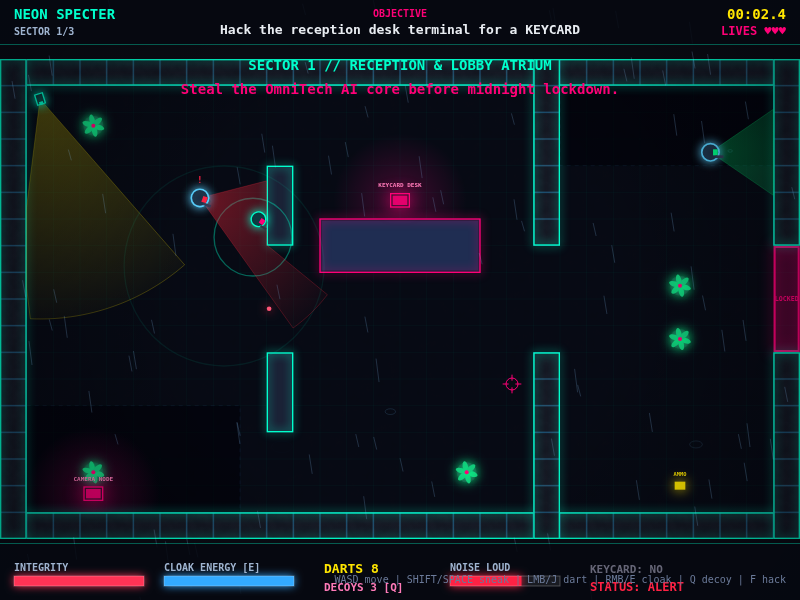
Top-down cyberpunk tactical stealth infiltration game: Neon Specter: Data Heist 2088. Setting & Story: In the…Top-down cyberpunk tactical stealth infiltration game: Neon Specter: Data Heist 2088. Setting & Story: In the neon-lit, rain-soaked mega-city of Neo-Shinjuku, you are Specter, a cybernetically enhanced corporate infiltrator. Infiltrate the high-security corporate tower of OmniTech Corp to steal the experimental master AI core before the midnight security lockdown. Key Gameplay & Features: 1. Top-Down Stealth, Vision Cones & Dynamic Shadows: - Movement: WASD or Arrow Keys for fluid 8-directional movement. - Aim & Look: Crosshair follows mouse cursor (or faces movement direction). - Sneak Mode: Hold Shift or Space to crouch-sneak silently (slow movement, no sound waves emitted) vs normal walking/sprinting which generates visible expanding sound circles that alert nearby guards. - Dynamic Field of View / Vision Cones: Patrolling guards and surveillance cameras project visible colored vision cones (Green = calm patrol, Yellow = suspicious searching/investigating sound, Red = combat alert / firing). - Stealth Occlusion: Line-of-sight checks against walls, security data racks, and shadows. If behind cover or outside vision cones, the player remains undetected. 2. Cybernetic Infiltration Arsenal & Abilities: - Silenced EMP Dart Pistol (Left Click / J): Fires silent non-lethal darts to neutralize guards from behind (limited ammo darts). - Active Optical Camo (E key / Right Click): Activates temporary holographic invisibility for 4 seconds (has cooldown and energy meter). - EMP Distraction Decoy (Q key): Throws a remote noisemaker to lure guards away from patrol posts. - Security Terminal Hacking (Walk up to glowing terminals and hold F / E): Triggers an interactive quick-hack sequence to disable laser security grids, turn off surveillance cameras, and download encrypted keycards. 3. Multi-Room Levels & Boss Encounter: - Room 1: Reception & Lobby Atrium (basic security droids, potted neon plants, keycard desk). - Room 2: Server Vaults (moving laser tripwires that trigger instant alarms, patrolling heavy cyborg guards). - Room 3: Executive Penthouse & Boss Encounter: Head of Security "Vance Vance" with an automated shielded defense turret rig, requiring the player to sneak around and hack 3 terminal power conduits to disable his shields and take him down. 4. Visuals, Cyberpunk Atmosphere & Polish: - Dark cyberpunk neon palette (#0a0c14 background, #00ffcc cyan laser grids, #ff0077 hot pink terminals, #ffe600 alert cones). - Raindrop ripples on the floor, soft shadow projections, glowing neon terminal screens, and floating alert icons (! and ? over guards). - Sleek HUD with Cloak Energy Bar, Dart Ammo counter, Noise Level Indicator, and Level Objective Tracker. 5. Audio & Dynamic Music: - Web Audio API procedural cyberpunk synthwave soundtrack: calm, pulsing low-tempo bass groove while undetected, seamlessly transitioning to a fast, driving tense synth chase track when an alert triggers! - Rich sound effects: footstep taps, silenced dart thwip, guard knockout thump, laser grid hum, hacking terminal chirps, camera alert beep, and victory fanfare. Unlock Web Audio on first user gesture. 6. Sovereign Forge SDK Integration: - import { forge } from "@forge/sdk"; - Persistent operative save data (ghost rating, best clear times, total hacks, credits) with forge.kv (key: "neon_specter_save"). - Global Speedrun Leaderboard with forge.leaderboard.submit("neon_specter", clearTimeSeconds) and viewing top scores.
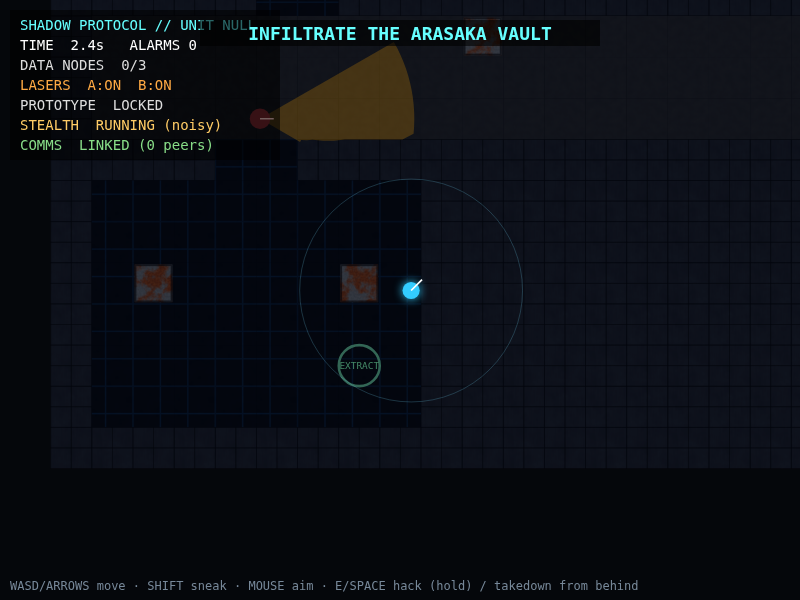
Create a top-down tactical stealth infiltration game titled 'Shadow Protocol: Covert Ops' (inspired by Shadow…Create a top-down tactical stealth infiltration game titled 'Shadow Protocol: Covert Ops' (inspired by Shadow Tactics and Metal Gear). Story: As cyborg operative Unit Null, infiltrate the Arasaka Cybernetics research vault in Neo-Kyoto. Avoid roving sentinel guards, disable laser tripwires, hack data nodes, and extract encrypted prototypes before the thermal lockdown alarm is triggered. Controls & Mechanics: 1. Controls: WASD or Arrow Keys to move; hold Shift to sneak silently (sneaking reduces footstep detection radius); mouse cursor to aim facing direction; Space or E to interact/hack terminals and perform takedowns from behind. 2. Guard AI & Vision Cones with forge.math: Multiple patrolling guards navigate looping waypoint paths. Guards smoothly rotate their facing angles using 'forge.math.angleTo' and 'forge.math.angleDiff'. Vision cone detection: guards spot the operative using 'forge.math.inCone(player.x, player.y, guard.x, guard.y, guard.angle, Math.PI / 3, 180)'. Check wall obstruction using 'forge.math.raycast'. 3. Vision Cones & Canvas FX: Draw translucent amber vision cone arcs for guards; when suspicious, cones turn yellow, and when alerted they turn bright flashing red. 4. Hacking & Tweens: Hacking data terminals and laser control consoles uses 'const tweens = forge.tween.createGroup()' to animate circular progress gauges and UI alert notifications with 'tweens.to(gauge, { p: 1 }, 1200, "easeOutQuad")'. 5. Audio & Procedural Stealth Synth: On first click, call 'forge.audio.unlock()' and start tense atmospheric music with 'forge.audio.startMusic("stealth", { bpm: 105 })'. Trigger sound effects: 'forge.audio.play("alarm")' if guards are alerted, 'forge.audio.play("hack")' when accessing terminals, 'forge.audio.play("hit")' for takedowns, and 'forge.audio.play("powerup")' on mission extraction. 6. Persistence & Leaderboards: Save best stealth completion time and clearance rank with 'forge.kv.set("shadow_protocol_save", state)'. Join covert comms via 'await forge.net.join("shadow-ops-net")'. Submit stealth infiltration scores with 'await forge.leaderboard.submit("shadow-protocol-covert-ops", score)' and show high scores.
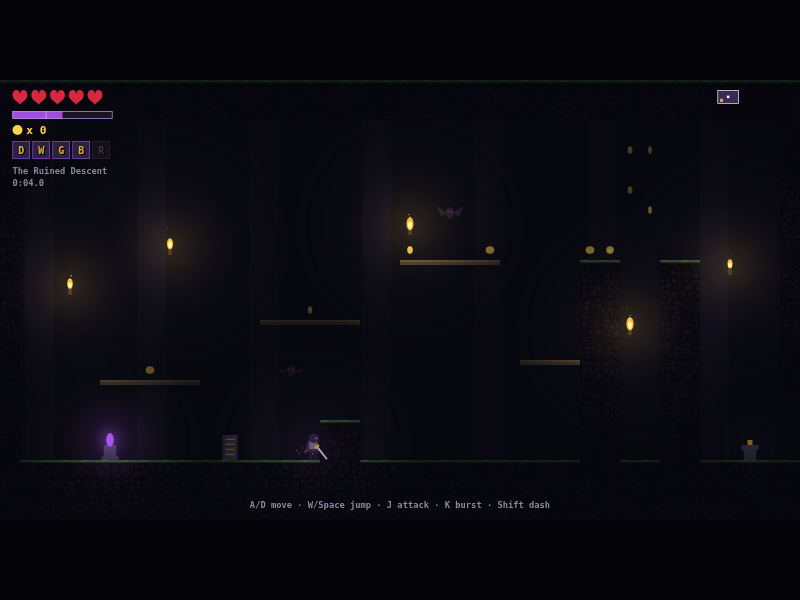
2D gothic metroidvania action platformer: Crypt of the Relic: Curse of Aethelgard. Setting & Story: Deep…2D gothic metroidvania action platformer: Crypt of the Relic: Curse of Aethelgard. Setting & Story: Deep beneath the ruined kingdom of Aethelgard lies the subterranean Sunken Citadel. Play as Kaelen, a cursed Relic Hunter seeking the Sunstone Relic to break the creeping obsidian curse. Navigate treacherous cavern chambers, slay undead guardians, discover secret chambers, and conquer the colossal Obsidian Behemoth. Key Gameplay & Features: 1. Buttery-Smooth 2D Platforming Physics: - Movement: A/D or Left/Right Arrow to run. - Jump: W, Up Arrow, or Space. Variable-height jump (hold longer for higher jump), coyote time (0.12s jump grace after stepping off ledges), and jump buffering for tight, responsive platforming feel. - Wall Mechanics: Wall-slide down vertical stone shafts with dust particles; Wall-Jump off walls to scale high shafts. - Air Dash: Shift or double-tap direction to dash horizontally through air, dodging attacks and clearing wide gaps. 2. Tight Combat & Relic Powers: - 3-Hit Sword Combo (J or Left Click): Fast slash combo with swinging visual slash arc trails and hit-stop impact feel. - Downward Aerial Pogo Strike (Down + Attack in air): Slash downwards to bounce safely off enemies and environmental spikes (Hollow Knight style pogo). - Sunstone Burst (K or Right Click): Spend Soul Energy to fire a piercing beam of radiant solar light that harms distant foes and lights ancient sun torches. - Ground Slam: Down + Jump in midair to crash down and shatter cracked stone floors into hidden secret chambers. 3. Interconnected Dungeon Map & Progression: - Multi-room interconnected map with seamless transitions at screen edges: - Chamber 1: The Ruined Descent (mossy stone platforms, tutorial bats, ancient lore tablet, first Save Shrine). - Chamber 2: The Sunken Caverns (bubbling acid pools, moving floating platforms, patrolling skeleton warriors). - Chamber 3: The Secret Vault (requires ground slam through cracked floor to find Relic upgrade +20% damage, gold chests). - Chamber 4: The Obsidian Sanctum (Boss chamber with seal gates that lock upon entry). - Top-right Mini-Map HUD showing visited rooms, current location, and save shrines. 4. Epic Boss Encounter: The Obsidian Behemoth: - Massive towering stone golem animated with glowing magma runes. - Attacks: - Stone Ground Slam: Sends shockwaves rolling across the floor that Kaelen must jump over. - Ceiling Collapse: Causes heavy falling stalactites marked by falling dust telegraphs. - Phase 2 (under 50% HP): Enrages with glowing red eyes, charges headlong across the arena (can be baited into crashing into stone pillars to stun it), and unleashes sweeping magma chest laser! 5. Visuals & Atmosphere: - Moody gothic subterranean color palette (#0e0d16 dark stone, #e0a93b warm flickering torchlight, #9d4edd purple soul energy, #ff3b30 boss magma). - Rich particle effects: wall-slide sparks, landing dust puffs, sword slashes, collectible coin shines, torch light glow with soft flicker. - Clean retro HUD: Health hearts/bar, Soul Energy gauge, Ancient Coins counter, Mini-map, and Relic Inventory. 6. Audio & Dynamic Music: - Web Audio API procedural gothic dungeon soundtrack: atmospheric eerie minor synth arpeggios while exploring, dynamically intensifying into a rapid, pounding boss theme during the Behemoth fight. - Rich sound effects: blade woosh, metal sword clank, jump grunt, wall-slide scrape, crumbling stone, pogo bounce spring sound, and boss roar. Unlock audio on first user interaction. 7. Sovereign Forge SDK Integration: - import { forge } from "@forge/sdk"; - Save game state at Save Shrines with forge.kv (key: "crypt_save", stores health, coins, unlocked abilities, boss beaten). - Global speedrun leaderboard on boss defeat: forge.leaderboard.submit("crypt_of_the_relic", clearTimeSeconds).
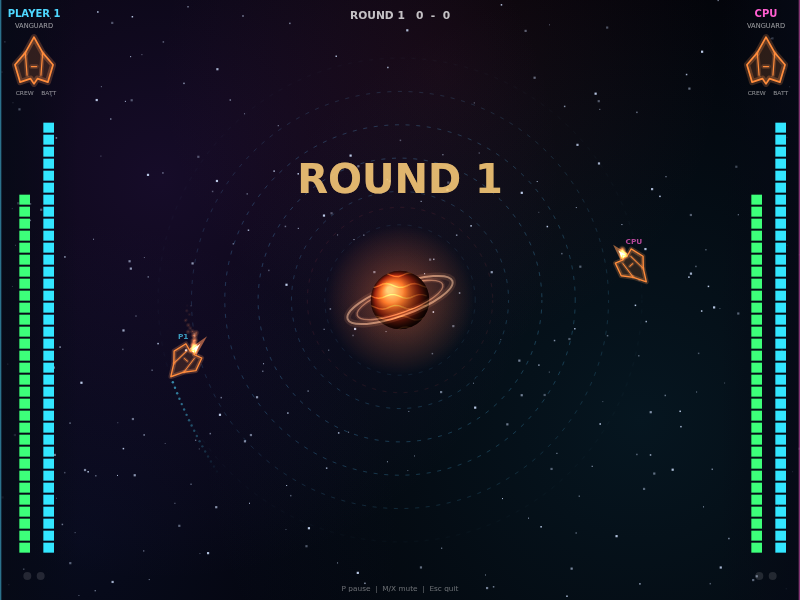
Role: You are an expert 2D game developer, physics programmer, and technical artist. Build a complete…Role: You are an expert 2D game developer, physics programmer, and technical artist. Build a complete, single-file playable HTML5/Canvas space arena combat game called "ORBITAL CLASH"—a tactile, high-contrast, single-screen tactical duel inspired by Star Control II: Super Melee, featuring Newtonian gravity-well physics, curved ballistics, asymmetric alien ships, and synthesized Web Audio sound effects.1. Visual Aesthetic & Juice (Retro-Vector meets Modern Shader Glow):Art Direction: Deep cosmic obsidian background with a multi-layered parallax starfield, subtle nebula gradients, and crisp, glowing vector-styled ship silhouettes with distinct faction colors and thruster plumes.Central Gravity Well: A rotating, ringed planetoid or molten dwarf star at the center of the arena with an animated accretion/gravity-field contour ring showing its pull radius.Combat Juice: Additive blending (globalCompositeOperation = 'lighter') for plasma bolts, laser beams, engine exhaust ribbons, hit-stop micro-freezes (20–30ms on heavy impacts), directional screen shake, expanding shockwave rings, and persistent drifting hull debris on ship destruction.Synthesized Audio (Web Audio API): Zero external assets. Generate distinct procedural sound effects for thrusters (filtered pink noise), plasma cannons (pitch-swept oscillators), railguns (metallic crack + sub-bass boom), tractor beams (modulated hum), gravity-well alarm beeps when approaching event horizon, and multi-layered explosions.2. Core Physics Engine (Newtonian Gravity & Curved Ballistics):Fixed-Timestep Simulation: Run physics at 60Hz with toroidal screen-wrapping at the arena edges (ships and projectiles wrap seamlessly across opposite edges while velocity vectors are preserved, just like Star Control).Gravity Well Mechanics: Every ship, physical projectile, mine, and piece of debris experiences inverse-square gravitational acceleration toward the central planetoid:$$\vec{a}_g = -\frac{G \cdot M}{r^2 + \epsilon} \hat{r}$$(Include a softening factor $\epsilon$ to prevent infinite slingshot spikes at the core).Slingshot & Hazard Rules: Ships can skim close to the planetoid for high-speed gravitational slingshots, while colliding with the planet's surface deals heavy hull damage and bounces the ship outward with sparks.Curved Projectiles: Kinetic shells, plasma bolts, and proximity mines obey the exact same gravity well, allowing players to curve shots around the planet to hit enemies hiding behind cover.3. Asymmetric Ship Roster (4 Distinct Playable Ships):Implement a pre-match Ship Select Screen where Player 1 and Player 2 (or AI) pick from 4 radically asymmetric ships, each with Crew (HP), Battery (Energy) with regeneration, a Primary Weapon, and a Tactical Special:1. VANGUARD DREADNOUGHT (Heavy Brawler):Stats: High mass, slow turn rate, massive hull/crew, high energy capacity.Primary (Twin Heavy Plasma): Fires slow, high-damage plasma orbs that curve heavily in the gravity well.Special (Point-Defense Flak / Shockwave): Emits an expanding radial kinetic pulse that destroys incoming missiles/mines, knocks back nearby ships, and imparts physical recoil.2. ZEPHYR INTERCEPTOR (Glass-Cannon Slingshotter):Stats: Ultra-light mass, rapid turn rate, high thrust, fragile hull.Primary (Fusion Lance): Instantaneous high-energy hitscan beam with short-to-medium range and rapid battery drain.Special (Phase Blink / Afterburner): Teleports forward a fixed distance while preserving momentum (leaving an afterimage trail), ideal for escaping gravity traps or appearing behind a dreadnought.3. ARACHNID WEAVER (Area-Denial & Trap Layer):Stats: Medium mass, omni-directional lateral thrusters, high energy regen.Primary (Scatter Needles): Rapid-fire burst of light kinetic darts with slight spread.Special (Orbital Gravity Mines): Deploys autonomous proximity mines that enter stable orbits around the central planet and home in when an enemy enters their sensor radius.4. KRAKEN DISRUPTOR (Control & Close-Quarters):Stats: Heavy-medium mass, strong forward thrust, durable armor.Primary (Arc Lightning): Short-range chain-lightning discharge that automatically arcs toward the nearest enemy within range.Special (Graviton Tractor Beam): Fires a tether beam that locks onto the enemy ship, pulling both ships together (or dragging the enemy down into the central planet's gravity well).4. Game Modes, AI & Diegetic HUD:Modes: 1P vs. Tactical AI (AI calculates thrust vectors to avoid falling into the planet, leads curved shots, and uses ship specials intelligently) and 2P Local Shared-Keyboard (WASD + Left Shift/Ctrl vs. Arrow Keys + M/N).Diegetic Side-Panels (Zero Clutter): Clean left and right vertical telemetry bars on the outer edges of the screen displaying segmented Crew (Green) and Battery (Cyan) pips, ship silhouette, and a subtle Orbital Trajectory Predictor dotted line extending from the player's nose showing their next 1.5 seconds of gravity-curved flight path.Round Flow: Best-of-3 arena duels. When a ship is destroyed, trigger dramatic slow-motion explosion debris, pause briefly, and return to ship selection or next round.5. Technical Constraints:Deliver a single, self-contained index.html file using HTML5 Canvas and clean, modular vanilla JavaScript (no external libraries or image assets).Include an intuitive title/ship-select overlay, pause/mute toggles (P and M), and crisp 60 FPS performance.
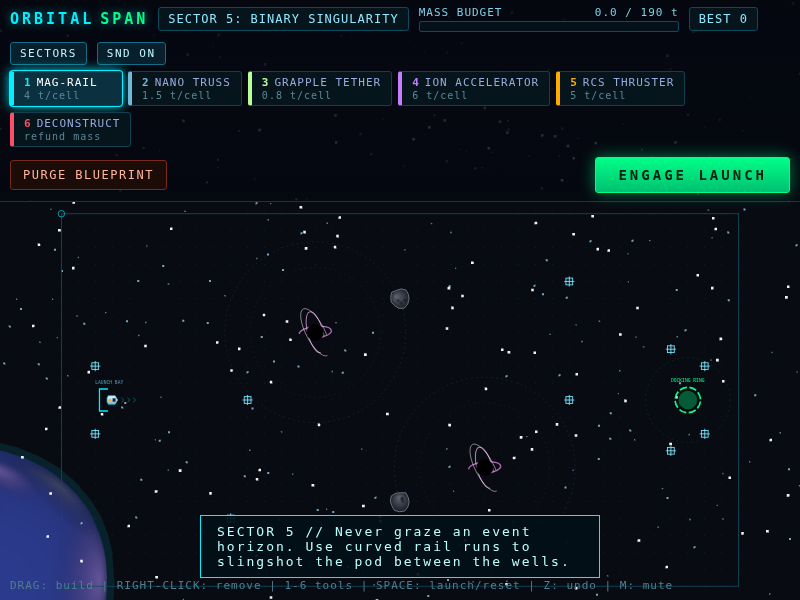
Build a complete, single-file HTML5/Canvas/JavaScript physics game called **"ORBITAL SPAN: Zero-G Docking…Build a complete, single-file HTML5/Canvas/JavaScript physics game called **"ORBITAL SPAN: Zero-G Docking"**. ### Core Concept & Twist on the Genre Instead of building static bridges against downward gravity, the player acts as an orbital engineer constructing **zero-gravity docking gantries, magnetic railgun tracks, and elastic tether-nets** to guide fragile supply pods from a Launch Bay to a Station Docking Ring. Because there is no default "down," structures drift and flex in 360 degrees unless anchored to asteroids or station hardpoints, requiring clever use of tension, thrusters, and momentum redirection. ### Technical Requirements * **Single File:** Everything (HTML, CSS, JS) must be contained in one self-contained `.html` file with zero external dependencies or asset URLs. * **Custom Physics Engine:** Write a clean, stable **Verlet Integration** physics engine (nodes + distance/spring constraints) from scratch in JS. Do not use external libraries like Matter.js so you have total control over tension visualization, breaking thresholds, and zero-G stability. * **Sub-stepping:** Run physics updates at 6–8 sub-steps per frame so high-speed supply pods don't tunnel through guide rails and tethers don't jitter. ### Building Mechanics & Pieces Players have a Mass/Resource Budget per level and build on a grid with snap-to-node functionality (attaching to fixed station hardpoints and floating asteroid anchors). 1. **Mag-Rail Guide (Solid/Collidable):** Rigid titanium guide rails that supply pods bounce off or slide along without taking hull damage. Moderate mass; snaps under high impact or shear stress. 2. **Carbon-Nanotube Truss (Support):** Ultra-lightweight structural bracing (background layer—pods pass right through it) used to triangulate and stabilize floating Mag-Rails. 3. **Grapple Tether (Elastic):** High-stretch, zero-mass tension cables. Used to anchor floating structures to distant asteroids or build elastic "catcher nets" to absorb a pod's momentum. 4. **Ion Accelerator Ring (Dynamic Piece):** A pass-through gate/rail segment that applies a strong directional thrust impulse to any supply pod passing through its vector field. 5. **Reaction Control Thruster (Dynamic Piece):** A rhythmic maneuvering thruster attached to a structural node that fires in pulses (every 2 seconds) during simulation, allowing players to build rotating docking arms, moving airlocks, or self-stabilizing bridges. ### Dynamic Environments & Level Design (5 Distinct Levels) Include a level selector with 5 hand-crafted orbital sectors featuring active space hazards: * **Sector 1: Low-Earth Assembly.** Zero gravity with two stationary asteroid anchors between the Launch Bay and Docking Ring. Introduces guiding a drifting pod around a corner using Mag-Rails and Tethers. * **Sector 2: Solar Wind Corridor.** Periodic bands of **Solar Radiation Wind** sweep across the sector (visualized with glowing plasma streaks), pushing lightweight trusses and drifting pods off-axis unless heavily braced. * **Sector 3: Artificial Gravity Centrifuge.** A massive rotating station ring creates a localized **radial gravity field** in the center of the map, pulling pods and structures outward toward the ring's walls. * **Sector 4: Kessler Debris Field.** Periodic **micrometeorite showers** streak across the screen, shattering unshielded struts on impact. Players must build sacrificial debris shields or flexible tether-webs that absorb impacts without snapping. * **Sector 5: Binary Singularity.** Two dense micro-singularities (gravity wells) sit near the flight path, curving the trajectory of the supply pod and pulling on structural nodes—requiring slingshot rail curves to reach the docking port. ### Visuals, Juice & Audio * **Aesthetic:** Crisp NASA/sci-fi telemetry aesthetic (deep space obsidian `#080b12` with subtle parallax starfield, blueprint cyan `#00f0ff` struts, warning amber `#ffaa00` dynamic thrusters, and glowing emerald `#00ff88` docking targets). * **Stress Visualization:** Struts dynamically shift color from their base color to bright crimson as tension/compression approaches their breaking threshold, with warning dashed outlines on over-stressed nodes. * **Game Feel ("Juice"):** Add subtle screen shake when struts snap or meteorites hit, thruster plume particles, electrical sparks when pods grind along Mag-Rails, and a slow-motion celebratory zoom when a pod locks into the Docking Ring. * **Procedural Web Audio:** Use the browser's built-in `AudioContext` to synthesize sci-fi sound effects (holographic node placement blips, ion thruster whooshes, metallic hull clangs, structural snap/depressurization bursts, and a telemetry docking chime) with a mute toggle button. ### UI & Controls * **Modes:** Seamless toggle between **BLUEPRINT MODE** and **LAUNCH SIMULATION**. Resetting after a test immediately restores the player's exact station schematic. * **Controls:** Left-click and drag to construct struts; Right-click (or Deconstruct tool) to remove pieces; Hovering displays strut mass cost, length, and angle. * **HUD:** Clean orbital telemetry top bar showing Current Sector, Mass Budget Meter, Component Selector buttons with hotkeys (1–5), a "Purge Blueprint" button, and a prominent **"ENGAGE LAUNCH"** button.
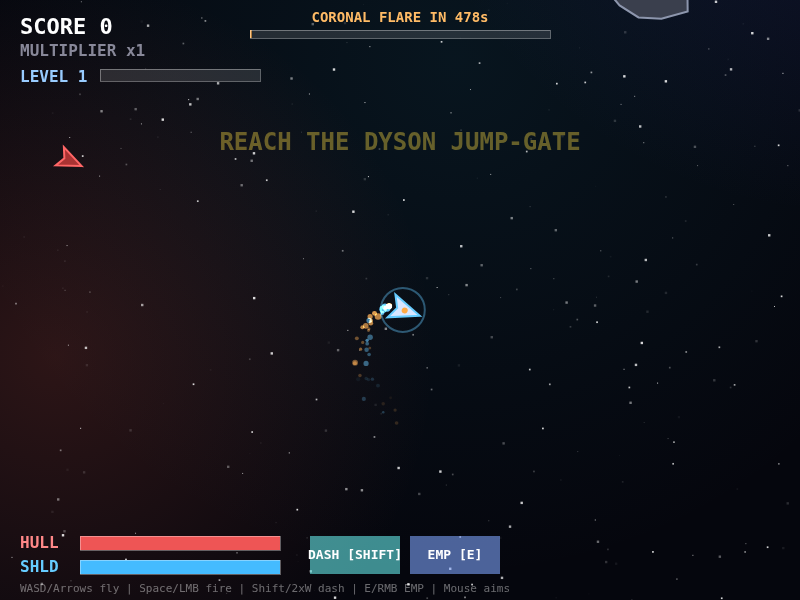
Top-down space roguelite fleet survivor game: Solar Drifter: The Orion Run. Setting & Story: In 2184, a…Top-down space roguelite fleet survivor game: Solar Drifter: The Orion Run. Setting & Story: In 2184, a hyper-solar coronal flare sweeps across the Orion Mining Belt. Pilot the Solar Drifter experimental interceptor through waves of derelict defense drones, automated gunships, and rogue asteroid fields to reach the Dyson Jump-Gate before the flare incinerates the sector. Key Gameplay & Features: 1. 360-Degree Newtonian Inertia Flight & Controls: - Rotate ship with A/D or Left/Right arrows (or aim toward mouse cursor). - Thrust with W / Up arrow (accelerates forward with inertia and deceleration drift). - Retro-thruster brake with S / Down arrow. - Fire primary cannons with Space or Left Click. - Warp Dash with Shift or Double-tap thrust (brief invulnerability phase dash with particle exhaust). - EMP Shockwave with E or Right Click (discharges an expanding EMP ring destroying enemy projectiles and stunning nearby drones). 2. Combat, Upgrades & Roguelite Progression: - Destroying asteroids and enemy ships drops glowing Salvage Cores (blue/gold EXP orbs). - Collecting Salvage fills the EXP bar to Level Up! - On level up, pause briefly with a sleek 3-choice upgrade modal: e.g. Twin Plasma -> Spread Cannon -> Antimatter Beam, Shield Generator (+Max Shield, faster regen), Seeker Drone (spawns an automated escort drone shooting nearby targets), Overdrive Thrusters (+Speed and dash cooldown), or Magnet Field (+Salvage collection radius). 3. Enemies, Asteroids & Boss Encounter: - Asteroids: Large tumbling space rocks that split into medium and small fragments on destruction. - Scout Drones: Fast swarming interceptors that circle and fire pulse lasers. - Mining Gunships: Heavy armored combatants firing dual plasma barrages. - Sector Boss: "Leviathan Dreadnought" - A massive multi-turreted automated warship with glowing energy shield nodes, homing missile volleys, and an epic boss health bar. 4. Retro Space Visuals & FX: - Starfield parallax background with twinkling nebula clouds. - Glowing particle thruster exhaust trails, shield impact ripple rings, asteroid shattering debris, and fiery ship explosion shockwaves. - Floating combat text, damage numbers, and score multipliers. 5. Audio & Music: - Procedural Web Audio API retro space synth soundtrack (atmospheric driving space chiptune synth). - Rich sound effects: laser blasts, thruster hum, asteroid crunches, explosion rumbles, EMP discharge, level up chime, and shield hit rings. Unlock audio on first user gesture. 6. Sovereign Forge SDK Integration: - import { forge } from "@forge/sdk"; - Persistent player stats (high score, best level, total runs) with forge.kv (key: "solar_drifter_save"). - Global Arcade Leaderboard with forge.leaderboard.submit("solar_drifter", score) and viewing top scores.
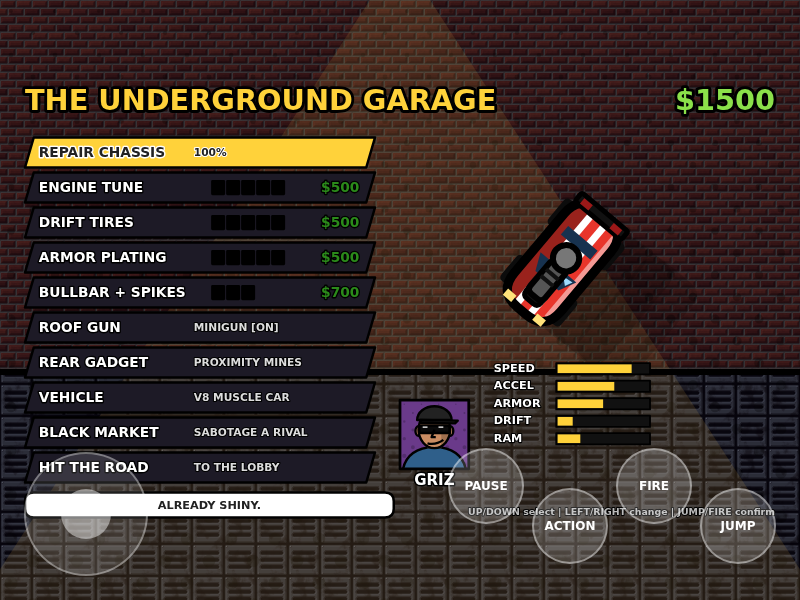
Design a gritty, high-octane, top-down 2D vehicular combat and drifting racing game inspired by classic…Design a gritty, high-octane, top-down 2D vehicular combat and drifting racing game inspired by classic arcade racers like *Death Rally* (1996), rendered in a bold, hand-inked **cel-shaded art style** and set across rugged Australian landscapes. #### 1. Cel-Shaded Look & Atmosphere * **Graphic Novel Aesthetic:** Give the entire overhead world a striking, illustrated comic-book look. Use thick, hand-drawn black ink outlines around every car, cliff edge, tree, and guardrail, paired with flat, vibrant color fills and hard-edged, high-contrast cel shadows instead of soft gradients. * **Stylized Effects & Comic Action:** Render tire smoke, red outback dust clouds, muzzle flashes, and explosions as bold, layered 2D comic-style puffs and jagged starburst shapes. When cars collide, scrape guardrails, or take heavy damage, trigger sharp comic-style visual accents like bright white impact flashes, inked speed lines around the screen edges during boost, and bold, stylized smoke plumes. * **Dramatic Depth & Elevation:** Use crisp, layered parallax cutouts and stark, hard-edged drop shadows to make coastal cliffs feel dizzyingly high and mountain ravines feel deep and claustrophobic. * **Persistent Inked Chaos:** Every race leaves a permanent, graphic record on the road—bold black tire skid marks from wide drifts, jagged scorch craters from mines, scattered metal debris, and smoldering, blackened car wrecks. * **Australian Biomes in Vibrant Cel-Shading:** * **Coastal Cliffside:** Sun-bleached, winding tarmac bordered by crisp white wooden guardrails, jagged ochre limestone cliffs, and vibrant, flat-shaded turquoise ocean waves with stark white comic-style seafoam. Knocking a rival through the guardrail sends them plummeting into the surf below. * **Misty Mountain Pass:** Tight, technical uphill and downhill switchbacks cutting through stylized eucalyptus and snow-gum canopies, with overhanging rock faces and layered, translucent bands of valley fog far below. * **Deep Sandstone Ravine:** A narrow ribbon of asphalt and red dirt snaking between towering, sun-baked terracotta canyon walls, creating razor-sharp, high-contrast shadow lines across the track as you race between blinding sunlight and deep gorge shade. * **Authentic Details:** Crisp yellow kangaroo warning signs, rusty corrugated iron sheds with inked panel lines, golden-hour sunset lighting that casts long, dramatic black shadows across the asphalt, and glowing, high-contrast weapon pickups. #### 2. Feel & Driving Physics * **Heavy, Tactile Arcade Drifting:** Cars should feel weighty and powerful, like tuned V8 muscle cars and rugged off-road utes. Tapping the handbrake or flicking into a corner kicks the tail out into a wide, controllable slide. * **Momentum & Risk-Reward:** Holding a deep drift through a winding mountain hairpin builds up a nitro boost meter and lets you swing your rear-mounted weapons toward pursuers, while exiting cleanly launches the car forward with a visceral burst of speed and inked wind streaks. * **Visceral Impact:** Collisions should feel crunchy and brutal. Side-swiping a rival throws bright comic-style sparks, shoves them toward cliff edges, and visibly dents, blackens, and smokes their chassis as their health drops. #### 3. How It Plays (Combat, AI & Multiplayer) * **The Core Loop:** Win by either crossing the finish line first *or* being the last car left running. Every race is a frantic balance between pure driving skill, resource scavenging, and ruthless combat. * **Vehicular Weaponry & Gadgets:** * **Roof-Mounted Guns:** Forward-firing miniguns, twin cannons, and plasma repeaters that rattle the screen, eject stylized shell casings, and chew through rival armor. * **Rear & Tactical Traps:** Drop proximity mines, glossy black oil slicks (to spin out drifting racers behind you), or spike strips right on the apex of blind mountain corners. * **Battering Rams:** Heavy steel bullbars and wheel spikes that reward aggressive ramming and T-boning during tight ravine bottlenecks. * **Dynamic Track Pickups & Hazards:** Swerve to grab glowing, thick-outlined repair wrenches, ammo crates, nitro boosts, and stacks of cash scattered on dangerous racing lines, while dodging explosive red fuel barrels and wandering wildlife. * **Multiplayer & Ruthless AI:** * **Seamless Lobbies:** Built for chaotic multiplayer races where any empty spots are filled by distinct, personality-driven AI rivals with bold, illustrated character portraits. * **Smart Rival Behavior:** Opponents shouldn't just drive on rails—they drift hard around hairpins, aggressively try to pit-maneuver you toward cliff drop-offs, drop mines when being tailgated, and swerve off the racing line to steal repair pickups when damaged. * **Underground Garage & Sabotage:** Between races, visit a moody, comic-book-styled garage menu to spend prize money and bounty cash on repairs, engine upgrades, drift tires, armor, and weapons—or pay shady mechanics in a black-market backroom to secretly sabotage a rival's car before the next race begins.
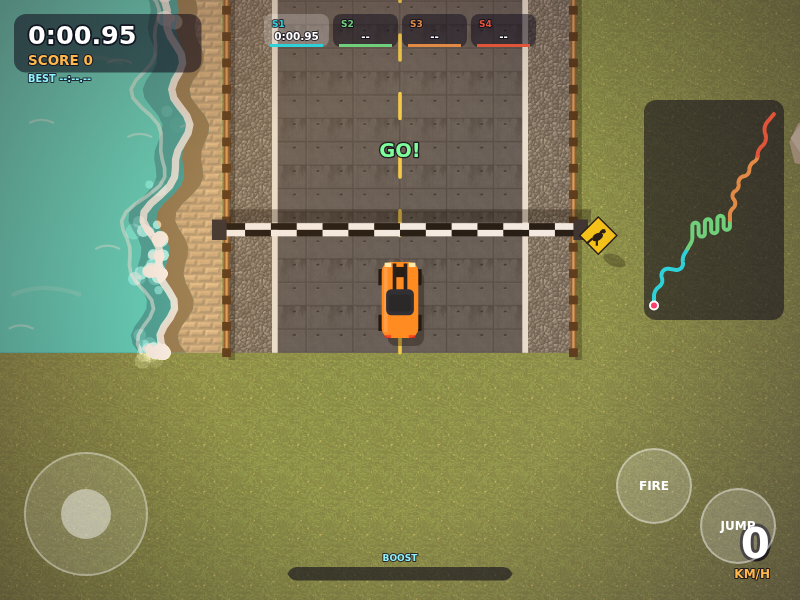
Create a stylized, top-down 2D arcade drifting and racing game set across iconic Australian landscapes…Create a stylized, top-down 2D arcade drifting and racing game set across iconic Australian landscapes. ### Core Gameplay & Physics * **Camera Perspective:** Smooth overhead/top-down camera with subtle dynamic zoom (zooming out slightly at high speeds to give better corner visibility) and slight camera lead in the direction the car is drifting. * **Drifting Mechanics:** Responsive arcade drift physics. Tapping the handbrake or sharply turning at high speed initiates a slide. Maintaining a drift builds up a "Boost" meter, leaves persistent dark tire skid marks on the asphalt, and kicks up thick white tire smoke (or red dirt clouds if a wheel clips the shoulder). Counter-steering controls the drift angle, and exiting a clean drift triggers a speed burst. * **Vehicles:** Classic Australian muscle cars and street-tuned icons (e.g., 1970s V8 coupes, twin-turbo utes, and custom drift sedans) with distinct handling stats for grip, drift angle, and top speed. ### Track Design & Environments Design long, technical, point-to-point touge runs and sweeping circuits featuring dramatic elevation illusions (using layered shadows, bridges, underpasses, and cliffside drop-offs) across four distinct Australian biomes: 1. **Coastal Cliffside (Great Ocean Road style):** Long, winding tarmac hugging jagged limestone cliffs directly beside a crashing turquoise ocean, featuring sweeping coastal hairpins, ocean spray particles, and wooden guardrails. 2. **Mountain Pass & Alpine Switchbacks (Victorian High Country / Snowy Mountains style):** Tight, technical uphill and downhill S-bends cutting through towering eucalyptus and snow-gum forests, complete with overhanging rock faces and misty valleys below. 3. **Deep Mountain Ravine (Blue Mountains / Gorge style):** A narrow, high-speed ribbon of asphalt snaking through the bottom of a deep canyon flanked by sheer sandstone cliff walls on both sides, creating dramatic lighting shifts between bright sunlight and deep canyon shadows. 4. **Inland Red-Dirt & Tarmac Hybrid:** Sun-baked red earth shoulders, rusty corrugated iron sheds, and sweeping high-speed corners where clipping the apex kicks up orange outback dust. ### Visuals, Audio & Atmosphere * **Art Style:** Crisp, vibrant 2D vector or high-detail pixel art with strong environmental depth—use parallax layers for deep ravines, crashing waves, and treetops below elevated bridges. * **Australian Details:** Include authentic roadside props like yellow kangaroo warning signs, white wooden guideposts, eucalyptus trees, rocky outcrops, and golden-hour sunset lighting. * **Audio:** Roaring V8 and turbo flutter engine notes, screeching tires during sustained drifts, gravel crunch when hitting the road shoulder, and an energetic Aussie pub-rock / synth-wave soundtrack. ### Technical Requirements for Prototype * Implement a complete, playable vertical slice featuring one multi-biome winding track that transitions from a coastal cliff road into a tight mountain ravine. * Include a drift score counter, lap/sector timer, ghost replay system for best times, and simple keyboard/gamepad controls (Accelerate, Brake/Reverse, Steer, Handbrake, Boost).
PANTRY ALCHEMIST — a kitchen pantry and meal-planning web app themed as an alchemist's grimoire: your…PANTRY ALCHEMIST — a kitchen pantry and meal-planning web app themed as an alchemist's grimoire: your ingredients are reagents, your recipes are formulae, and the app tells you what you can brew from what you already have. THE PITCH Every household throws away food it forgot it had, and every evening someone stares into the fridge asking "what can I make?". Pantry Alchemist answers both. You keep an inventory of your pantry, fridge and freezer (the Reagent Shelves), with quantities and best-before dates. You keep your favourite recipes (the Formulae) with their ingredients. The app's Transmutation Table matches the two: it shows which recipes you can brew right now, which are one or two reagents away, and which reagents are about to spoil so you can use them first. It builds a weekly meal plan and a shopping list from the gaps. The theme is playful and atmospheric, but the tool is practical and fast enough to use every day. DESIGN DIRECTION: THE ALCHEMIST'S GRIMOIRE - Feel: an old leather-bound book open on a candlelit desk, but with crisp modern usability. - Palette: aged parchment (#efe3c8) for page surfaces, oxblood leather (#5c1f1f) for the outer frame and headers, ink brown (#2e2018) for text, verdigris (#3f8f7d) for "ready to brew", amber (#d99a2b) for "almost", alchemical red (#b23a2e) for "spoiling soon", and gold leaf (#c8a24a) for accents and focus rings. - Typography: headings in a serif stack with character ("Palatino Linotype", "Book Antiqua", Palatino, Georgia, serif) in small caps; body in Georgia; numbers in tabular figures. - Ornament: each section is a "page" with a slightly torn top edge (a CSS clip-path or an SVG edge), corner glyphs drawn as alchemical symbols in inline SVG (triangles for fire/water/air/earth, the circle-dot of gold, a crescent of silver), and faint ruled lines like a ledger. - Categories become elements: Produce = Earth (green triangle), Dairy & Eggs = Water, Grains & Bread = Air, Spices & Condiments = Fire, Meat & Fish = Salt, Frozen = Quicksilver. Show these glyphs on reagent chips. - Motion: a soft shimmer when a recipe becomes brewable; a page-turn fade between sections; respects prefers-reduced-motion. Call forge.ui.theme() for base controls, and layer the grimoire styles in style.css. SECTIONS (a left sidebar of tabs on wide screens, a bottom tab bar on phones) 1. Reagent Shelves (inventory) - Add an ingredient: name, quantity, unit (g, kg, ml, l, pcs, cup, tbsp, tsp), category (element), location (Pantry, Fridge, Freezer), and optional best-before date. Quick-add field that parses "2 kg flour" or "6 eggs" or "milk 1 l" into quantity, unit and name. - List grouped by location, with filters (element, location, "spoiling within 3 days") and sorting (name, expiry, recently added). Search box. - Each item shows quantity with − and + buttons, the element glyph, and an expiry badge: verdigris if fine, amber within 7 days, alchemical red within 2 days or past. - Edit inline; delete with forge.ui.confirm and an undo toast. 2. Formulae (recipes) - Add a recipe: name, servings, time, tags (e.g. vegetarian, quick, comfort), ingredients as lines ("200 g pasta", "2 cloves garlic", "olive oil to taste" — parse quantity, unit and name; "to taste" means optional), and method steps. - Scale servings up and down and see the quantities update. - Recipe card view with ingredients marked as Have (verdigris), Short (amber, shows the shortfall) or Missing (red). - Import recipes by pasting a plain-text recipe (ingredients and steps separated by a blank line) and export them as JSON. 3. Transmutation Table (what can I make?) - Three columns: Ready to Brew (all required ingredients available in sufficient quantity), One or Two Away (with the missing reagents listed and an "Add to shopping list" button), and Inspiration (recipes that use reagents spoiling soonest, ranked by how many soon-to-spoil reagents they use up). - Matching must handle units sensibly: convert between g/kg, ml/l, and tsp/tbsp/cup for common pantry items; treat "pcs" separately; ignore optional ("to taste") lines. Match names loosely (case-insensitive, singular/plural: "egg" matches "eggs", "tomatoes" matches "tomato"). - "Brew it": marks a recipe as cooked, subtracts the used quantities from the shelves (after showing a confirmation of what will be deducted), and logs it to the Grimoire History. 4. The Week (meal planner) - A seven-day grid (Monday to Sunday) with Lunch and Dinner slots; drag recipes from a side list into slots (also possible with keyboard: select a slot, press Enter, choose a recipe). - An "Auto-plan" button that fills empty slots, preferring recipes that use spoiling reagents and avoiding the same recipe twice in a week. - The plan's total ingredient needs are compared with the shelves to generate the shopping list. 5. Shopping Scroll (shopping list) - Generated from the week's plan and from manual additions; grouped by element/aisle; check items off as you shop; "Move checked to shelves" adds them to the inventory with today's date. - Export as plain text and copy to clipboard (forge.ui.copy) for sharing. 6. Grimoire History and Settings - A log of brewed recipes and wasted reagents (when an item expires and is removed, ask "Used or wasted?" and keep a small waste tally to celebrate improvement: "This month you saved 6 reagents from spoiling"). - Export/import all data (JSON) with forge.ui.download and forge.ui.pickFile; CSV export of the inventory with forge.data.csv.stringify. - Default servings, week start day, unit system preference (metric only is fine, with cups/spoons supported for recipes). - Clear all data behind a danger confirmation. DATA AND PERSISTENCE - forge.data.collection("reagents"), collection("formulae"), collection("history") for records. - forge.kv for the week plan ("pantry-week"), shopping list ("pantry-shopping") and settings ("pantry-settings"). - Everything persists across reloads. SEED CONTENT AND EMPTY STATES - First run: an inviting empty state with "Stock the shelves with a starter pantry" (adds about 20 common reagents with realistic quantities and some near-expiry dates, clearly marked as examples) and "Add five starter formulae" (e.g. Garlic Pasta, Vegetable Omelette, Tomato Soup, Pancakes, Chickpea Curry). Both can be removed with one click. - The Transmutation Table must immediately show some Ready to Brew and One Away recipes with the starter data. QUALITY BAR - Inline validation with friendly messages (quantities must be positive numbers; dates valid). - Keyboard shortcuts via forge.ui.hotkeys: "a" quick-add reagent, "r" new recipe, "/" search, "t" Transmutation Table, "w" the Week, "?" shortcuts dialog. - Accessible: labelled controls, proper headings, focus rings in gold, status badges with text (not colour alone), tabs as a tablist. - No alert, prompt or confirm: forge.ui.toast, forge.ui.confirm, forge.ui.prompt, forge.ui.dialog only. - Render the full shell immediately on load, then fill in data. - Number formatting with forge.data.fmt.number and dates with forge.data.fmt.date / relative ("in 2 days"). TECHNICAL REQUIREMENTS FOR THIS PLATFORM - Render into <main id="app"> with DOM APIs; plain ES modules: main.js (shell and navigation), store.js (collections, kv, import/export), parse.js (ingredient line parsing and unit conversion), shelves.js, formulae.js, table.js (matching logic), week.js, shopping.js, history.js, glyphs.js (SVG element symbols). Each imported name exported by its file. - import { forge } from "@forge/sdk" (kv, data, ui). No external libraries, fonts or images. - Keep the matching logic in pure functions (parse.js and table.js) separate from the DOM so it's reliable. ACCEPTANCE CHECKLIST - The grimoire-styled shell renders immediately; starter data can be added in one click. - Inventory: add (including quick-add parsing), adjust, filter, sort, search, expiry badges, delete with undo. - Recipes: add with parsed ingredient lines, scale servings, see Have/Short/Missing per ingredient, import pasted text, export JSON. - Transmutation Table shows Ready, One or Two Away and Inspiration correctly, with unit conversion and loose name matching; "Brew it" deducts quantities. - Week planner with drag-and-drop and keyboard, auto-plan, and a shopping list generated from gaps; checked items move to the shelves. - History with the waste tally; export/import; everything persists via forge.data.collection and forge.kv. AN EVENING WITH PANTRY ALCHEMIST, AS THE USER SHOULD EXPERIENCE IT It's 6 pm and the user opens Pantry Alchemist on the kitchen tablet. The grimoire design is already there: a parchment page inside an oxblood leather frame, gold corner glyphs, and the Transmutation Table open by default. Because they stocked the starter pantry last week, the Ready to Brew column shows three formulae with verdigris seals: Garlic Pasta, Vegetable Omelette and Tomato Soup. The Inspiration column is headed "Use before they spoil" and puts the Vegetable Omelette first, because the spinach and the eggs both expire in two days — their reagent chips glow alchemical red. They open the omelette, scale it from 2 to 3 servings with the + button (the quantities update: 6 eggs, 150 g spinach), and press "Brew it". A dialog lists what will be deducted ("6 eggs, 150 g spinach, 30 g cheese, 1 tbsp butter"); they confirm, and the shelves update. A soft shimmer plays across the Ready column as Pancakes drops to "One Away — missing 200 ml milk". They tap "Add to shopping list". On Sunday, they open The Week, press Auto-plan, and the grid fills with seven dinners, favouring recipes that use what is about to spoil. The Shopping Scroll lists everything needed grouped by element: Earth (onions, carrots), Water (milk), Salt (chicken thighs). At the shop they tick items off on their phone; at home they press "Move checked to shelves", and the reagents appear with today's date. At the end of the month, the History page says "This month you saved 11 reagents from spoiling." VOICE AND MICROCOPY Playful alchemy flavour in headings, plain and clear in actions: - Section titles: "Reagent Shelves", "Formulae", "Transmutation Table", "The Week", "Shopping Scroll", "Grimoire History". - Buttons stay literal: "Add reagent", "Brew it", "Add to shopping list", "Auto-plan the week". - Empty shelves: "Your shelves are bare. Stock them with a starter pantry, or add what you have." - Ready column empty: "Nothing can be brewed from the shelves yet. The One Away column shows the closest formulae." - Spoiling badge text: "spoils in 2 days", "spoils today", "spoiled 1 day ago". - Brew confirmation: "Brewing Vegetable Omelette for 3 will use: …". - Waste prompt when removing an expired item: "Was it used or wasted?" with two buttons. PARSING AND MATCHING RULES (implement as pure functions with clear tests in mind) - Quantity parsing: accept "2", "1.5", "1/2", "1 1/2", "½", "2-3" (take the upper bound for shopping, the lower for matching), and words "a" or "an" as 1. - Units: g, kg, ml, l, tsp, tbsp, cup, pcs (also "piece", "pieces", "clove(s)" → pcs, "pinch" → optional), "to taste" and "optional" → optional ingredient. - Conversions: 1 kg = 1000 g; 1 l = 1000 ml; 1 tsp = 5 ml, 1 tbsp = 15 ml, 1 cup = 240 ml. For dry goods measured in cups (flour, sugar, rice), use rough densities: flour 125 g per cup, sugar 200 g, rice 185 g, oats 90 g, butter 227 g. If units can't be reconciled (pcs vs g), treat as "Have" when any amount is on the shelves and mark it with a small "≈" sign. - Name normalisation: lower case, trim, remove adjectives in a short list (fresh, chopped, diced, large, small, ripe), singularise simple plurals (es, s, ies → y), and match against shelf names with the same normalisation; allow a manual alias list in Settings ("scallion = spring onion"). - Shortfall: required minus available after conversion; "Short" when 0 < available < required. - Auto-plan: score each recipe = 3 × (number of spoiling-soon reagents it uses) + 1 × (number of ingredients already available) − 2 × (missing ingredients); pick greedily without repeats, leaving slots empty if no recipe scores above zero. POLISH LIST - Element glyphs drawn as tiny inline SVGs with consistent stroke widths; each category has its own subtle tint. - The shopping list is printable and copyable as clean plain text with checkboxes ("[ ] 200 ml milk"). - Keyboard-first: the quick-add field is focused when pressing "a"; Enter adds, Escape clears. - Quantity steppers respect units (± 1 for pcs, ± 50 for g and ml, ± 0.1 for kg and l). - On phones, the bottom tab bar shows icons with labels, and the Transmutation Table stacks its three columns as collapsible sections with counts in their headers.
Role: You are an expert game developer and physics programmer. Build a complete, single-file playable…Role: You are an expert game developer and physics programmer. Build a complete, single-file playable HTML5/JavaScript puzzle game called "PATCH // VOID"—a tactile, diegetic sci-fi telecom switchboard game with real-time rope physics, signal routing, and physical cable tangling. 1. Visual Aesthetic & Diegetic UI: Theme: Retro-futuristic cassette-punk / brutalist orbital relay terminal (inspired by Alien, Papers, Please, and Keep Talking and Nobody Explodes). Deep charcoal brushed-metal chassis, warm amber/phosphor-green CRT readouts, recessed brass/chrome 1/4-inch jack sockets, and braided cloth/rubber patch cables. Procedural Audio (Web Audio API): Synthesize all sound effects with zero external assets: heavy mechanical clunk on plug-in, spring twang when a cable is pulled taut, subtle electrical hum proportional to active signal load, static crackle on interference, and a crisp relay snap on level completion. Zero-Text HUD: All instructions and state are diegetic—LED ring indicators around jacks, an analog voltage/signal-integrity needle gauge, and etched metal labels on the faceplate. 2. Core Physics Engine (2D Verlet Integration): Implement a custom 2D Verlet physics solver running at a fixed 60Hz timestep with 8–12 constraint relaxation iterations per frame. Each patch cable is a chain of 18–24 point masses with distance constraints, subtle gravity, and air damping. Cable-to-Cable Collision & Tangling: Cables must physically collide with each other and with board obstacles (capacitor pillars, heat sinks, grounding pegs) using segment-to-segment distance checks and positional impulse resolution. Cables cannot pass through pegs or each other, allowing them to drape, snag, and tangle. Tension Mechanics: Each cable has a maximum physical slack length. Pulling a cable too far stretches it taut (visualized by cable thinning, vibration, and rising pitch hum). Exceeding max tension pops the plug out of the socket with a spark burst. 3. Gameplay Mechanics & Puzzle Rules: Sockets: Transmitters (TX): Emit a specific signal wave (Square, Sine, Sawtooth) and color/frequency. Receivers (RX): Require a matching waveform and minimum signal strength to lock in. Modifiers / Nodes: Inline sockets (Signal Amplifier, Phase Inverter, Frequency Splitter) that must be patched through to reach the final RX. The Tangle & Cross-Talk Mechanic (Core Twist): When two unshielded cables physically touch or cross under tension, they induce Cross-Talk Interference (visualized by arcing sparks at the intersection point and jitter on the CRT oscilloscope). Players must route cables around insulating ceramic pegs, drape heavy shielded cables over unshielded ones to pin them down, or unplug and re-weave existing connections in the correct topological order to eliminate cross-talk while maintaining enough slack to reach distant jacks. Controls: Click and drag a cable plug to lift, move, and snap into sockets. Right-click (or flick) a plugged jack to unplug it. Hovering over a cable highlights its current tension and signal integrity. 4. Level Progression (5 Distinct Handcrafted Levels + Reset/Next Controls): Level 1 (Handshake): 2 TX, 2 RX, 1 central obstacle peg. Teaches slack limits and basic routing. Level 2 (Cross-Talk): 3 pairs where direct paths force cable collisions; player must weave over/under and hook around insulating pegs to separate lines. Level 3 (The Relay): Introduces an inline Amplifier node and a fixed pre-patched "legacy" cable that cannot be unplugged, forcing the player to route around a physical obstacle. Level 4 (Overload & Slack): Tight cable lengths where hooking around pegs consumes too much slack, requiring a specific plug-in sequence so cables drape cleanly without snapping. Level 5 (The Rat's Nest): 5 active lines, pre-tangled dummy cables that must be unpatched and re-ordered, and mixed signal modifiers. 5. Technical Constraints: Output a single, self-contained index.html file with embedded CSS and vanilla JS (HTML5 Canvas). Include a clean CRT oscilloscope preview in the corner of the switchboard showing live target vs. received waveforms. Ensure smooth mouse/touch dragging with spring-damped cursor attachment so fast drags feel weighty rather than rigid.
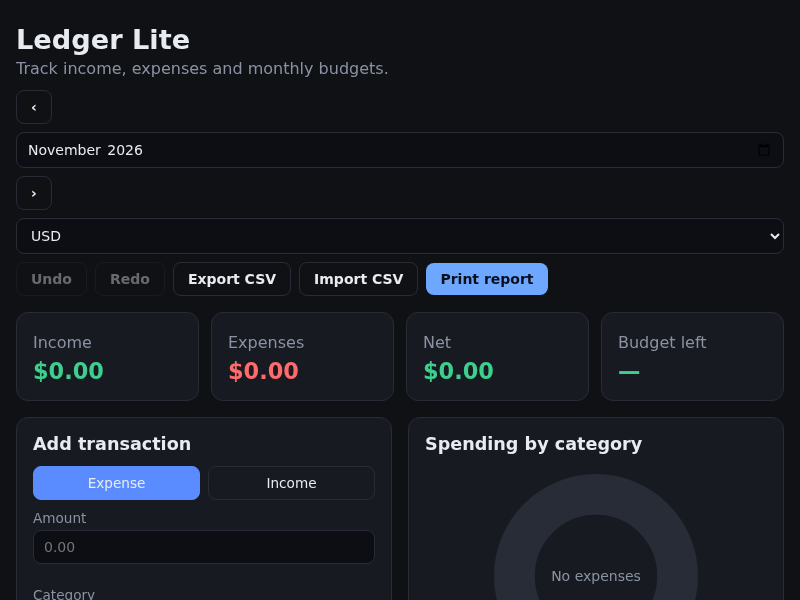
A personal expense and budget tracker: log income and expenses with categories, set monthly budgets, and see…A personal expense and budget tracker: log income and expenses with categories, set monthly budgets, and see spending summaries by category.
3D river runner game built with Three.js and @forge/sdk: Mousy Paradise Sewer Rapids. Theme & Narrative: You…3D river runner game built with Three.js and @forge/sdk: Mousy Paradise Sewer Rapids. Theme & Narrative: You are Pip, a brave little mouse riding an inflatable rubber tube down a wild, turbulent sewer river, dodging sewer hazards and collecting cheese on a quest to reach the legendary Mousy Paradise (a sunlit sanctuary filled with giant cheese wheels). Key Gameplay & Features: 1. 3D Sewer River & Environment: Dynamic rushing sewer flume with animated rushing water, slimy brick tunnel walls, overhead pipe arches, dripping sewer stalactites, and floating foam particles. The river curves dynamically as the player hurtles downstream. 2. Player Controls & Tube Physics: - Player is a cute mouse riding inside a bright rubber inner tube with realistic water buoyancy and rocking tilt. - Controls: A/D or Left/Right Arrow keys to steer across the current, W to paddle faster forward, S to brake/slow down, Spacebar to hop/bounce the inner tube over floating obstacles. 3. Hazards & Obstacles: - Floating radioactive sludge barrels (toxic splash on contact). - Rusty sewer iron grates, submerged debris, and wooden planks. - Snapping sewer alligators lurking on tunnel walls. - Swirling water whirlpools that drag the tube towards the vortex. 4. Collectibles & Powerups: - Swiss cheese wedges scattered along river currents (+50 score, speed boost). - Golden Cheese Wheel (+invulnerable glowing bubble shield). - Soda Can Rocket (+rapid jet boost with bubble exhaust). - Extra Hearts / Cheese Rations to heal tube health. 5. Journey to Mousy Paradise & Progression: - Distance meter (0 to 1,000 meters). Progressively transitions through sewer zones (The Dark Culvert -> Slime Rapids -> The Siphon -> The Sunlit Drain to Mousy Paradise). - Reaching 1,000m triggers the glorious Mousy Paradise victory scene: golden sun rays, blooming greenery, giant cheese mountains, and celebration confetti. 6. HUD, Audio & Presentation: - Full arcade HUD: Cheese Hearts (Health), Cheese Score counter, Distance Progress Bar, Speedometer. - Web Audio API procedural sound synthesizer: water rushing ambient loop, splash sound on steer, bounce boing, cheese chime pickup, crash thump, and victory fanfare. - Responsive Three.js resize handling and smooth following camera. 7. Sovereign Forge SDK Integration: - import { forge } from "@forge/sdk"; - High score and best run persistence with forge.kv (forge.kv.get("mousy_paradise_best") and forge.kv.set("mousy_paradise_best", ...)). - Global Leaderboard with forge.leaderboard.submit("mousy_paradise", score) and view top runs. - Multiplayer party / ghost mode with forge.net so players can see other mice tubing down the river.
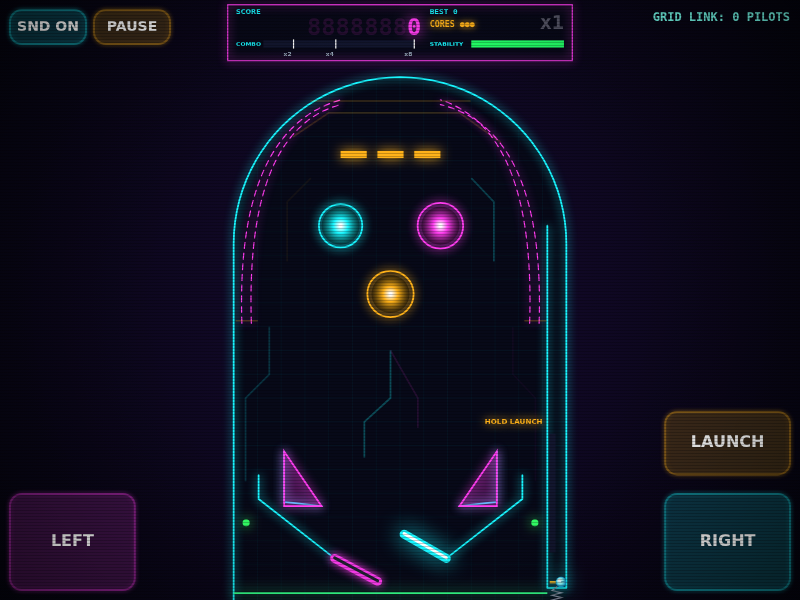
Create a high-speed retro-cyberpunk arcade pinball game titled "HyperSphere: Kinetic Pinball". STORY & THEME…Create a high-speed retro-cyberpunk arcade pinball game titled "HyperSphere: Kinetic Pinball". STORY & THEME: Deep inside the Sol Research Tokamak magnetic containment chamber, an experimental plasma core named Kinetix has achieved critical energy. The player must manipulate electromagnetic flippers, repulsion bumpers, laser ramps, and gravity wells to deflect Kinetix through magnetic circuits, stabilize tokamak coolant valves, trigger multiball chain reactions, and prevent an antimatter meltdown! VISUAL STYLE & GRAPHICS: - Rich 2D canvas retro-future neon synthwave pinball table (responsive vertical arcade cabinet layout centered on screen). - Dark metallic tokamak grid background with pulsing neon cyan, magenta, and amber circuits. - Glowing circular bumpers that pulse and flash upon collision with radiant ring shockwaves. - Articulated dual flippers (left and right) with smooth angular kinematics and illuminated contact edges. - Curved wireframe ramps and drop-target light sequences. - Dynamic particle emitter trails behind the glowing plasma sphere. - CRT scanline overlay and camera screen-shake on heavy bumper combos. - Retro digital arcade LED score display at the top, combo multiplier gauge (x2, x4, x8), and containment stability meter. GAMEPLAY MECHANICS: - Realistic pinball ball physics: velocity, gravity, friction, ball spin inertia. - Precise flipper mechanics: Left flipper (A or Left Arrow, or left screen touch/button), Right flipper (D or Right Arrow, or right screen touch/button). Ball can be trapped, cradled, or aimed with flipper tip precision. - Spring Plunger / Auto-launch: Spacebar or Down Arrow or "Launch" button pulls back spring plunger to shoot ball up the launch chute into play. - Interactive Table Elements: * 3 Central Tokamak Super-Bumpers (repels ball with velocity kick, sparks, and SFX). * 2 Return Slingshots above the flippers that kick the ball inward. * Quantum Overdrive Ramp: hitting the ball through the upper loop activates Overdrive (score multiplier + temporary ball saver barrier). * 3 Antimatter Drop-Targets: knocking down all 3 unlocks Multiball (spawns 2 additional kinetic plasma spheres simultaneously!). * Outlane kickback savers and center drain hazard. * Drain detection with ball count (3 plasma cores per run), Extra Ball awards on milestone scores. PLATFORM INTEGRATIONS: - Must import and use `@forge/sdk`: * `forge.math.distToSegment(px, py, x1, y1, x2, y2)` and `forge.math.reflect(vx, vy, nx, ny, elasticity)` for flipper line-segment collision resolution and angle reflections. * `forge.math.lineIntersect(x1, y1, x2, y2, x3, y3, x4, y4)` for ramp trigger lines and sensor gates. * `forge.physics.bounce` and `forge.physics.circleBox` for bumper and barrier reflections. * `forge.audio.play("bumper")`, `forge.audio.play("flipper")`, `forge.audio.play("launch")`, `forge.audio.play("score")`, `forge.audio.play("powerup")`, `forge.audio.play("explosion")`. * `forge.audio.startMusic("synthwave", { bpm: 128 })` for high-energy synthwave arcade soundtrack with mute/unmute control. * `forge.fx.createEmitter()` for particle sparks on bumper impacts and flipper strikes. * `forge.tween.to` for floating combo score indicators (+500, +2,000, MULTIBALL!) and HUD animations. * `forge.kv.get("kinetic_pinball_best")` and `forge.kv.set("kinetic_pinball_best", bestScore)` for local persistence. * `await forge.net.join("tokamak-reactor-grid")` with `room.broadcast` and `room.onMessage` for multiplayer spectator high scores. * `await forge.leaderboard.submit("hyper-sphere-kinetic-pinball", finalScore)` and high score table display. - Include responsive on-screen buttons for touch / mouse input (Left Flipper, Right Flipper, Launch, Sound toggle). - Standalone self-contained game with polished menu, instructions, game loop, pause state, game over state with leaderboard submit, and high replayability!
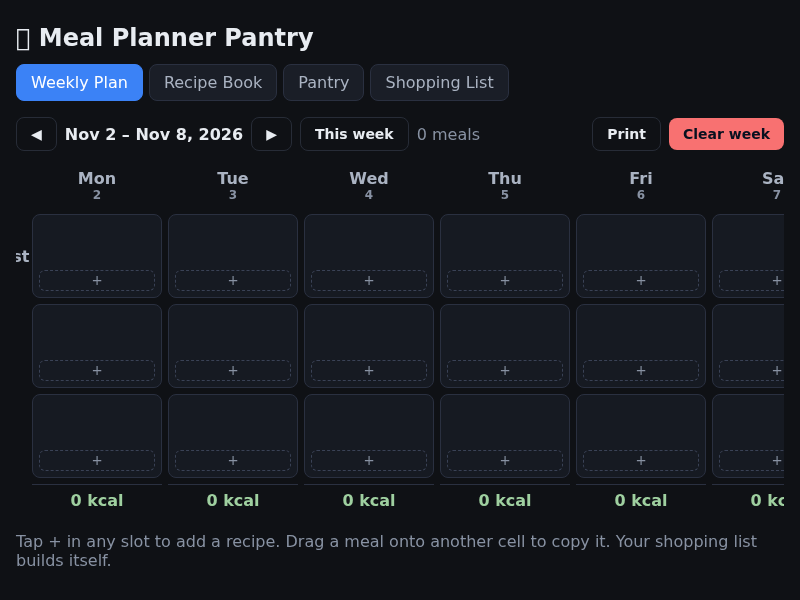
A weekly meal planner with a recipe book: plan meals on a weekly grid and auto-generate a combined shopping…A weekly meal planner with a recipe book: plan meals on a weekly grid and auto-generate a combined shopping list from the planned recipes.
A flashcard study app with decks and spaced repetition scheduling: review due cards, rate recall, and see…A flashcard study app with decks and spaced repetition scheduling: review due cards, rate recall, and see study statistics.
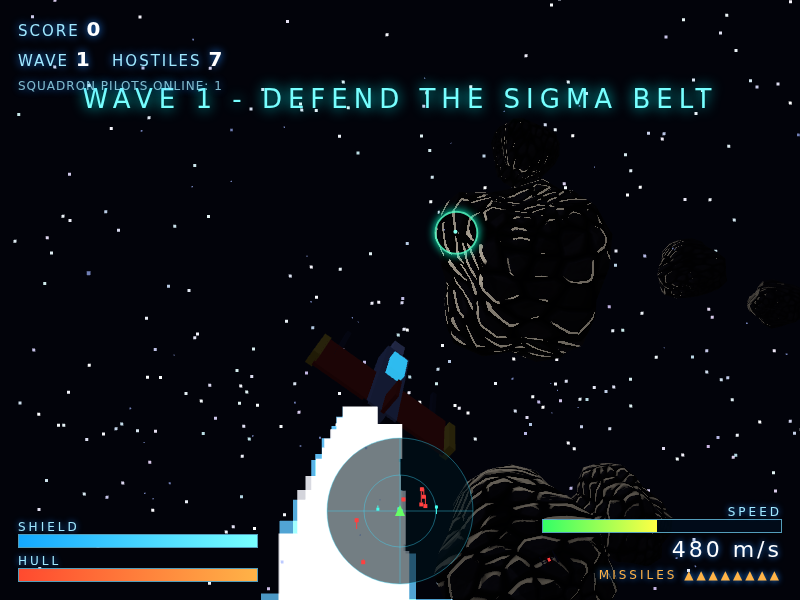
Create an exhilarating 3D arcade starfighter space combat simulator titled 'Star Corsair 3D'. Story: As pilot…Create an exhilarating 3D arcade starfighter space combat simulator titled 'Star Corsair 3D'. Story: As pilot of the starfighter Corsair-1, defend the Sigma Asteroid Belt from an encroaching enemy armada of drone fighters, defense turrets, and dreadnoughts. Gameplay & Features: 1. Full 3D dogfight combat in Three.js with a smooth third-person chase camera. Controls: Mouse or Arrow keys (or WASD) to pitch, yaw, and roll with realistic ship banking tilt; W/S or Up/Down for throttle acceleration and airbrakes; Space or Left Click to fire twin plasma lasers; Shift, F, or Right Click to fire lock-on homing missiles. 2. 3D Voxel Models: load and display 3D models from models.js such as 'spaceship' for player craft, 'security_drone' for swarming enemy fighters, 'sentry_turret' for defense platforms, and 'crystal' for floating energy asteroids. 3. 3D Physics & Collisions: use 'forge.math.dist3' and 'forge.math.sphereHit' for 3D projectile hits and proximity warnings, and 'forge.math.lerp3' for smooth camera interpolation. 4. Audio & Procedural Space Music: start the atmospheric space arpeggio music with 'forge.audio.startMusic("space", { bpm: 120 })' and call 'forge.audio.unlock()' on initial canvas click. Use built-in sound presets: 'forge.audio.play("laser")' for blasters, 'forge.audio.play("lockon")' when acquiring targets, 'forge.audio.play("missile")' for rocket fire, and 'forge.audio.play("explosion")' for enemy kills. 5. Visual FX & Cockpit HUD: reticle target crosshair, lock-on diamond indicators, shield/hull integrity meters, speed gauge, and engine particle thruster exhaust. 6. Multiplayer & Leaderboard: join flight channel via 'await forge.net.join("star-corsair-squadron")' and submit mission score with 'await forge.leaderboard.submit("star-corsair-space-flight-3d", score)'.
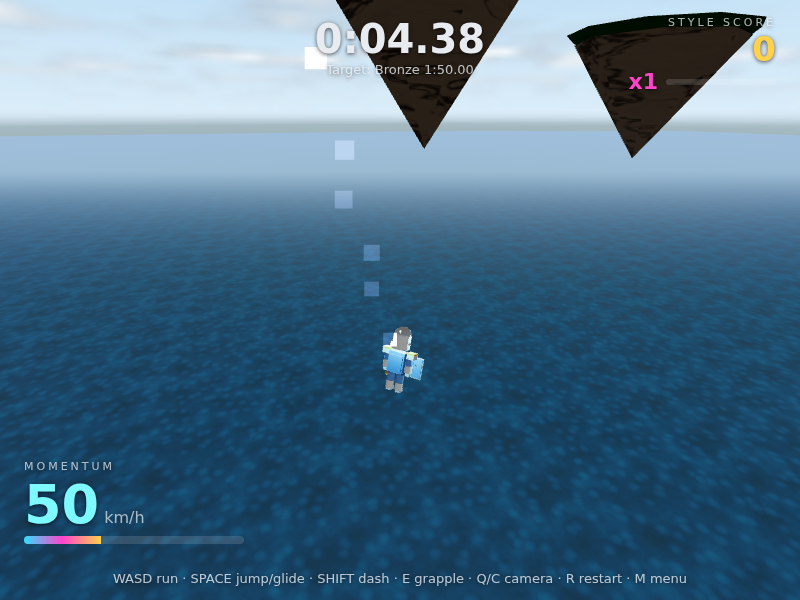
Create Aether Strider 3D (aether-strider-3d), a high-speed 3D sky-ruins grapple, rail-grind, and wingsuit…Create Aether Strider 3D (aether-strider-3d), a high-speed 3D sky-ruins grapple, rail-grind, and wingsuit parkour action game in Three.js. Features: (1) Third-person animated 3D runner with responsive WASD sprint, double-jump, air-dash, grapple-hook swing (E/Click) to floating grapple anchors, glowing energy rail-grinding between sky islands, and wingsuit updraft gliding; (2) 3 multi-stage floating temple courses with rotating ring boosters, moving stone platforms, laser hazards, and sentinel drones; (3) Momentum speedometer HUD, style combo multiplier, split timer, medal ratings (Bronze/Silver/Gold/Aether), and persistent best times + unlocked suit trails via forge.kv.
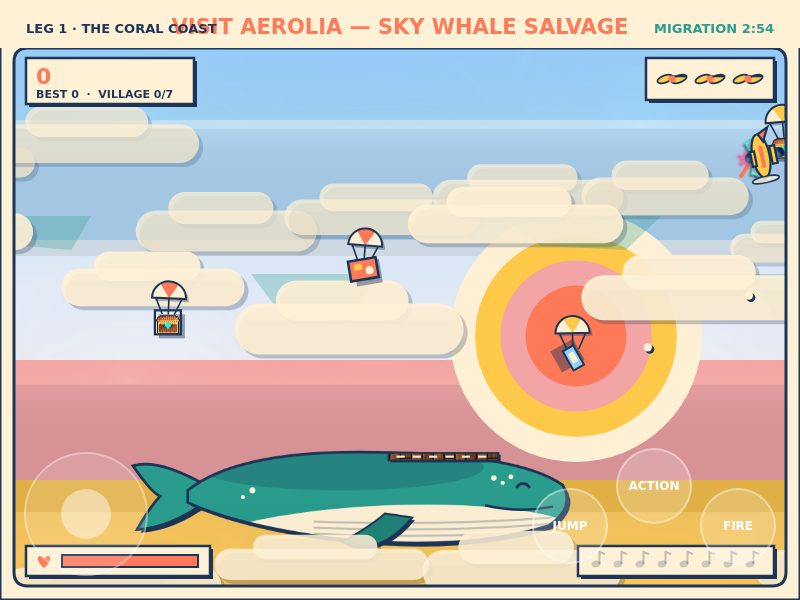
SKY WHALE SALVAGE — a 2D canvas arcade salvage shooter painted like a 1950s travel poster, flown from the…SKY WHALE SALVAGE — a 2D canvas arcade salvage shooter painted like a 1950s travel poster, flown from the back of a giant migrating sky whale. THE PITCH Above the cloud sea of Aerolia, great sky whales migrate along the trade winds, carrying whole villages on their backs. When airships wreck in storms, their cargo floats in the clouds — and salvagers on whale-back race to claim it. You are June Calloway, a salvage pilot whose little biplane, the Daisy Bell, launches from the back of Old Marguerite, the oldest whale in the flock. Sky Whale Salvage is a side-scrolling arcade game with a twist: you fly loops around the whale itself, grabbing floating crates with your grappling hook, fighting off sky-pirates who want the same loot, and bringing everything home to Marguerite's back to build up the village. Marguerite is your base, your shield and your friend — she sings, she rolls, and if she's hurt too badly the migration ends. ART DIRECTION: 1950s TRAVEL POSTER Bold, flat, optimistic mid-century illustration: limited palettes, big simple shapes, subtle halftone texture and soft offset shadows. - Palette: sunset coral (#ff7a59), sunflower (#ffc94a), teal (#2a9d8f), cream (#fff1d6), navy ink (#1d3557), dusty pink (#f4a6a6), and sky blues from #8fd3ff to #e9f7ff. - Sky: horizontal bands of flat colour with a big low sun drawn as a perfect circle with concentric stripes, stylised clouds as stacked rounded rectangles in cream with flat navy shadows offset down-right, and far floating islands as simple silhouettes. - Halftone: pre-render a dot-pattern texture once (an offscreen canvas of small dots) and overlay it on clouds and the whale's shadow side at low alpha for a printed-paper look. Add a cream paper border around the play area with rounded corners and a poster title strip at the top: "VISIT AEROLIA — SKY WHALE SALVAGE" in a bold condensed font stack ("Impact", "Arial Black", sans-serif). - Old Marguerite: an enormous whale silhouette spanning most of the screen's width at the bottom third, drawn with flat teal body, cream belly, darker navy markings, barnacle dots, a slow tail flick and a blinking eye. On her back: a village of little houses with coral roofs, a lighthouse, laundry lines with flapping cloth, and a runway. The village grows as you deliver salvage. - The Daisy Bell: a small sunflower-yellow biplane with coral stripes, a spinning propeller (a blur ellipse), and a scarf trailing from June's open cockpit. - Sky-pirates: navy and black gyrocopters with skull-shaped balloons, drawn in the same flat style. FLIGHT AND CORE LOOP 1. The world scrolls slowly to the right with Marguerite's migration; the camera keeps her in the lower part of the screen. The Daisy Bell flies freely in all directions with momentum (thrust, drag and a gentle lift) — arcade, not simulation. 2. Salvage crates, barrels and lost suitcases drift in from the right among the clouds, each a cute flat icon with a little parachute. Fly near and press the action button to fire the grappling hook; it latches on with a rope (a line with a slight sag) and the cargo dangles behind the plane, swinging with pendulum physics, slowing you slightly. 3. Fly back and drop the cargo onto Marguerite's back (touch the landing zone or press action again over her) to bank it. Banked salvage adds to the village and your score. 4. You can carry up to three items in a chain (each heavier), creating risk and reward: a long swinging chain is worth more but is harder to fly and easier for pirates to cut. 5. Sky-pirates swoop in to steal floating cargo and to cut your rope. Shoot them with the Daisy Bell's pea-shooter (fire action) — fast little cream pellets. Pirates that are hit spin down trailing smoke puffs and drop their stolen loot. 6. Storm fronts roll in on some waves: dark navy clouds with lightning bolts (flat zigzag shapes) that flash a warning before striking. Flying through a storm cloud shakes the plane and may knock cargo loose. 7. Marguerite has a Song meter that fills as you bank salvage. When full, the jump action triggers Whale Song: she sings (big concentric musical rings expand from her blowhole), blowing all pirates away and pulling nearby floating cargo toward her. CONTROLS (forge.input only) - Fly: input.axes.move (arrows, WASD, stick, touch joystick) — thrust direction. - Fire (F / X / touch): pea-shooter (hold for continuous fire, with a slight cooldown). - Action (E / B / touch): fire the grappling hook / release cargo. - Jump (Space / A): Whale Song when the meter is full; otherwise a quick barrel roll that dodges pellets. - Pause: pause menu. forge.input.configure({ touchButtons: ["fire", "action", "jump"] }). THE FIRST FRAME Open in flight: the Daisy Bell has just launched from Marguerite's runway, clouds are scrolling, the whale is swimming, and a first crate is drifting nearby. The arrow keys fly the plane immediately. A poster-style title card "SKY WHALE SALVAGE" with "arrows to fly · E to grapple · F to fire" sits at the top and fades out after a few seconds or on the first input. Never wait for a click. THE JOURNEY (levels as legs of the migration) Each leg lasts about three minutes and ends at a landmark painted as a postcard, with a short narration line from June: - Leg 1, The Coral Coast: calm skies, lots of crates, a few lazy pirates. "Marguerite hums when the wind is right. Today she won't stop humming." - Leg 2, The Lighthouse Isles: floating islands to weave between, faster pirates. "Pa used to say every crate in the sky is somebody's lost hope. We bring them home." - Leg 3, The Thunder Shelf: storm fronts and lightning. "Marguerite dives under the storms. I don't. That's the job." - Leg 4, The Pirate Armada: the Iron Gull, a pirate flagship blimp that fires harpoons at Marguerite, with destructible engine pods (boss fight with a health bar). "They want her ambergris. They're not getting it." - Finale, The Summer Grounds: the whole flock gathers in a golden sunset sky; the village on Marguerite's back holds a festival with lanterns and fireworks; a results postcard shows totals. Between legs, show a postcard screen with an illustration of the landmark (drawn with the same flat shapes), June's line, and a summary of salvage banked. THE VILLAGE GROWS Banked salvage builds the village on Marguerite's back, visible during play: first a few tents, then houses, a bakery with a smoking chimney, a carousel, a lighthouse that lights up, and festival bunting. Each building also gives a small perk (the bakery repairs the plane slowly when landing, the workshop strengthens the rope, the lighthouse reveals incoming storms earlier). SCORING AND PERSISTENCE - Points per banked item (more for chains), pirates downed, and a no-damage bonus per leg. - Save the best total score and the furthest leg with forge.kv ("sky-whale-best"), and the village state between sessions so it keeps growing. - forge.leaderboard.submit("sky-whale-salvage", score) inside try/catch at the end. HUD (drawn on the canvas in poster style) - Top: the poster title strip with the leg name. - Top left: score; top right: the Daisy Bell's health as three little propeller icons. - Bottom left: Marguerite's health as a heart drawn in flat coral; bottom right: the Song meter as a row of musical notes that fill. - Cargo chain count near the plane. AUDIO (forge.audio) - Engine: "engine" occasionally at low volume. Pea-shooter: "laser" (rate-limited). - Grapple: "grapple". Bank cargo: "coin" followed by a short rising tone. - Pirate hit: "hit"; pirate down: "explosion" small. - Lightning: "shatter". Whale Song: a sequence of low, sliding tones with forge.audio.tone (whale-like, e.g. 110 Hz sliding to 220 Hz over a second) then "buff". - Leg complete: "checkpoint". Boss: "roar". - Music: forge.audio.startMusic("nautical") after the first input; "boss" for the Iron Gull. GAME FEEL - The rope swings convincingly (simple verlet points between plane and cargo). - Clouds in three parallax layers; the whale moves with a slow wave. - Puffs of flat cream smoke behind damaged pirates; confetti when the village grows. - Small screen shake on lightning and boss hits. Pools for pellets, particles and pirates; pre-render the halftone and the whale once to offscreen canvases. TECHNICAL REQUIREMENTS FOR THIS PLATFORM - 2D canvas on the existing <canvas id="game"> with getContext("2d"), sized to the window, resize handled. - Plain ES modules: main.js, sky.js (background, clouds, storms), whale.js (Marguerite and the village), plane.js (Daisy Bell and the rope), salvage.js, pirates.js, journey.js (legs, postcards, story), hud.js, audio.js. - import { forge } from "@forge/sdk" (input via forge.input.poll() once per frame; audio; kv; leaderboard). No external images or fonts. - requestAnimationFrame loop from page load; something moves every frame. - No alert/prompt/confirm. ACCEPTANCE CHECKLIST - Loads already flying above Marguerite; arrow keys fly the plane immediately. - Grapple, swinging cargo chains and banking on the whale all work; the village visibly grows. - Pirates steal cargo and cut ropes; the pea-shooter downs them; Whale Song clears the sky. - At least four legs with postcard interludes, storms, and the Iron Gull boss; a festival finale. - Poster art style with halftone texture and the flat palette. - Best score, furthest leg and village state persist via forge.kv; audio and music throughout. THE FIRST TWO MINUTES, AS THE PLAYER SHOULD EXPERIENCE THEM A poster frame with a cream border fills the screen: "VISIT AEROLIA" in coral capitals across the top, a striped sun low in a peach sky, and an enormous teal whale gliding across the bottom with a tiny village on her back. A sunflower-yellow biplane lifts off the whale's runway with a cheerful putter. The player presses up and the Daisy Bell climbs, June's scarf streaming; a little wooden crate with a parachute drifts out of a cloud ahead. Pressing E fires the grapple — a line snaps out, hooks the crate with a clunk, and it swings beneath the plane like a pendulum, pulling the plane's nose down a touch. The player loops back toward Marguerite and drops the crate on her back: it lands with a bounce, a coin chime plays, and a striped tent pops up in the village with confetti. Then a navy gyrocopter with a skull balloon swoops in toward the next crate. The player fires — "pop pop pop" — and the pirate wobbles, puffs smoke, and spins down into the clouds, dropping the crate it grabbed. Marguerite lets out a low, happy hum, and the Song meter's first musical note lights up. CHARACTERS AND VOICE - June Calloway (pilot): plucky, warm, a bit cheeky. Lines appear in a small poster-style caption box at the bottom: "Easy, Daisy. Easy." / "That's a fine crate. Somebody's grandma's teapot, probably." / "Not today, pirates!" / when low on health: "Daisy's coughing. Gotta be careful." - Old Marguerite: never speaks words; she hums. Her moods show in her eye (happy squint, worried wide eye when hurt) and her tail. - Captain Grimsby of the Iron Gull (boss): a moustached pirate in a speech bubble: "That whale's worth a fortune, girl! Step aside!" / when his pods are destroyed: "My beautiful engines!" / defeated: "This isn't over… it's just… deflating." - The village kids on Marguerite's back wave flags when you bank cargo and cheer "June! June!" as a small caption. CONTENT TABLE: SALVAGE TYPES - Wooden crate (common): 10 points, light. - Barrel of cloud-honey: 15 points, medium weight, sticky (slows the plane more). - Steamer trunk: 25 points, heavy. - Lost suitcase with stickers: 20 points, spins as it swings. - Golden chest (rare, glinting): 75 points, very heavy, pirates prioritise it. - Message bottle (rare): 0 points but reveals a postcard line with a tiny backstory about the sky, collected in a "Bottles" list in the pause menu (eight to find). TUNING NUMBERS - Plane: thrust 260 px/s², max speed 320 px/s, drag 1.4/s, a small constant lift so hovering is possible with light input. - Rope: length 70 px per link, up to three items; each item adds 15% drag and the swing uses verlet with 4 iterations. - Pea-shooter: 8 shots/s, 600 px/s, 1 damage. Pirates: 3 hp (gyrocopter), 6 hp (armoured raider), Iron Gull pods 40 hp each × 4, then the gondola 80 hp. - Rope cut: pirates cut the rope if they pass within 20 px of it, so fly to keep them away. - Storm: lightning warning 1.2 s before a strike, strike width 40 px. - Whale Song: meter fills after 8 banked items; clears pirates within the whole screen and pulls floating salvage toward Marguerite for 4 s. - Leg length: 180 s each; landmark postcard after each. - Daisy Bell health: 3 propellers; repairs one on landing on the runway (or two with the bakery built). POLISH LIST - Everything with flat offset shadows (a darker shape drawn 4 px down-right) to sell the poster look. - The halftone overlay should be subtle (alpha 0.08) and fixed to the screen so it reads as printed paper, not part of the world. - When cargo is banked, a little "+20" in coral rises and the village building pops in with a squash. - Pirates telegraph their dives with a short dotted line toward their target. - On the finale, the sky turns gold, lanterns float up from every whale, and fireworks in the flat poster style burst in coral, teal and sunflower.
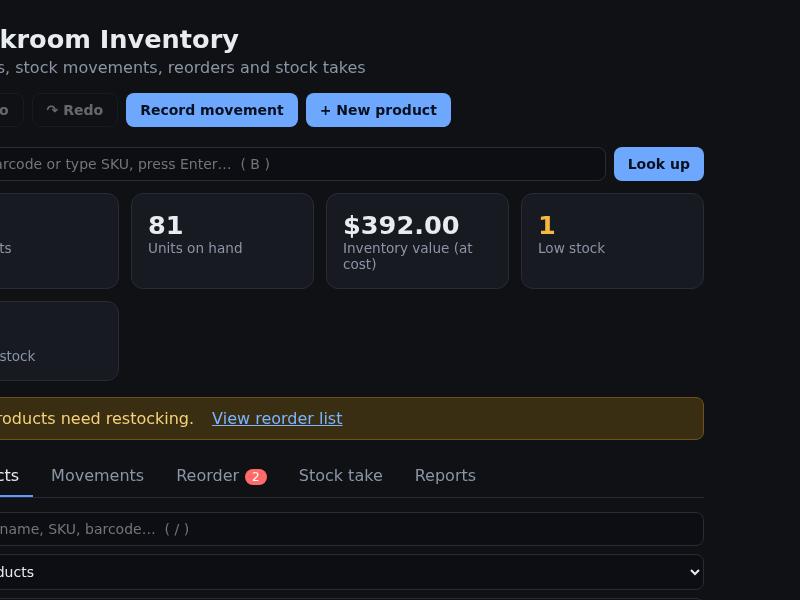
An inventory manager for a small shop: products with SKU, quantity and reorder level, stock in/out movements…An inventory manager for a small shop: products with SKU, quantity and reorder level, stock in/out movements log, and low-stock alerts.
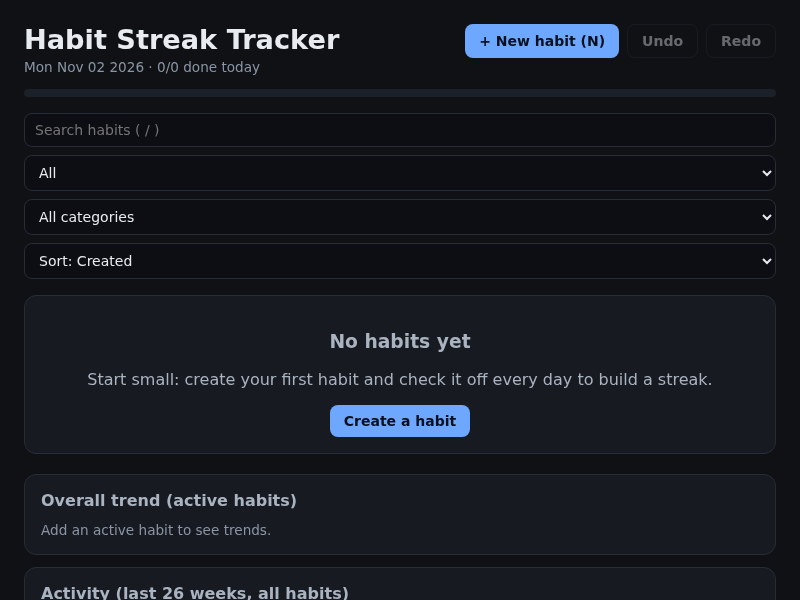
A habit tracker: define daily or weekly habits, check them off each day, and see streaks and a calendar…A habit tracker: define daily or weekly habits, check them off each day, and see streaks and a calendar heatmap of completions.
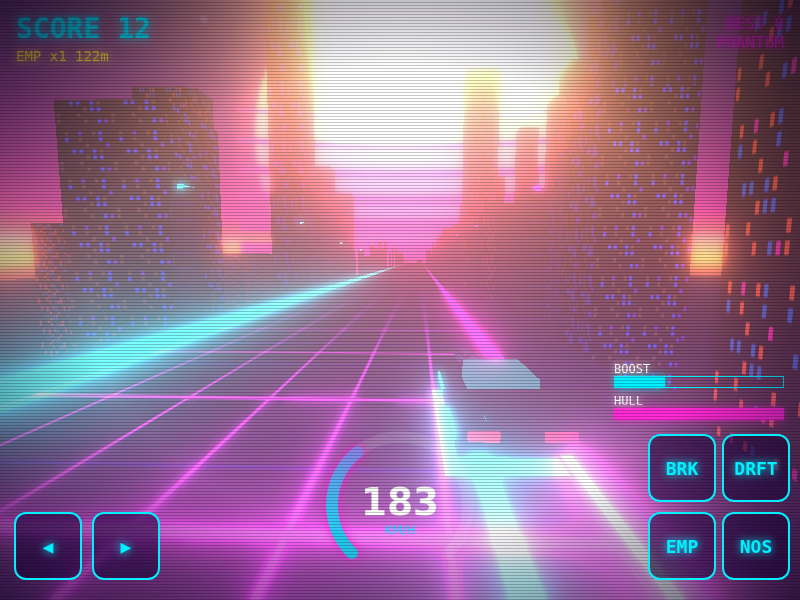
A high-octane 3D retro-futuristic synthwave outrun cyber-racer set in Neo-Metropolis 2099 titled Neon…A high-octane 3D retro-futuristic synthwave outrun cyber-racer set in Neo-Metropolis 2099 titled Neon Overdrive. Pilot a supercharged cyber-interceptor down an infinite digital highway high above the smog canopy. Use procedural Spritely textures: equirectangular synthwave skybox (sky_synthwave), neon grid road floor (scifi_floor), metal grate road shoulders (metal_grate), and sci-fi bulkhead panels (scifi_panel) imported from assets.js. Features: smooth high-speed 3D racing physics with responsive steering, braking, drifting, and nitrous boost; diverse cyber-traffic including patrol drones, autonomous cyber-haulers, stealth interceptors, and Sentinel boss ships; collectible energy shards to charge boost meter, EMP pulses to disable obstacles, and shield generators; multiple player cyber-vehicles to choose from with distinct handling, top speed, and turbo profiles; dynamic synthwave visual effects with bloom, neon trails, grid lines, retro scanlines, and digital speed gauge HUD; full audio chiptune sound effects from assets.js; global leaderboard integration using submitScore for high scores; desktop and touch/mobile responsive controls.
Stellar Vanguard 3D - An intense 3D third-person planetary defense mech shooter built with Three.js set on…Stellar Vanguard 3D - An intense 3D third-person planetary defense mech shooter built with Three.js set on volcanic moon Tartarus Prime. Pilot heavy combat walker Aegis-X defending the central terraforming atmospheric converter against waves of rogue autonomous combat drones and heavy walkers. Features 3D rigged glTF voxel models with skeletal animations (biped_mech for player, security_drone for flying swarms, spider_tank for ground crawlers, and siege_titan for colossal boss) loaded via GLTFLoader and animated with AnimationMixer. Procedural volcanic rock and metal grid textures, rich audio SFX (sfx_laser, sfx_explosion, sfx_shield, sfx_jump, sfx_alarm), third-person chase camera with mouse crosshair aiming, thruster boost jumps, homing missiles, 2-player co-op squad lobby using forge.net.join('tartarus-defense-squad'), persistent profile via forge.kv, and global leaderboard submission via forge.leaderboard.submit('stellar-vanguard-3d', score).
[SYSTEM / PROJECT OVERVIEW] Create a 3D subterranean sci-fi horror-survival, vehicle-drilling, and…[SYSTEM / PROJECT OVERVIEW] Create a 3D subterranean sci-fi horror-survival, vehicle-drilling, and base-defense action game titled Deep Core Vanguard: Tartarus Drill 3D. The player pilots a heavy, industrial tracked excavation mech ('Vanguard MK-III') into the claustrophobic, pitch-black depths of the frozen volcanic moon Tartarus-IV. Combine the heavy, tactile isolation of deep-sea/subterranean horror with resource extraction, structural engineering, and relentless alien ambush survival. [1. ATMOSPHERE, SETTING & NARRATIVE PREMISE] • The World: Tartarus-IV is a dead, ice-choked volcanic moon hiding a pulsing gravitational anomaly—the Singularity Core—500 meters beneath its crust. Previous automated mining expeditions went dark; their rusted rigs, distress beacons, and shattered hulls remain buried in the strata. • Perspective & Immersion: Playable from a tight, over-the-chassis third-person perspective or an enclosed cockpit view featuring scratched armored glass, flickering dashboard warning lights, and audible hull creaks under immense subterranean pressure. • Claustrophobic Dread: Outside the cone of the Vanguard’s dual high-beam floodlights and flaring emergency flares, the underground is absolute darkness. Every tunnel the player carves becomes a potential ambush corridor behind them. [2. CORE MECH CONTROLS & SURVIVAL SYSTEMS] • Heavy Tracked Locomotion: Drive and steer the Vanguard with weighty suspension, track traction on steep inclines, and loud hydraulic gear shifts. Engage Vertical Jump-Thrusters to hover across magma chasms or boost out of deep vertical bore-shafts, at the cost of rapid fuel burn and loud acoustic signatures that attract nearby predators. • 360° Articulated Bore-Drill: Aim the hydraulic drill arm and spotlights independently in 3D space. Engage the spinning diamond bore-head to carve smooth, deformable 3D tunnels in real time through walls, floors, and ceilings. • Diegetic Survival Gauges (No Safe Haven): • Energy / Fuel: Consumed by drilling dense stone, running high-beam spotlights, and firing thrusters. Running out of power plunges the cavern into near-total darkness, leaving only dim emergency red cabin lights. • Hull Integrity: Degraded by structural cave-ins, superheated magma splashes, and relentless alien claws/acid. Cracked hull armor causes cockpit sparks, distorted radar static, and oil leaks. • Acoustic & Seismic Signature: Loud drilling and thruster bursts send vibrations through the rock, waking dormant hive nests in adjacent strata. [3. MULTI-LAYERED 3D GEOLOGICAL STRATA (0m to -500m)] Design a seamless 3D subterranean world divided into five increasingly hostile biomes, each with distinct rock hardness, environmental storytelling, and hazards: 1. Layer 1 (0m – -100m | The Frost Tomb): Frozen permafrost and translucent blue glacial ice. Low traction causes heavy sliding; frozen corpses of prior survey teams and half-buried supply pods are visible encased inside the ice walls. 2. Layer 2 (-100m – -200m | The Shifting Silt): Loose sandstone and unstable shale. Drills rapidly, but carving wide caverns without structural support triggers creaking audio warnings followed by deadly 3D rockfalls. 3. Layer 3 (-200m – -320m | The Basalt Veins): Dense volcanic basalt and jagged granite columns. Throws blinding orange sparks on drill contact, overheats un-upgraded drill heads, and conceals narrow organic hive tunnels. 4. Layer 4 (-320m – -450m | The Necropolis Ruins): Corroded non-human metal plating, weeping bio-mechanical pipes, and ancient megalithic architecture. Ambient whispers and rhythmic mechanical thumping echo through the halls. 5. Layer 5 (-450m – -500m | The Singularity Core): Cracked obsidian crust suspended over churning molten magma veins. Extreme ambient heat distorts vision, slowly scorches unshielded hulls, and illuminates the colossal cavern of the final boss. [4. SUBTERRANEAN HORROR ECOSYSTEM & ENEMY BEHAVIORS] Populate the depths with distinct alien burrower species driven by sensory AI (reacting to light, drill vibrations, and heat): • Skitter-Mites (Swarm Ambushers): Small, pale, blind arachnid burrowers that travel in packs inside tunnel walls. They detect drill vibrations, erupt suddenly from freshly mined rock faces, and latch onto the Vanguard’s tracks and hull to gnaw through armor plates. • Acid Spitters (Ceiling Stalkers): Biologically adapted to cling silently to dark cavern ceilings outside the player's direct spotlight cone. They wait until the player turns away to mine, then launch corrosive bile that melts turret plating and blurs cockpit visibility. • Goliath Bore-Fiends (Armored Juggenauts): Massive, blind, heavily chitinous worms that tunnel directly toward the player's location whenever high-decibel drilling continues for too long. They telegraph their breach with localized wall bulging, falling dust, and a deafening subterranean screech before ramming the mech. • Mimic Geodes (Lure Predators): Found in deeper ruins and basalt layers, these organisms disguise themselves as clusters of high-value Blue Crystal or Plasma Shards. When approached with the magnetic tractor beam or drill, they split open into rows of jagged mandibles to ensnare the drill arm. • Ruins Sentinels (Corrupted Automata): Ancient, spindly biomechanical constructs patrolling Layer 4. Dormant until hit by direct spotlight beams, they react to light with erratic, twitching movements and high-energy cutting lasers. [5. EXTRACTION, CRAFTING & DEFENSIVE ENGINEERING] • Resource Harvesting: Mined ore chunks physically fracture off rock walls and pull magnetically into the rear cargo hopper: Iron Ore, Blue Crystal, Volcanic Gold, and Plasma Shards. • Mobile Fabricator (Holographic 3D Blueprints): Project 3D placement holograms onto cavern floors, walls, and ceilings to fortify tunnels before pushing deeper: • Hydraulic Support Pillars: Extend from floor to ceiling to brace unstable sandstone and prevent lethal cave-ins. • Automated Sentry Turrets: 360° tracking twin-barrel turrets equipped with motion sensors and narrow laser sights that sweep the dark and shred emerging burrowers—until they run out of ammo or get overwhelmed. • Floodlight Flares & Seismic Thumpers: Deployable perimeter lights to eliminate blind spots in large caverns, and decoy thumpers that emit rhythmic vibrations to lure Goliath Bore-Fiends away from your position. • Fuel Refineries & Repair Beacons: Field stations that slowly convert raw minerals into fuel and weld damaged hull plating while emitting vulnerable hums that draw nearby stalkers. • Mech Chassis Upgrades: Bore-Head Tier 2/3 (faster cutting, lower noise), Thermal Magma Plating, Reinforced Cockpit Glass, Expanded Cargo Hopper, and High-Output Thrusters. [6. EPIC BOSS ENCOUNTER: THE MAGMA WYRM] • Awakening (-500m): Breaching the obsidian seal of the Singularity Core awakens the Magma Wyrm—a colossal, multi-segmented serpentine leviathan fused with ancient molten machinery. • Boss Behavior & Attacks: • Dives seamlessly into the cavern walls, ceiling, and magma floor, leaving glowing, superheated tunnel scars that damage the mech if driven over. • Telegraphs massive lunges with violent seismic camera shake, collapsing stalactites, and deep sub-bass roars echoing from the direction of attack. • Fires arcing barrages of molten slag and releases waves of Skitter-Mites from its shedding carapace. • Defeat & Extraction: Use sonar and sound cues to track its movement through the rock, dodge its breaches, and focus your upgraded diamond drill or mining charges onto the glowing thermal vents along its armored segments to shatter its plating and claim the Singularity Core. [7. SENSORY HUD, AUDIO & PROGRESSION] • Minimalist Diegetic HUD: Depth Altimeter (0m to -500m), Fuel/Power Gauge, Hull Armor Integrity, Cargo Capacity, and a 3D Spherical Sonar Radar that pulses outward—revealing nearby ore veins, placed turrets, and shadowy movement blips in the surrounding rock, at the cost of slightly increasing your acoustic signature. • Oppressive Sound Design & Reactive Score: • Ambient Horror: Deep, echoing cavern drones, metallic hull groans under earth pressure, dripping water, and distant skittering behind solid rock walls. • Combat Escalation: Seamless transition into a suffocating, industrial pulse of distorted bass and screeching metal when hostiles breach or the Magma Wyrm surfaces. • Directional 3D Audio: Spatialized drill grinding (pitched by rock density), echoing rockslides, turret fire cutting through silence, and muffled alien shrieks behind walls so players can hear threats before seeing them. • Persistence & Global Leaderboard: Automatically saves unlocked mech chassis upgrades, blueprint tiers, and deepest depth reached across expeditions, while submitting final extraction and survival scores to a global deep-core pilot leaderboard.
A Pomodoro focus timer with a task list: pick a task, run 25/5 work-break cycles, track completed sessions…A Pomodoro focus timer with a task list: pick a task, run 25/5 work-break cycles, track completed sessions per task and a daily focus summary.
Isometric 3D dungeon crawler built with Three.js and @forge/sdk. Features: 1. Isometric Camera & Dungeon…Isometric 3D dungeon crawler built with Three.js and @forge/sdk. Features: 1. Isometric Camera & Dungeon Atmosphere: High-angle isometric perspective (camera at elevation 18, distance 18, tilted 45 degrees, smooth lerping tracking the player). Atmospheric dungeon scene: gloomy stone tile floors, carved stone block walls, flickering warm torch pointlights with ember particles floating upward. 2. Procedural Dungeon Generation: Connected rooms and stone corridors, doorway arches, obstacle pillars, treasure chests, floor traps, and exit stairs leading down to deeper dungeon floors (Floor 1, 2, 3...). Deeper floors increase monster count, monster difficulty, and loot drop rarity. 3. 4 Unique Player Classes with Distinct Visuals & FX: - Warrior: High HP, Plate armor, Greatsword. Special FX: Whirlwind (circular slashing particle ring), Shield Slam (shockwave cone), Battle Shout (flaming aura boosting attack speed). - Mage: High Mana, Arcane Robes, Elemental Staff. Special FX: Fireball (fiery projectile that detonates into sparks and smoke), Frost Nova (expanding crystal ice ring), Arcane Blink (instant teleport leaving purple magical trail). - Rogue: High Crit, Leather Gear, Dual Daggers. Special FX: Shadowstep (teleports behind target with dark smoke burst), Blade Flurry (rapid multi-slash particles), Smoke Bomb (blinds enemies in smoke cloud). - Paladin: Balanced Guardian, Relic Plate, Warhammer & Shield. Special FX: Holy Radiance (golden rays of healing light), Smite (vertical holy beam crushing target), Aegis Barrier (glowing golden spherical shield). 4. Items, Equipment & Loot: Enemies and chests drop glowing color-coded loot: Common (White), Rare (Blue), Epic (Purple), Legendary (Gold). Weapons (Broadswords, Shadow Daggers, Archmage Staves, Holy Hammers), Armor (Robes, Leather, Chainmail, Obsidian Plate), and Potions. Interactive Inventory Modal & Equipment Paperdoll (toggle with I key or UI button) displaying equipped gear and stats. 5. Diverse Monster Sizes & AI: Small Monsters (scale 0.5x: Cave Spiders, Dungeon Rats), Medium Monsters (scale 1.0x: Skeleton Swordsmen, Undead Archers), and Large Boss Monsters (scale 2.5x: Minotaur Executioner, Stone Golem with boss HP bar, ground slam shockwaves, enraged phase). Floating combat text on hits and crits. 6. Continuous Progression & Persistence via @forge/sdk: XP gained from slaying monsters; level up to gain stat points. Full persistence using import { forge } from "@forge/sdk"; forge.kv.get("dungeon_crawler_save") and forge.kv.set("dungeon_crawler_save", saveObj) saving class, level, stats, equipped gear, gold, and highest floor reached across sessions. 7. Multiplayer Co-Op Environment & Leaderboards via @forge/sdk: Room lobby modal to Host/Join co-op multiplayer dungeon rooms using forge.net. Co-op sync: broadcasts player movement, class model, health, ability casts, and monster attacks to party members. Global Leaderboard: submit highest dungeon floor, boss kills, and score using forge.leaderboard.submit(). 8. Full HUD & Sound: Health and Mana globes/bars, Level & XP bar, Action bar with cooldowns [1, 2, 3], Floor depth indicator, Gold counter, Boss HP bar. Web Audio API procedural sound synthesizer for slashes, magic, level up fanfare, and loot chimes.
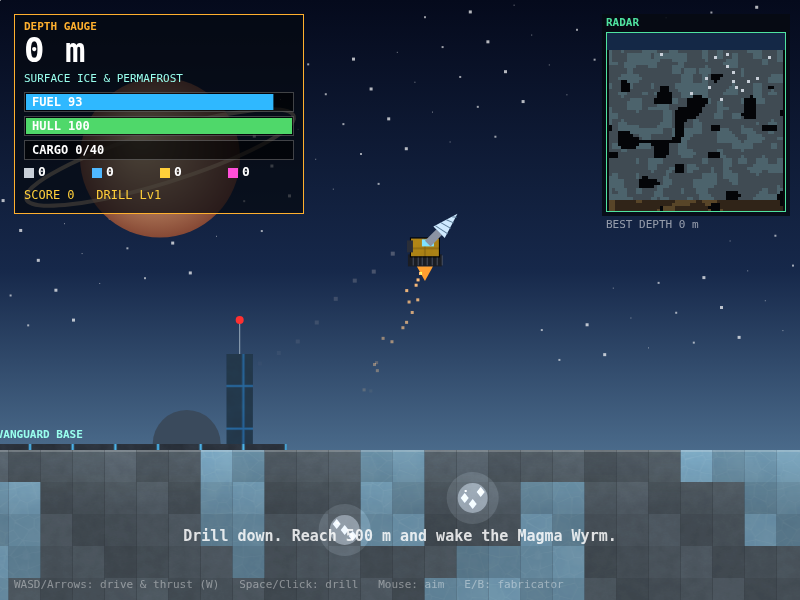
2D Sci-Fi Mining, Crafting & Subterranean Survival Action game: Deep Core Vanguard: Tartarus Drill. Setting…2D Sci-Fi Mining, Crafting & Subterranean Survival Action game: Deep Core Vanguard: Tartarus Drill. Setting & Story: On the frozen volcanic mining moon Tartarus-IV, pilot the heavy tracked excavation drill-mech 'Vanguard MK-III'. Drill through deep multi-layered geological strata—from surface ice and permafrost down through sandstone, volcanic basalt, ancient machine ruins, and molten magma veins—to extract rare minerals, build defensive support pylons, survive subterranean alien burrowers, and defeat the colossal Magma Wyrm guarding the planet's Singularity Core! Key Gameplay & Mechanics: 1. Direct Mech Control & Directional Mining: - Movement: WASD or Arrow keys to steer and drive the heavy Vanguard drill-mech with realistic track physics and ground friction. - Directional Mining Drill (Space or Left Click): Aim crosshair with mouse; activate the diamond drill head to carve out destructible geological tiles in real-time. - Fuel & Hull System: Drilling and booster thrusters consume Energy/Fuel; taking damage from falling rocks, lava pockets, or enemy aliens degrades Hull Integrity. 2. Rich Strata & Procedural Multi-Material Terrain: - Excavate distinct geological layers with different hardness and textures imported from ./materials.js: * Layer 1 (Surface): Frozen Permafrost & Glacial Ice. * Layer 2 (Shallow): Sandstone & Loose Dirt (fast drilling, chance of cave-ins). * Layer 3 (Mid-Depth): Basalt Stone & Dense Granite (requires upgraded drill). * Layer 4 (Deep Ruins): Corroded Metal Plating & Ancient Bricks. * Layer 5 (The Core): Molten Magma Veins & Heat Hazards. 3. Crafting, Base Upgrades & Base Defense: - Collect mined resources: Iron Ore, Blue Crystal, Volcanic Gold, and Plasma Shards. - Press E or B to open the Mobile Fabricator to construct: * Support Pillars (prevent cavern ceiling collapses). * Automated Sentry Turrets (fires at encroaching alien burrowers). * Fuel Refineries & Repair Beacons (restores energy and repairs hull armor). * Mech Upgrades (Drill Speed lvl 2/3, Thermal Magma Plating, Cargo Capacity). 4. Epic Boss: The Magma Wyrm: - At Depth 500m in the Core, summon or awaken the ancient Magma Wyrm: a multi-segmented serpentine terror that burrows through stone leaving molten trails, telegraphs strikes with seismic screen-shake, and fires lava bursts! - Target its glowing thermal weak points to defeat it and extract the Singularity Core. 5. Visuals & Atmosphere: - High-contrast sci-fi industrial palette with glowing ore veins and dynamic mech headlights illuminating the dark subterranean tunnels. - Particle effects: flying stone debris, drill sparks, falling dust cave-in warnings, smoking exhaust, and bubbling lava splash. - Clean HUD: Depth Gauge, Fuel/Energy Bar, Hull Armor Bar, Cargo Capacity, and Radar Mini-map. 6. Web Audio API Music & Industrial SFX: - Procedural subterranean synth soundtrack: quiet, resonant ambient drone while mining, intensifying into a tense mechanical industrial rhythm when hostiles or the Magma Wyrm attack! - SFX: grinding drill motor, rock crumble, metal clank, turret fire, gem chime, fuel hiss, and wyrm roar. Unlock Web Audio on first user input. 7. Sovereign Forge SDK Integration: - import { forge } from "@forge/sdk"; - Persistent save of unlocked chassis upgrades and highest depth with forge.kv (key: "deep_core_save"). - Global Leaderboard: forge.leaderboard.submit("deep_core_vanguard", finalScore) and viewing top miners via forge.leaderboard.get("deep_core_vanguard").